Effectiveness of Existential–Humanistic Group Therapy on Self-Compassion, Mindfulness, and Flourishing among Female University Students Residing in Dormitories
Keywords:
Existential–humanistic therapy, self-compassion, mindfulness, flourishing, female students, dormitory students, group therapyAbstract
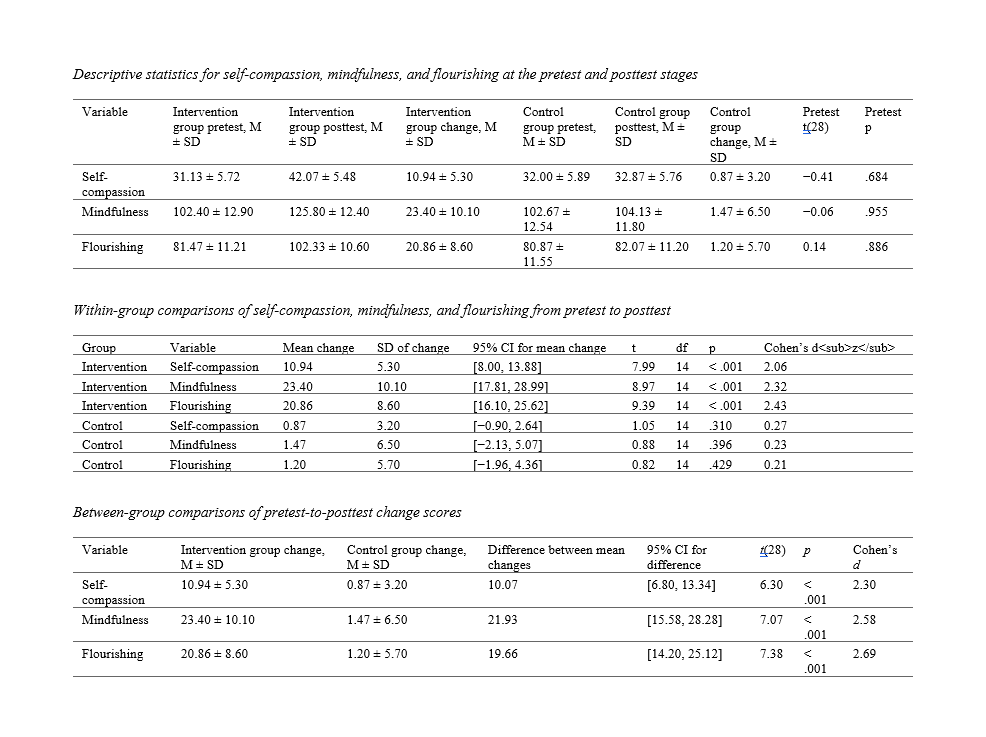
This study aimed to determine the effectiveness of existential–humanistic group therapy in improving self-compassion, mindfulness, and flourishing among female university students residing in dormitories. This quasi-experimental study used a pretest–posttest design with an intervention group and a control group. The statistical population consisted of female dormitory students enrolled at public and non-public universities in Mashhad, Iran, during the second semester of the 2023–2024 academic year. Thirty eligible students were recruited through quota and convenience sampling and assigned to the intervention and control groups using permuted blocks, with 15 participants in each group. Data were collected using the Self-Compassion Scale–Short Form, the Kentucky Inventory of Mindfulness Skills, and the PERMA-Profiler. The intervention group participated in nine weekly 90-minute existential–humanistic group therapy sessions, whereas the control group attended a book-introduction group unrelated to the study variables. Data were analyzed in SPSS version 21 using paired-samples and independent-samples t tests at a significance level of .05. Paired-samples t tests showed significant increases in self-compassion, t(14) = 7.99, p < .001, mindfulness, t(14) = 8.97, p < .001, and flourishing, t(14) = 9.39, p < .001, in the intervention group, whereas no significant changes were observed in the control group. Comparisons of change scores indicated that the intervention group improved significantly more than the control group in self-compassion, t(28) = 6.30, p < .001, Cohen’s d = 2.30; mindfulness, t(28) = 7.07, p < .001, Cohen’s d = 2.58; and flourishing, t(28) = 7.38, p < .001, Cohen’s d = 2.69. Existential–humanistic group therapy appears to be an effective intervention for enhancing self-compassion, mindfulness, and flourishing among female dormitory students and may be incorporated into university counseling and student-support programs.
Downloads
References
Ajm, A. A., Farzan, F. J., & Shokouhi, F. H. (2016). The Role of Self-Compassion in General Health and Academic Progress of Nursing and Midwifery Students at Mashhad University of Medical Sciences in 2014. Nursing Education, 5(5 Suppl 19), 9-16. https://doi.org/10.21859/jne-05052
Alizadeh, K. (2017). The Relationship between Self-Compassion and Quality of Life in Female Students. Third Conference of the Freshness of Positive Psychology,
Azimi, S. (2018). The Effectiveness of Mindfulness in Reducing Stress and Depression in Students. Advances in Behavioral Sciences, 3(22), 17-21.
Bhatia, R. (2024). Relationships between Self-Compassion and Its Components with Flourishing and Satisfaction with Life in College Students Ohio University].
Black, S. W., & Kim, E. E. (2026). Existential-Spiritual Psychotherapy.
Bull, F. C., Al-Ansari, S. S., Biddle, S., Borodulin, K., Buman, M. P., Cardon, G., & Willumsen, J. F. (2020). World Health Organization 2020 Guidelines on Physical Activity and Sedentary Behaviour. British Journal of Sports Medicine, 54(24), 1451-1462. https://doi.org/10.1136/bjsports-2020-102955
Butler, J., & Kern, M. L. (2016). The PERMA-Profiler: A Brief Multidimensional Measure of Flourishing. International Journal of Wellbeing, 6(3), 1-48. https://doi.org/10.5502/ijw.v6i3.526
Carr, A., Cullen, K., Keeney, C., Canning, C., Mooney, O., Chinseallaigh, E., & O'Dowd, A. (2021). Effectiveness of Positive Psychology Interventions: A Systematic Review and Meta-Analysis. The Journal of Positive Psychology, 16(6), 749-769. https://doi.org/10.1080/17439760.2020.1818807
Dolatabadi, A., Jafari, F., & Zabihi, R. (2019). The Effectiveness of Group Self-Compassion Focused Therapy on Flourishing in Menopausal Women. Psychological studies, 15(2).
Ewert, C., Vater, A., & Schröder-Abé, M. (2021). Self-Compassion and Coping: A Meta-Analysis. Mindfulness, 12, 1063-1077. https://doi.org/10.1007/s12671-020-01563-8
Feizi, M., Kamali, Z., Gholami, M., Abadi, B. A. G. H., & Moeini, S. (2019). The Effectiveness of Existential Psychotherapy on Attitude to Life and Self-Flourishing of Educated Women Homemakers. Journal of education and health promotion, 8, 237. https://doi.org/10.4103/jehp.jehp_473_18
Fernandez-Romero, M. (2023). Mindfulness for the Reduction of Stress, Anxiety and Depression in University Students in Yhú, Paraguay. Revista Científica de Ciencias de la Salud, 5, e5115. https://doi.org/10.53732/rccsalud/2023.e5115
Frostadottir, A. D., & Dorjee, D. (2019). Effects of Mindfulness-Based Cognitive Therapy (MBCT) and Compassion-Focused Therapy (CFT) on Symptom Change, Mindfulness, Self-Compassion, and Rumination in Clients with Depression, Anxiety, and Stress. Frontiers in psychology, 10, 1099. https://doi.org/10.3389/fpsyg.2019.01099
Furchtlehner, L. M., Fischer, E., Schuster, R., & Laireiter, A. R. (2024). A Comparative Study on the Efficacy of Group Positive Psychotherapy and Group Cognitive Behavioral Therapy on Flourishing, Happiness, and Satisfaction with Life: A Randomized Controlled Trial. Journal of Happiness Studies, 25, 104. https://doi.org/10.1007/s10902-024-00806-y
Gholipour, T., & Karshki, H. (2021). Psychometric Characteristics of the PERMA Flourishing Questionnaire. Journal of Educational Measurement, 12(45), 115-134.
Guo, T., Su, J., Hu, J., Aalberg, M., Zhu, Y., Teng, T., & Zhou, X. (2021). Individual vs. Group Cognitive Behavior Therapy for Anxiety Disorder in Children and Adolescents: A Meta-Analysis of Randomized Controlled Trials. Frontiers in Psychiatry, 12, 674267. https://doi.org/10.3389/fpsyt.2021.674267
Han, A., & Kim, T. H. (2023). Effects of Self-Compassion Interventions on Reducing Depressive Symptoms, Anxiety, and Stress: A Meta-Analysis. Mindfulness, 14, 1553-1581. https://doi.org/10.1007/s12671-023-02148-x
Hogan, M. J. (2020). Collaborative Positive Psychology: Solidarity, Meaning, Resilience, Wellbeing, and Virtue in a Time of Crisis. International review of psychiatry, 32(7-8), 698-712. https://doi.org/10.1080/09540261.2020.1778647
Hosseini, N., Masoumi, R., & Talebi, Z. (2021). Prevalence of Anxiety Disorders in Female Students Living in University Dormitories. Iranian Behavioral Sciences and Clinical Psychology Journal, 15(2), 45-53.
Kılıç, M., Arslan, C., & Hamarta, E. (2026). Examination of Secondary Traumatic Stress in Psychological Counsellors Working with Earthquake Victims within the Scope of Psychosocial Support: Mixed-Methods Study. Turkish Psychological Counseling and Guidance Journal, 16(81), 418-437. https://doi.org/10.17066/tpdrd.1809573
Kögler, M., Brandstätter, M., Borasio, G. D., Fensterer, V., Küchenhoff, H., & Fegg, M. J. (2015). Mindfulness in Informal Caregivers of Palliative Patients. Palliative & Supportive Care, 13(1), 11-18. https://doi.org/10.1017/S1478951513000400
Manzoor, M., Naz, N., & Hussain, R. (2026). Analyzing Well-Being Models: Their Evolution, Limitations, and Future Pathways. Nuqtah Journal of Theological Studies, 6(1), 54-72.
Martela, F. (2024). Flourishing as the Central Aim of Education: Steps toward a Consensus. Theory and Research in Education, 22(2), 180-188. https://doi.org/10.1177/14778785241258857
Mason, A., Rapsey, C., Sampson, N., Lee, S., Albor, Y., Al-Hadi, A. N., & van der Heijde, C. (2025). Prevalence, Age-of-Onset, and Course of Mental Disorders among 72,288 First-Year University Students from 18 Countries in the World Mental Health International College Student (WMH-ICS) Initiative. Journal of psychiatric research, 183, 225-236. https://doi.org/10.1016/j.jpsychires.2025.02.016
Mousavi, M., & Jafari, L. (2019). Prevalence and Factors Related to Depression among Female Dormitory Students: A Cross-Sectional Study. Iranian Health Psychology Journal, 10(3), 72-80.
Nasiri Hanis, G., Sadeghi, M., & Gholamrezaei, S. (2021). Comparison of the Effect of Existential, Cognitive-Existential, and Humanistic-Existential Group Psychotherapy on Sexual Satisfaction in Women with Type II Diabetes. Quarterly Journal of Counseling Research, 20(78), 53-79. https://doi.org/10.18502/qjcr.v20i78.6782
Nourian, L., Golparvar, M., & Aghaei, A. (2021). Effectiveness Distinctions of Positive Psychotherapy and Acceptance and Commitment Therapy on Flourishing and Psychological Flexibility of Depressed Women. Journal of Applied Research in Applied Clinical Psychology, 3(4), 15-29. https://doi.org/10.61838/kman.jarac.3.4.2
Pereira Gonçalves, M., Nascimento Júnior, J. R., Tavares, J. E. T., Dias, R. F., Correia Júnior, J. L., & Gouveia, V. V. (2023). Resilience, Life Satisfaction and Flourishing: Mediation of Positive and Negative Affects in the COVID-19 Pandemic. Avances en Psicología Latinoamericana, 41(3). https://doi.org/10.12804/revistas.urosario.edu.co/apl/a.11868
Rezaei, M., Ahmadi, F., & Karimi, S. (2020). The Effect of Group Therapy on Improving Communication Skills in Students: A Study in Iranian Universities. Iranian Psychological Research Journal, 12(4), 56-65.
Rezapour-Mirsaleh, Y., Amini, R., & Rezai, Z. (2023). Effectiveness of Existential Therapy Based on Ontological Core Schemas on Rumination and Mindfulness of Depressed Women: A Randomized Clinical Trial Design. Journal of Contemporary Psychotherapy, 53(2), 181-190. https://doi.org/10.1007/s10879-022-09552-9
Sadeghi Arfaei, R., Fariborz, F., Namaki Beydeli, B., & Zeinab, Z. (2016). The Relationship between Mindfulness and Resilience in Students. Journal of Mental Health Principles, 18(Special Issue), 627-632.
Sakai, A., Terao, T., Kawano, N., Akase, M., Hatano, K., & Shirahama, M. (2019). Existential and Mindfulness-Based Intervention to Increase Self-Compassion in Apparently Healthy Subjects (the EXMIND Study): A Randomized Controlled Trial. Frontiers in Psychiatry, 10, 538. https://doi.org/10.3389/fpsyt.2019.00538
Schneider, K. J., & Krug, O. T. (2018). Existential Humanistic Therapy (2nd ed.). American Psychological Association. https://doi.org/10.1037/0000042-000
Smith, J., Williams, K., Brown, T., & Jones, L. (2022). The Role of Gender in Response to a Yoga and Lifestyle Intervention for Postural Health and Sedentary Behavior. Journal of Women's Health, 31(7), 985-998.
Uliaszek, A. A., Rashid, T., Williams, G. E., & Gulamani, T. (2016). Group Therapy for University Students: A Randomized Control Trial of Dialectical Behavior Therapy and Positive Psychotherapy. Behaviour Research and Therapy, 77, 78-85. https://doi.org/10.1016/j.brat.2015.12.003
Wilhite, K., Booker, B., Huang, B. H., Antczak, D., Corbett, L., Parker, P., Noetel, M., Rissel, C., Lonsdale, C., Del Pozo Cruz, B., & Sanders, T. (2023). Combinations of Physical Activity, Sedentary Behavior, and Sleep Duration and Their Associations with Physical, Psychological, and Educational Outcomes in Children and Adolescents: A Systematic Review. American Journal of Epidemiology, 192(4), 665-679. https://doi.org/10.1093/aje/kwac212
Zhang, D., Lee, E. K. P., Mak, E. C. W., Ho, C. Y., & Wong, S. Y. S. (2021). Mindfulness-Based Interventions: An Overall Review. British Medical Bulletin, 138(1), 41-57. https://doi.org/10.1093/bmb/ldab005
Downloads
Additional Files
Publication Timeline
- Submitted
- Revised
- Accepted