Explaining a Model of Obsessive–Compulsive Symptom Severity Based on Perfectionism and Intolerance of Uncertainty, with Emphasis on the Mediating Role of Rumination Among Women Attending Psychological Clinics
Keywords:
obsessive–compulsive symptoms, perfectionism, intolerance of uncertainty, rumination, womenAbstract
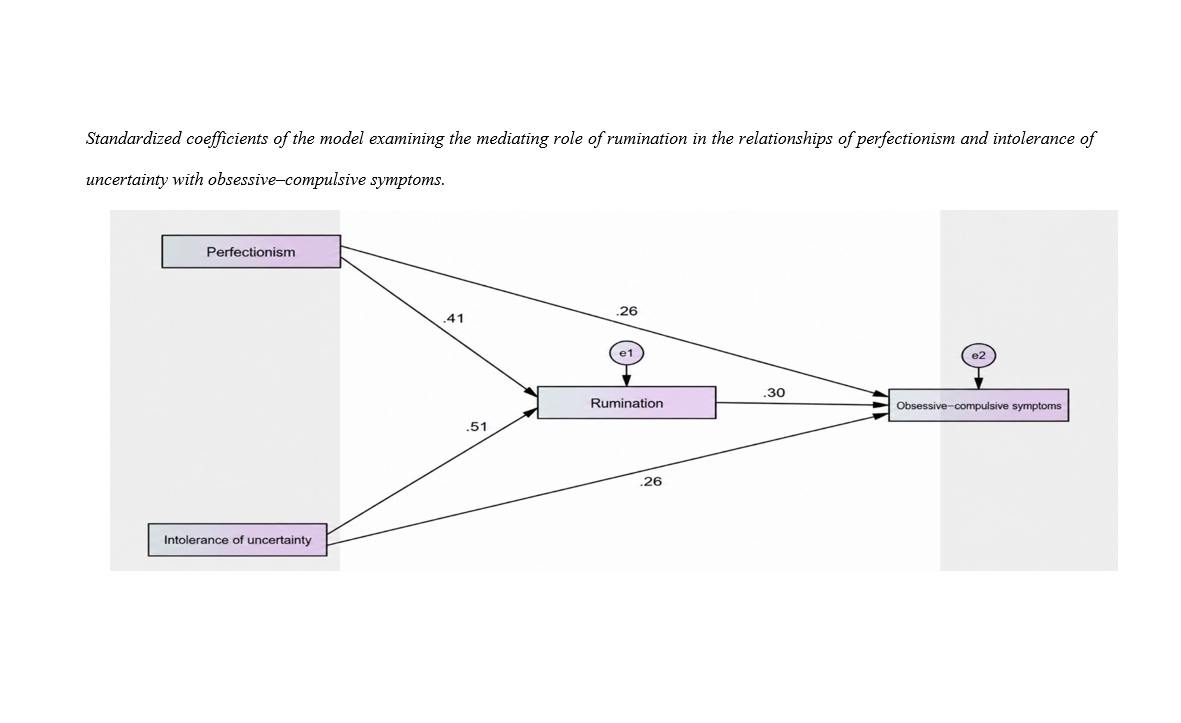
The present study aimed to explain a model of obsessive–compulsive symptom severity based on perfectionism and intolerance of uncertainty, with emphasis on the mediating role of rumination among women attending psychological clinics. In terms of its nature, this study was descriptive–applied, and methodologically, it employed a correlational design based on path analysis. The statistical population consisted of all women attending psychological clinics in Bandar Abbas in 2025 who had been diagnosed with obsessive–compulsive disorder (OCD) by a psychiatrist or clinical psychologist. The study sample was selected through convenience sampling. Accordingly, five active psychological clinics located in different areas of Bandar Abbas were selected, and 50 eligible women were recruited from each clinic, resulting in a total sample of 250 participants. The instruments included the Obsessive–Compulsive Inventory developed by Foa et al. (2002), the Multidimensional Perfectionism Scale developed by Hewitt and Flett (1991), the Intolerance of Uncertainty Scale developed by Freeston et al. (1994), and the Ruminative Responses Scale developed by Nolen-Hoeksema and Morrow (1991). The data were analyzed using descriptive and inferential statistics in SPSS version 27 and path analysis in AMOS. The findings indicated that rumination played a significant mediating role in the relationship between perfectionism and obsessive–compulsive symptom severity, as well as in the relationship between intolerance of uncertainty and obsessive–compulsive symptom severity (p < .01). These findings suggest that perfectionism and intolerance of uncertainty may exacerbate obsessive–compulsive symptoms among women attending psychological clinics through increased rumination, highlighting the need for further investigation of these mechanisms.
Downloads
References
Ahmadi Golsafidi, E., Asadi, J., Khajvand Khoshli, A., & Abdollahzadeh, H. (2021). Modeling Body Image Concern Based on Obsessive-Compulsive Symptoms, Perfectionism, and Eating Attitudes with the Mediating Role of Basic Psychological Needs in Girls. Rooyesh-e-Ravanshenasi, 10(8), 81-92.
Callaghan, T., Greene, D., Shafran, R., Lunn, J., & Egan, S. J. (2024). The Relationships Between Perfectionism and Symptoms of Depression, Anxiety and Obsessive-Compulsive Disorder in Adults: A Systematic Review and Meta-Analysis. Cognitive behaviour therapy, 53(2), 121-132. https://doi.org/10.1080/16506073.2023.2277121
Çelik, B. A., & Koç, V. (2025). The Multiple Mediating Effects of Perfectionism, Social Anxiety, and Rumination on the Relationship Between Narcissism and Obsession. Journal of Clinical Psychology Research, 9(1), 62-72. https://doi.org/10.57127/kpd.26024438.1460870
Dehaghain, V., Besharat, M. A., Gholamali Lavasani, M., & Naghsh, Z. (2023). The Mediating Role of Ego Strength in the Relationship Between Dimensions of Perfectionism and Relationship Obsessive-Compulsive Symptoms. Journal of Psychological Science, 22(123), 423-438. https://doi.org/10.52547/JPS.22.123.423
Dehghani Dolatabadi, S., Pardelan, N., & Vakili, S. (2026). Explaining a Model of Depressive Symptoms Based on Perfectionism with the Mediating Role of Intolerance of Ambiguity in Female University Students. Journal of Psychological Science, 25(160), 1-19. https://doi.org/10.66224/jps.25.160.9
Foa, E. B., Huppert, J. D., Leiberg, S., Langner, R., Kichic, R., Hajcak, G., & Salkovskis, P. M. (2002). The Obsessive-Compulsive Inventory: Development and Validation of a Short Version. Psychological assessment, 14(4), 485-496. https://doi.org/10.1037/1040-3590.14.4.485
Gagné, J. P., & Wong, S. F. (2025). Rumination in Response to Repugnant Obsessions: Catching the Sneakiest of Compulsions. Psychotherapy, 62(4), 518-528. https://doi.org/10.1037/pst0000585
Greville-Harris, M., Vuillier, L., Goodall, S., Talbot, C. V., Walker, C., & Appleton, K. M. (2024). Striving for the Perfect Diet? The Mediating Role of Perfectionism in the Relationship Between Obsessive Compulsive Symptoms and Traits of Orthorexia Nervosa. Journal of eating disorders, 12, 91. https://doi.org/10.1186/s40337-024-01032-w
Haddadi, S., & Tamannaeifar, M. R. (2023). A Structural Model of Social Anxiety Based on Maladaptive Perfectionism and Maladaptive Cognitive Emotion Regulation Strategies with the Mediating Role of Rumination. Quarterly Journal of Modern Psychological Research, 18(7), 97-109. https://doi.org/10.22034/jmpr.2023.55341.5434
Hefazi Torghabeh, L., Najafi, M., & Soltani, M. (2025). The Mediating Role of Obsessive-Compulsive Symptoms in the Relationship Between Maladaptive Perfectionism and Interpersonal Problems in Adolescents: A Descriptive Study. Journal of Rafsanjan University of Medical Sciences, 24(10), 907-920. https://doi.org/10.66224/jrums.24.10.907
Khorasanian, M., & Manzouri Shirejini, S. (2025). The Relationship of Moral Sensitivity and Intolerance of Uncertainty with Obsessive-Compulsive Symptoms in Eleventh-Grade Female Students in Gonbad-e Kavus. Quarterly Journal of Strategic Research in Education and Training, 5(42) 1-15. https://civilica.com/doc/2253403/
Lunn, J., Greene, D., Callaghan, T., & Egan, S. J. (2023). Associations Between Perfectionism and Symptoms of Anxiety, Obsessive-Compulsive Disorder and Depression in Young People: A Meta-Analysis. Cognitive behaviour therapy, 52(5), 460-487. https://doi.org/10.1080/16506073.2023.2211736
Memarzadeh, L., Abdollahi, A., & Hosseinian, S. (2025). Examining the Structural Relationships Between Perfectionism and Rumination in Women: The Moderating Role of Psychological Flexibility. Psychological studies, 21(3), 7-23. https://doi.org/10.22051/psy.2025.49123.3064
Nekić, M., & Mamić, S. (2019). Intolerance of Uncertainty and Mindfulness as Determinants of Anxiety and Depression in Female Students. Behavioral Sciences, 9(12), 135. https://doi.org/10.3390/bs9120135
Nekounam, M. S. (2014). A Comparative Study of Intolerance of Uncertainty and Perfectionism Among Individuals with OCD and Normal Individuals University of Tabriz]. https://elmnet.ir/doc/10280838-17606
Nemati Vanashi, R., & Saliminia, A. (2018). Comparison of Dimensions of Perfectionism and Health Locus of Control in Patients with Obsessive-Compulsive Disorder and Depressed Patients. Quarterly Journal of Applied Psychology, 12(4), 513-529. https://scj.sbu.ac.ir/article_97167.html
Öztürk Serter, G., & Balcı Çelik, S. (2025). Examining the Levels of Distress Tolerance and Intolerance of Uncertainty for Women Receiving Infertility Treatment. Cyprus Turkish Journal of Psychiatry and Psychology, 7(2), 132-140. https://doi.org/10.35365/ctjpp.25.2.03
Rakhshan Haghighifard, M., & Azad Yekta, M. (2026). The Relationship Between Negative Perfectionism and Bulimia Nervosa in Employed Women: The Mediating Role of Rumination. Scientific Journal of Health Psychology and Behavioral Disorders, 4(1) 1-15. https://doi.org/10.61838/jhpbd.151
Sadeghi Ahouei, J., Haji Mousaei, M., & Zarbakhsh Bahri, M. R. (2023). The Relationship of Metacognitive Beliefs and Perfectionism with Obsessions in Adolescents with Obsessive-Compulsive Disorder. A New Approach to Children's Education, 5(2), 200-209. https://doi.org/10.22034/naes.2024.467382.1479
Sametoğlu, S., Denissen, J. J. A., De Clercq, B., & De Caluwé, E. (2022). Towards a Better Understanding of Adolescent Obsessive-Compulsive Personality Traits and Obsessive-Compulsive Symptoms from Growth Trajectories of Perfectionism. Development and Psychopathology, 34(4), 1468-1476. https://doi.org/10.1017/S0954579421000195
Toroslu, B., & Çırakoğlu, O. C. (2023). Do Perfectionism and Intolerance of Uncertainty Mediate the Relationship Between Early Maladaptive Schemas and Relationship and Partner Related Obsessive-Compulsive Symptoms? Current Psychology, 42, 19037-19053. https://doi.org/10.1007/s12144-022-03050-w
Vakili Haris, S., Livarjani, S., & Moheb, N. (2019). Presenting a Pathological Model of Obsessive-Compulsive Disorder Based on Maladaptive Perfectionism and Threat Sensitivity in a Nonclinical Population: The Mediating Role of Intolerance of Uncertainty. Quarterly Journal of Applied Psychological Research, 10(4), 161-182. https://doi.org/10.22059/japr.2019.284499.643309
Vakili Haris, S., Livarjani, S., & Moheb, N. (2020). A Structural Model of Obsessive-Compulsive Disorder Based on Maladaptive Perfectionism and Parental Psychological Control. Journal of Psychology, 24(2), 231-247. https://sid.ir/paper/54475/fa
Wigunawati, E., Deliviana, E., Lase, F. J., & Jovani, A. (2023). Intolerance Towards Uncertainty and Self-Adjustment of Women Working in Essential and Critical Sectors. International Journal of Social Science and Human Research, 6(10), 6184-6191. https://ijsshr.in/index.php
Downloads
Additional Files
Publication Timeline
- Submitted
- Revised
- Accepted