Development and Evaluation of the Effectiveness of an Integrated Ego Educational Model Based on Object Relations Theory and Davanloo’s Psychodynamic Approach
Keywords:
Integrated Ego, Object Relations, Davanloo, Psychodynamic Approach, Ego Strength, Emotion Regulation, University StudentsAbstract
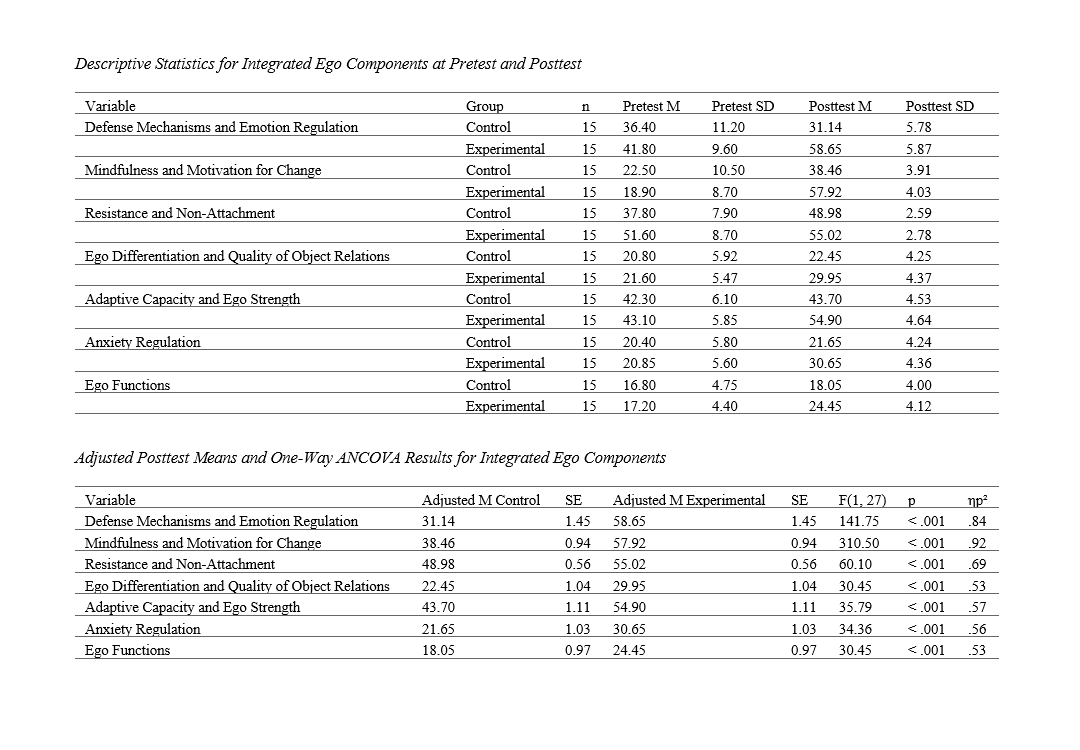
The present study aimed to develop and evaluate the effectiveness of an integrated ego educational model based on object relations theory and Davanloo’s psychodynamic approach among university students in Tehran. This study was conducted in two phases. In the first phase, the integrated ego educational model was developed through a survey-based developmental approach using theoretical literature, previous research, expert opinions, and the final factors derived from a researcher-made Integrated Ego Questionnaire. The final model consisted of seven dimensions: defense mechanisms and emotion regulation, mindfulness and motivation for change, resistance and non-attachment, ego differentiation and quality of object relations, adaptive capacity and ego strength, anxiety regulation, and ego functions. In the second phase, the effectiveness of the model was examined using a quasi-experimental pretest–posttest design with a control group. The sample included 30 university students in Tehran who were divided into an experimental group and a control group, with 15 participants in each group. The experimental group received the seven-session educational intervention, whereas the control group received no intervention. Data were analyzed using one-way analysis of covariance at a significance level of .05 while controlling for pretest scores. After controlling for pretest scores, the effect of group was statistically significant for defense mechanisms and emotion regulation, F(1, 27) = 141.75, p < .001, ηp² = .84; mindfulness and motivation for change, F(1, 27) = 310.50, p < .001, ηp² = .92; resistance and non-attachment, F(1, 27) = 60.10, p < .001, ηp² = .69; ego differentiation and quality of object relations, F(1, 27) = 30.45, p < .001, ηp² = .53; adaptive capacity and ego strength, F(1, 27) = 35.79, p < .001, ηp² = .57; anxiety regulation, F(1, 27) = 34.36, p < .001, ηp² = .56; and ego functions, F(1, 27) = 30.45, p < .001, ηp² = .53. The integrated ego educational model based on object relations theory and Davanloo’s psychodynamic approach was effective in significantly improving all seven dimensions of integrated ego functioning and may be considered a useful brief psychoeducational intervention for strengthening ego-related capacities in university students.
Downloads
References
Bahmaninia, M., & Sohrabi Shegefti, N. (2024). Comparing Ego Strength, Defense Mechanisms, and Object Relations in Individuals with Depression and Healthy Individuals. Clinical Psychology and Personality, 22(1), 99-110.
Chamani, F., & Najafi, M. (2018). The relationship of object relations and early maladaptive schemas with borderline personality symptoms among medical sciences students. Behavioral Sciences Research, 16(1), 31-46.
Hazratzadeh, M., Alizadeh Mousavi, E., & Mirzaei, S. H. (2023). Comparing the effectiveness of relationship imagery therapy and object relations therapy on sense of coherence and self-regulation in women with repeated divorces in Tehran. Quarterly Journal of Health Promotion Management.
Hosseini, M. S., Zarani, F., Heidari, M., Azadfallah, P., & Safdar, S. (2024). The role of ego development and representations of object relations in the decision to migrate. Clinical Psychology and Personality, 22(42), 1-16.
Jafari, S., & Joharifard, R. (2023). Effectiveness of Intensive Short-Term Dynamic Psychotherapy on Alexithymia, Defense Styles, and Ego Strength in Patients with Irritable Bowel Syndrome: A Quasi-Experimental Study. Journal of Rafsanjan University of Medical Sciences, 22(3), 243-258.
Kashefi, F., Azkhosh, M., Khanjani, M., & Aghaei, H. (2023). The Effect of Intensive Short-Term Dynamic Psychotherapy on Sensation Seeking, Self-Differentiation, and Attachment Behavior in Marital Relationships among Women with a Tendency toward Marital Infidelity Islamic Azad University, Shahroud Branch, Faculty of Humanities].
Maleki, S., Lilabadi, L., & Koushki, S. (2025). The Effectiveness of Mentalization-Based Group Therapy on Object Relations and Emotion Regulation Difficulties in Individuals with Dependent Personality Disorder Symptoms. Journal of Applied Psychological Research, 16(2), 233-250.
Mesgarian , F., Fallah , P. A., Farahani , H., & Ghorbani , N. (2017). Object Relations and Defense Mechanisms in Social Anxiety. Developmental Pscychology, 14(53), 3-14. https://www.magiran.com/paper/1779112
Mortazavi, A., Abedini Moghadam, H., & Sharifi, N. (2024). Examining the Effectiveness and Comparison of Accelerated Short-Term Psychodynamic Therapy and Cognitive Behavioral Therapy on Improving Ego Functions in Patients with Generalized Anxiety Disorder. Clinical Psychology: Innovations in Research and Practice, 16(2), 49-59. https://jcp.semnan.ac.ir/article_8972.html
Nikosafat, Z., & Qarebaghi, F. (2020). The Mediating and Moderating Role of Ego Strength in the Relationship Between Object Relations and Identity States Among Students. Clinical Psychology and Personality (Daneshvar Raftar), 18(2), 109-118. https://www.sid.ir/paper/1044139/en
Omidi Cheshmeh Kabood, A., Sepahvandi, M., & Mirderikvand, F. (2025). Examining the effect of object relations on fibromyalgia symptoms: the mediating role of alexithymia and self-compassion. J Psychol Sci, 24(151), 33-54. https://psychologicalscience.ir/article-1-2755-en.html
Oveisi, H., Monirpour, N., & Zargham Hajebi, M. (2023). A Model of Ego Strength Based on Object Relations and the Mediating Role of Personality Organization in Applicants for Cosmetic Head and Face Surgery. Rooyesh-e-Ravanshenasi, 12(1), 145-154.
Rajabi, M., Hajebi, M. Z., & Monirpour, N. (2024). Explaining the Model of Marital Commitment Based on Object Relations With the Mediating Role of Ego Strength. Hn, 2(4), 59-66. https://doi.org/10.61838/kman.hn.2.4.7
Rastgoo, F., Zarbakhsh Bahri, M. R., & Rahmani, M. A. (2023). Structural Equation Modeling of the Relationship between Ego-Strength, Defense Styles and Object Relations in Cluster B Personality Disorders with the Mediating Role of Cognitive Emotion Regulation [Research]. Islamic Life Style, 7(0), 19-34. http://islamiclifej.com/article-1-1874-en.html
Roghani, F., Seadatee Shamir, A., Abdollahpour, A., & Hashemi, N. (2024). The effectiveness of the Maher fluid intelligence psychoeducational intervention package on cognitive emotion regulation in children with attention-deficit/hyperactivity disorder. Psychological Dynamics in Mood Disorders, 3(2), 189-202.
Sarlak, N., & Talebi, G. (2025). Effectiveness of Short-Term Object Relations Group Intervention on Self-Awareness, Social Anxiety and Alexithymia in Patients with Asthma. Research in Clinical Psychology and Counseling, 15(1), 135-158. https://doi.org/10.22067/tpccp.2025.88949.1671
Shafagh Doust, M., & Shahamat Deh Sorkh, F. (2019). The mediating role of object relations and ego functions in the relationship between family functioning and students' mental health. Psychological Sciences, 13(3), 31-46.
Shojaei, M., & Dehghani, A. (2023). Examining Mentalization Based on Attachment Styles, Ego Strength, Object Relations, and the Pattern of Anxiety Manifestation in Students. Behavioral Sciences Research, 21(1), 176-189.
Downloads
Additional Files
Publication Timeline
- Submitted
- Revised
- Accepted