A Structural Model of Compassionate Love for Humanity Based on Narcissistic Status: The Mediating Role of Self-Differentiation
Keywords:
Compassionate love for humanity, Narcissism, Grandiose narcissism, Vulnerable narcissism, Self-differentiationAbstract
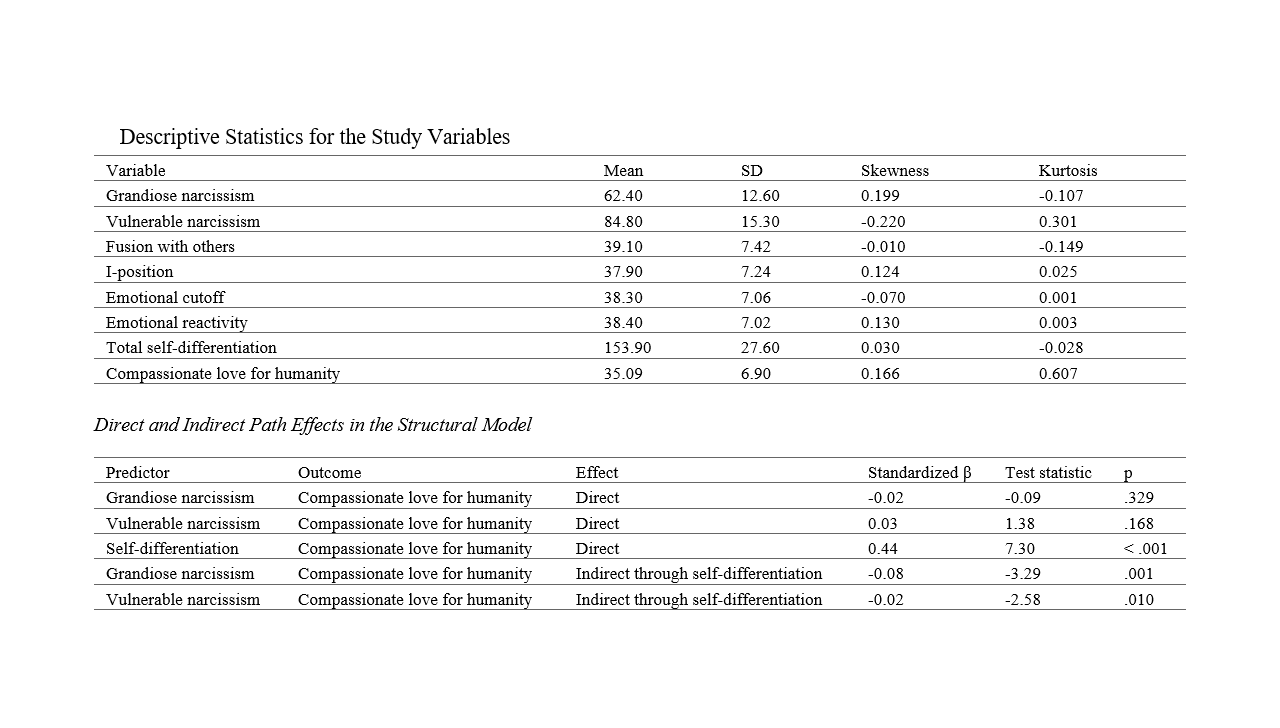
This study aimed to test a structural model of compassionate love for humanity based on narcissistic status, with self-differentiation as a mediating variable among university students. This descriptive, cross-sectional correlational study was conducted using structural equation modeling. The statistical population consisted of university students in Tehran during the 2023–2024 academic year, from whom 300 participants were selected using purposive and convenience sampling based on predefined inclusion and exclusion criteria. Data were collected using the Brief Pathological Narcissism Inventory, the Differentiation of Self Inventory, and the Revised Short Compassionate Love Scale for Humanity. Descriptive statistics and Pearson correlation coefficients were calculated using SPSS version 26, and the proposed structural model was evaluated using AMOS version 24 with maximum likelihood estimation. Model fit was assessed using χ²/df, RMSEA, CFI, NFI, GFI, and AGFI indices, and indirect effects were examined through mediation analysis. The structural model demonstrated satisfactory fit (χ²/df = 1.76, RMSEA = .05, CFI = .98, NFI = .96, GFI = .95, AGFI = .92). Grandiose narcissism did not have a significant direct effect on compassionate love for humanity (β = -0.02, p = .329), and the direct effect of vulnerable narcissism was also nonsignificant (β = 0.03, p = .168). Self-differentiation had a significant positive direct effect on compassionate love for humanity (β = 0.44, p < .001). Grandiose narcissism showed a significant negative indirect effect on compassionate love through self-differentiation (β = -0.08, p = .001), and vulnerable narcissism also had a significant negative indirect effect through self-differentiation (β = -0.02, p = .010). Self-differentiation appears to be a key psychological mechanism linking narcissistic status to compassionate love for humanity, such that higher differentiation is associated with greater compassion and mediates the negative indirect effects of both grandiose and vulnerable narcissism.
Downloads
References
Akıncı, İ., & Gençöz, T. (2025). How Do Grandiose and Vulnerable Narcissism Relate to Psychological Symptoms? The Role of Emotions. Psychological Reports, 128(5), 3108-3128. https://doi.org/10.1177/00332941231197167
Almasi Koupayi, M., & Khaleghipour, S. (2025). The Mediating Role of Self-Compassion and Mentalization in the Relationship of Idealistic Expectations and Alexithymia with Narcissism in Men. Behavioral Sciences Research, 23(3), 486-506.
Aysham, M. H., & Mousavipour, S. (2023). Predicting Differentiation of Self Based on Personality Dimensions and Religiosity. Islam and Psychological Research, 9(20), 129-148.
Behrouzizadeh, H., Chalmeh, R., & Khorramdel, K. (2023). Predicting Self-Objectification Based on Self-Compassion and Narcissism in Women Seeking Cosmetic Surgery. Bandar Abbas.
Biberdzic, M., Tan, J., & Day, N. J. S. (2023). 'It's Not You, It's Me': Identity Disturbance as the Main Contributor to Interpersonal Problems in Pathological Narcissism. Borderline personality disorder and emotion dysregulation, 10(1), 3. https://doi.org/10.1186/s40479-022-00209-6
Calatrava, M., Martins, M. V., Schweer-Collins, M., Duch-Ceballos, C., & Rodríguez-González, M. (2022). Differentiation of Self: A Scoping Review of Bowen Family Systems Theory's Core Construct. Clinical psychology review, 91, 102101. https://doi.org/10.1016/j.cpr.2021.102101
Dabbagh, M., Mahmoudjanlou, M., & Farzi, H. (2023). Examining the Relationship between Differentiation of Self and Self-Compassion among Married Students.
Dodson, S. J., & Heng, Y. T. (2022). Self-Compassion in Organizations: A Review and Future Research Agenda. Journal of Organizational Behavior, 43, 168-196. https://doi.org/10.1002/job.2556
Dolz-Del-Castellar, B., & Oliver, J. (2021). Relationship between Family Functioning, Differentiation of Self and Anxiety in Spanish Young Adults. PLoS One, 16(3), e0246875. https://doi.org/10.1371/journal.pone.0246875
Freund, V. L., Peeters, F., Meesters, C., Geschwind, N., Lemmens, L. H. J. M., Bernstein, D. P., & Lobbestael, J. (2022). Narcissistic Traits and Compassion: Embracing Oneself While Devoiding Others. Frontiers in psychology, 13, 914270. https://doi.org/10.3389/fpsyg.2022.914270
Ghaderi Baghejan, K. (2022). Structural Modeling of Self-Harm, Suicide, and High-Risk Behaviors among Youth in Tehran Based on Dark Traits, Vulnerable Dark Traits, and DSM-5 Proposed Pathological Personality Traits with the Mediation of Shame and Guilt Capacity Allameh Tabataba'i University, Department of Clinical Psychology]. Tehran.
Ghorbani, V., Mohammadpour, M., Foroughi, A. A., Mohebban, F., Derakhshani, M., & Soltanabadi, S. (2022). Psychometric Properties of the Persian Short Revised Version of the Compassionate Love Scale for Humanity. Cognitive Psychology and Psychiatry, 9(1), 95-105.
Hosack, L. L., Welton, G. L., & Homan, K. J. (2023). Differentiation of Self and Internal Distress: The Mediating Roles of Vulnerable Narcissism and Maladaptive Perfectionism. Clinical Social Work Journal, 51, 65-75. https://doi.org/10.1007/s10615-022-00851-1
Jauk, E., Breyer, D., Kanske, P., & Wakabayashi, A. (2021). Narcissism in Independent and Interdependent Cultures. Personality and individual differences, 177, 110716. https://doi.org/10.1016/j.paid.2021.110716
Kahana, E., Bhatta, T. R., Kahana, B., & Lekhak, N. (2021). Loving Others: The Impact of Compassionate Love on Later-Life Psychological Well-Being. The Journals of Gerontology: Series B, 76(2), 391-402. https://doi.org/10.1093/geronb/gbaa188
Kampe, L., Bohn, J., Remmers, C., & Hörz-Sagstetter, S. (2021). It's Not That Great Anymore: The Central Role of Defense Mechanisms in Grandiose and Vulnerable Narcissism. Frontiers in Psychiatry, 12, 661948. https://doi.org/10.3389/fpsyt.2021.661948
Milia, C., Kolubinski, D. C., & Spada, M. M. (2021). The Effects of Self-Critical Rumination on Shame and Stress: An Experimental Study. Behavioural and Cognitive Psychotherapy, 49(3), 272-286. https://doi.org/10.1017/S1352465820000727
Miller, J. D., Lynam, D. R., Hyatt, C. S., & Campbell, W. K. (2021). Controversies in Narcissism. Annual Review of Clinical Psychology, 17, 329-356.
Miller, J. T., & Verhaeghen, P. (2022). Mind Full of Kindness: Self-Awareness, Self-Regulation, and Self-Transcendence as Vehicles for Compassion. BMC psychology, 10(1), 188. https://doi.org/10.1186/s40359-022-00888-4
Mousavi, A. A., & Khaleghipour, S. (2024). The Mediating Role of Self-Compassion in the Relationship of Self-Esteem, Emotional Maturity, and Behavioral Patterns with Narcissism in Couples. Islamic Research Journal of Women and Family, 12(1), 1-15.
Neff, K. D. (2023). Self-Compassion: Theory, Method, Research, and Intervention. Annual review of psychology, 74, 193-218. https://doi.org/10.1146/annurev-psych-032420-031047
Noforosti, A., Moradi, H., & Amshkani, M. (2024). Self-Compassion in Iran: Predicting Self-Compassion Based on Demographic Factors. Rooyesh-e-Ravanshenasi Journal, 13(12), 205-214.
Özer, E. (2022). Five Factor Personality Traits in Self-Compassion, Coping Strategies and Communication Skills. Turkish Psychological Counseling and Guidance Journal, 12(64), 131-153. https://doi.org/10.17066/tpdrd.1096027
Ponzoni, S., Beomonte Zobel, S., Rogier, G., & Velotti, P. (2021). Emotion Dysregulation Acts in the Relationship between Vulnerable Narcissism and Suicidal Ideation. Scandinavian journal of psychology, 62, 468-475. https://doi.org/10.1111/sjop.12730
Reis, S., Huxley, E., Eng Yong Feng, B., & Grenyer, B. F. S. (2021). Pathological Narcissism and Emotional Responses to Rejection: The Impact of Adult Attachment. Frontiers in psychology, 12, 679168. https://doi.org/10.3389/fpsyg.2021.679168
Sarafraz, M. R., Amirbeigi, M., Ghasemi, O., & Firouzabadi, A. (2021). The Continuum Hypothesis of Narcissism, Self-Worth, and Self-Compassion. Jiroft.
Set, Z. (2021). Mediating Role of Narcissism, Vulnerable Narcissism, and Self-Compassion in the Relationship between Attachment Dimensions and Psychopathology. Alpha Psychiatry, 22(3), 147-152.
Seyedmajidi, S., Salehi, K., Madani, Y., & Shahmoradi, S. (2025). A Qualitative Study of the Conditions of Differentiation of Self in Iranian Families. Counseling Culture and Psychotherapy, 16(62), 1-36.
Sharpe, E. E., Schofield, M. B., Roberts, B. L. H., Kamal, A., & Maratos, F. A. (2024). Exploring the Role of Compassion, Self-Criticism and the Dark Triad on Obesity and Emotion Regulation. Current Psychology, 43(13), 11972-11982. https://doi.org/10.1007/s12144-023-05319-0
Tahmasebi, M., Baradaran, M., & Mirzaei, M. (2021). Moderating Role of Social Support in the Relationship between Interpersonal Sensitivity and Cyber Addiction.
van Schie, C. C., Jarman, H. L., Reis, S., & Grenyer, B. F. S. (2021). Narcissistic Traits in Young People and How Experiencing Shame Relates to Current Attachment Challenges. BMC psychiatry, 21(1), 246. https://doi.org/10.1186/s12888-021-03249-4
Yang, F., Hagiwara, C., Kotani, T., Hirao, J., & Oshio, A. (2023). Comparing Self-Esteem and Self-Compassion: An Analysis within the Big Five Personality Traits Framework. Frontiers in psychology, 14, 1302197. https://doi.org/10.3389/fpsyg.2023.1302197
Yu, Q., Ren, Y., Zuo, C., Qiu, S., Zhang, F., Guo, S., & Huang, S. (2025). Is Narcissism Always Bad? Allostatic Load Moderates the Different Relationships between Grandiose and Vulnerable Narcissism and Adolescents' Interpersonal Adaptation. Personality and individual differences, 246, 113340. https://doi.org/10.1016/j.paid.2025.113340
Zavardeh, S. Z. M., Ashoori, M., & Bazzazian, S. (2024). Self-Compassion in the Relationship between Personality Traits and Bedtime Procrastination. Shahid Sadoughi University of Medical Sciences.
Downloads
Additional Files
Publication Timeline
- Submitted
- Revised
- Accepted