Phenomenology of Misophonia in the Iranian Population: A Grounded Theory Study
Keywords:
misophonia, grounded theory, lived experience, paradigm model, Iranian populationAbstract
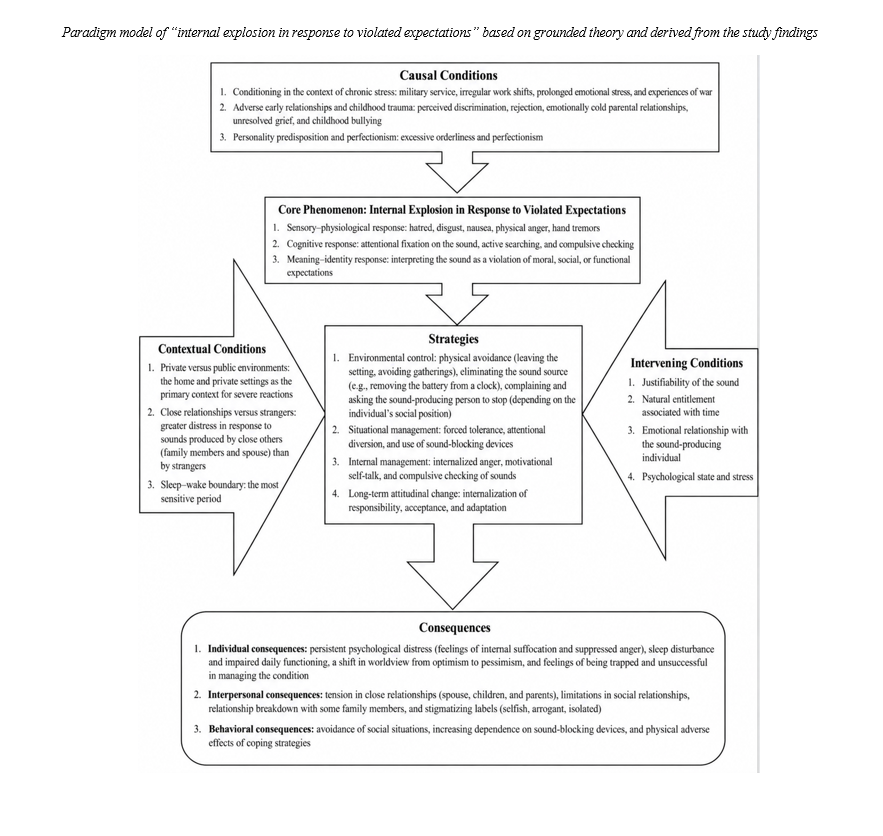
The present study aimed to explore the lived experiences of individuals with misophonia in Iran and to develop a data-grounded theory of the phenomenon. This qualitative study employed grounded theory using the systematic approach of Strauss and Corbin. The participants comprised 14 individuals, including 12 individuals with misophonia, one clinical psychology specialist, and one family member of an individual with misophonia, who were selected from among students at universities in Zanjan through purposive and theoretical sampling. Data were collected through in-depth semi-structured interviews and analyzed using MAXQDA software through open, axial, and selective coding. The findings led to the identification of the core phenomenon of “internal explosion in response to violated expectations,” comprising three interrelated layers: sensory–physiological, cognitive, and meaning–identity. Causal conditions included conditioning in the context of chronic stress, including military service, irregular work shifts, and experiences of war; adverse early relationships and childhood trauma, including bullying; and personality predisposition and perfectionism. Contextual conditions included private versus public environments, close relationships versus interactions with strangers, and the sleep–wake boundary. Intervening conditions included the perceived justifiability of the sound, the natural entitlement associated with time, the emotional relationship with the sound-producing individual, and psychological state and stress. Coping strategies were identified at four levels: environmental control, situational management, internal management, and long-term attitudinal change. Consequences emerged across three dimensions: individual consequences, including persistent psychological distress, sleep disturbance, and changes in worldview; interpersonal consequences, including tension in close relationships and stigmatizing labels; and behavioral consequences, including avoidance and dependence on sound-blocking devices. In addition, nine novel concepts emerged from the data: acquired hypervigilance, the day/night sleep paradox, threefold sound justifiability, a triadic vicious cycle, compulsive sound checking, the association between misophonia and childhood bullying trauma, cognition–affect conflict or a quasi-delusional experience, the bipolarity of auditory experience, and the effects of loneliness and warm social interactions.
Downloads
References
Aazh, H. (2025). Cognitive Behavioural Therapy (CBT) for Managing Tinnitus, Hyperacusis, and Misophonia: The 2025 Tonndorf Lecture. Brain Sciences, 15(5), 526. https://doi.org/10.3390/brainsci15050526
Akbari Saneh, N., Ghorbani, S., Farahani, H., Abedi, Z., Ashouri, A., & Mazaheri Asadi, D. (2025). The Mediating Role of Sensory Processing and Attentional Control in the Relationship Between Misophonia and Severity of Disability, Emotional Traits, and Disgust Propensity in Iranian College Students. Proceedings of the 2nd International Conference on Psychology, Social Sciences, Educational Sciences and Philosophy, Tehran, Iran.
Aldakhil, A. F., & Shaik, R. A. (2025). Misophonia in Autism: A Systematic Review of Prevalence, Clinical Features, and Comorbidities. Research in Developmental Disabilities, 161, 105005. https://doi.org/10.1016/j.ridd.2025.105005
Andermane, N., Bauer, M., Simner, J., & Ward, J. (2023). A Symptom Network Model of Misophonia: From Heightened Sensory Sensitivity to Clinical Comorbidity. Journal of Clinical Psychology, 79, 2364-2387. https://doi.org/10.1002/jclp.23552
Ay, E., Huviyetli, M., & Çakmak, E. (2024). The Mediating Role of Anxiety in the Relationship Between Misophonia and Quality of Life: Findings from the Validated Turkish Version of MisoQuest. Frontiers in psychology, 15, 1361645. https://doi.org/10.3389/fpsyg.2024.1361645
Black, V. K., Allen, K. J. D., Aazh, H., Johnson, S. L., & Erfanian, M. (2026). Misophonia Symptom Severity Is Linked to Impaired Flexibility and Heightened Rumination. British Journal of Psychology, 117(1), 271-300. https://doi.org/10.1111/bjop.70025
Dibb, B., & Golding, S. E. (2022). A Longitudinal Investigation of Quality of Life and Negative Emotions in Misophonia. Frontiers in Neuroscience, 16, 900474. https://doi.org/10.3389/fnins.2022.900474
Ferrer-Torres, A., & Giménez-Llort, L. (2022). Misophonia: A Systematic Review of Current and Future Trends in This Emerging Clinical Field. International journal of environmental research and public health, 19(11), 6790. https://doi.org/10.3390/ijerph19116790
Gercek, H. G., Gurbuz Ozgur, B., Hayta, Z., Sapanca, A., & Aksu, H. (2025). The Relationship Between Cognitive Disengagement Syndrome and Misophonia in Children with Attention Deficit Hyperactivity Disorder: The Mediating Role of Cognitive Disengagement Syndrome Symptoms. Annals of General Psychiatry, 24(1), 44. https://doi.org/10.1186/s12991-025-00583-9
Guetta, R. E., Cassiello-Robbins, C., Trumbull, J., Anand, D., & Rosenthal, M. Z. (2022). Examining Emotional Functioning in Misophonia: The Role of Affective Instability and Difficulties with Emotion Regulation. PLoS One, 17(2), e0263230. https://doi.org/10.1371/journal.pone.0263230
Guetta, R. E., Siepsiak, M., Shan, Y., Frazer-Abel, E., & Rosenthal, M. Z. (2024). Misophonia Is Related to Stress but Not Directly with Traumatic Stress. PLoS One, 19(2), e0296218. https://doi.org/10.1371/journal.pone.0296218
Guzick, A. G., Cervin, M., Smith, E. E., Clinger, J., Draper, I., Goodman, W. K., & Storch, E. A. (2023). Clinical Characteristics, Impairment, and Psychiatric Morbidity in 102 Youth with Misophonia. Journal of affective disorders, 324, 395-402. https://doi.org/10.1016/j.jad.2022.12.083
Guzick, A. G., Rast, C. E., Maddox, B. B., Rodriguez Barajas, S., Clinger, J., McGuire, J., & Storch, E. A. (2025). "How Can I Get Out of This?": A Qualitative Study of the Phenomenology and Functional Impact of Misophonia in Youth and Families. Psychopathology, 58(1), 33-43. https://doi.org/10.1159/000535044
Humolli, M., Poerio, G., & Simner, J. (2026). Social Context in Misophonia: Does Misophonia Impact Social Judgements (& Do Social Judgements Impact Misophonia)? Hearing Research, 470, 109512. https://doi.org/10.1016/j.heares.2025.109512
Lewin, A. B., Milgram, L., Cepeda, S. L., Karlovich, A., Dickinson, S., Bolen, M., Harmon, S. L., Small, B. J., & Ehrenreich-May, J. (2026). Treatment of Youth Misophonia: A Randomized Controlled Trial Comparing Transdiagnostic Cognitive-Behavioral Therapy to Psychoeducation and Relaxation Training. Behavior therapy, 57(1), 63-78. https://doi.org/10.1016/j.beth.2025.04.006
McMahon, K., Cassiello-Robbins, C., Greenleaf, A., Guetta, R., Frazer-Abel, E., Kelley, L., & Rosenthal, M. Z. (2024). The Unified Protocol for Transdiagnostic Treatment of Emotional Disorders for Misophonia: A Pilot Trial Exploring Acceptability and Efficacy. Frontiers in psychology, 14, 1294571. https://doi.org/10.3389/fpsyg.2023.1294571
Möllmann, A., Heinrichs, N., Illies, L., Potthast, N., & Kley, H. (2023). The Central Role of Symptom Severity and Associated Characteristics for Functional Impairment in Misophonia. Frontiers in Psychiatry, 14, 1112472. https://doi.org/10.3389/fpsyt.2023.1112472
Müfreze, P., Avcil, C., & Herdi, O. (2025). Beyond the Sound: The Role of the Source of Human-Made Trigger Sounds in Misophonia. Nöro Psikiyatri Arşivi, 62(1), 48-53.
Mutlu, K., Tamam, L., Namli, Z., Demirkol, M. E., & Karaytug, M. O. (2023). Misophonia and Its Relationship with Other Psychiatric Disorders. Psychiatry and Clinical Psychopharmacology, 33(2), 406-414. https://doi.org/10.37990/medr.1208093
Natalini, E., Fioretti, A., Eibenstein, R., & Eibenstein, A. (2024). Metacognitive Interpersonal Therapy for Misophonia: A Single-Case Study. Brain Sciences, 14(7), 717. https://doi.org/10.3390/brainsci14070717
Norena, A. (2024). Did Kant Suffer from Misophonia? Frontiers in psychology, 15, 1242516. https://doi.org/10.3389/fpsyg.2024.1242516
Ozuer, Y., Cima, R., Kestens, E., & Van Diest, I. (2025). Understanding the Misophonic Experience: A Mixed Method Study. Frontiers in psychology, 16, 1493676. https://doi.org/10.3389/fpsyg.2025.1493676
Patro, C., Wasko, E., Prabhu, P., & Srinivasan, N. K. (2025). Investigating Neurophysiological, Perceptual, and Cognitive Mechanisms in Misophonia. Biology, 14(3), 238. https://doi.org/10.3390/biology14030238
Pfeiffer, E., Allroggen, M., & Sachser, C. (2025). The Prevalence of Misophonia in a Representative Population-Based Survey in Germany. Social Psychiatry and Psychiatric Epidemiology, 60(1), 257-264. https://doi.org/10.1007/s00127-024-02707-0
Rosenthal, M. Z., McMahon, K., Greenleaf, A. S., Cassiello-Robbins, C., Guetta, R., Trumbull, J., & Kelley, L. (2022). Phenotyping Misophonia: Psychiatric Disorders and Medical Health Correlates. Frontiers in psychology, 13, 941898. https://doi.org/10.3389/fpsyg.2022.941898
Savard, M. A., & Coffey, E. B. J. (2025). Toward Cognitive Models of Misophonia. Hearing Research, 458, 109184. https://doi.org/10.1016/j.heares.2025.109184
Savard, M. A., Sares, A. G., Coffey, E. B., & Deroche, M. L. (2022). Specificity of Affective Responses in Misophonia Depends on Trigger Identification. Frontiers in Neuroscience, 16, 879583. https://doi.org/10.3389/fnins.2022.879583
Siepsiak, M., Turek, A., Michałowska, M., Gambin, M., & Dragan, W. Ł. (2023). Misophonia in Children and Adolescents: Age Differences, Risk Factors, Psychiatric and Psychological Correlates. A Pilot Study with Mothers' Involvement. Child Psychiatry & Human Development, 1-14. https://doi.org/10.21203/rs.3.rs-2784361/v1
Spencer, S. D., Guzick, A. G., Cervin, M., & Storch, E. A. (2023). Mindfulness and Cognitive Emotion Regulation in Pediatric Misophonia. Journal of Contextual Behavioral Science, 29, 182-191. https://doi.org/10.1016/j.jcbs.2023.07.005
Swedo, S. E., Baguley, D. M., Denys, D., Dixon, L. J., Erfanian, M., Fioretti, A., & Raver, S. M. (2022). Consensus Definition of Misophonia: A Delphi Study. Frontiers in Neuroscience, 16, 841816. https://doi.org/10.3389/fnins.2022.841816
Vitoratou, S., Hayes, C., Uglik-Marucha, N., Pearson, O., Graham, T., & Gregory, J. (2023). Misophonia in the UK: Prevalence and Norms from the S-Five in a UK Representative Sample. PLoS One, 18(3), e0282777. https://doi.org/10.1371/journal.pone.0282777
Woolley, M. G., Ramos, A. M., Bowers, E. M., Muñoz, K., Petersen, J. M., & Twohig, M. P. (2025). Recognizing Individual Variability in Misophonia: Identifying Symptom-Based Subgroups with Gaussian Mixture Modeling. Journal of psychiatric research, 184, 232-240. https://doi.org/10.1016/j.jpsychires.2025.02.054
Downloads
Additional Files
Publication Timeline
- Submitted
- Revised
- Accepted