Comparison of the Effectiveness of Intensive Short-Term Dynamic Psychotherapy (ISTDP) and Cognitive Behavioral Therapy (CBT) on Somatization Symptoms and Dissociative Experiences in Patients with Social Anxiety Disorder
Keywords:
Intensive Short-Term Dynamic Psychotherapy, Cognitive Behavioral Therapy, Social Anxiety Disorder, Somatization, Dissociative ExperiencesAbstract
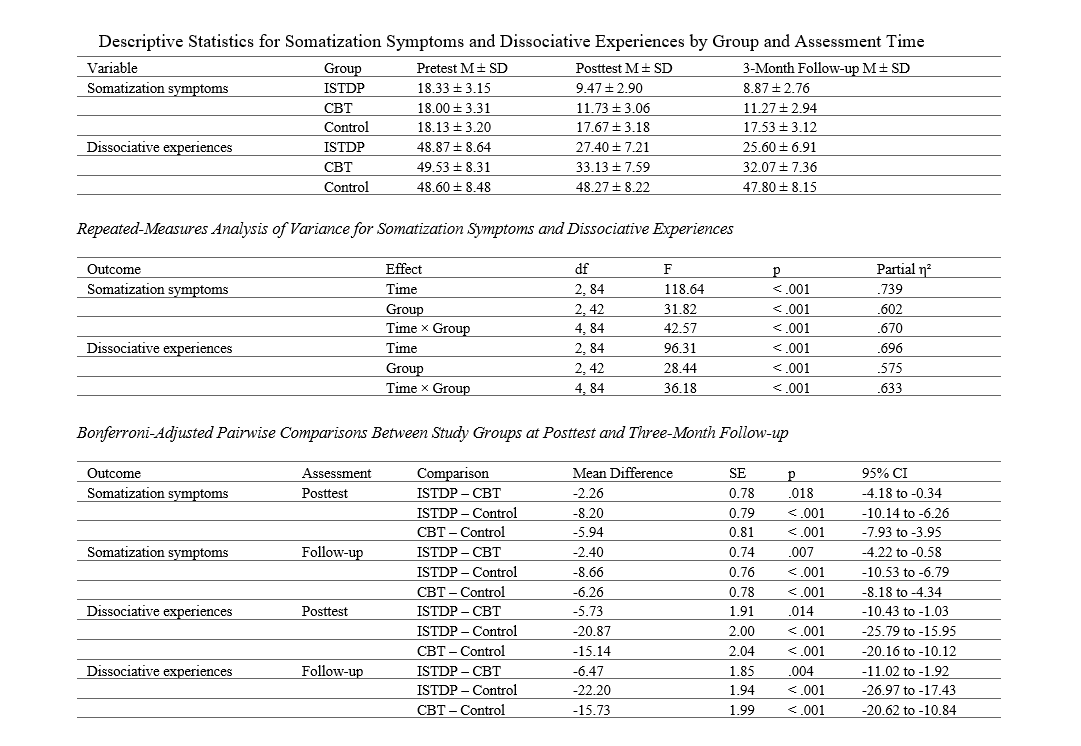
The present study aimed to compare the effectiveness of Intensive Short-Term Dynamic Psychotherapy (ISTDP) and Cognitive Behavioral Therapy (CBT) in reducing somatization symptoms and dissociative experiences in patients with social anxiety disorder. This randomized controlled study employed a pretest–posttest design with a three-month follow-up and three parallel groups. The statistical population consisted of adults with social anxiety disorder who attended psychological and psychiatric treatment centers in Tehran, Iran. A total of 45 eligible participants were selected through purposive sampling and randomly assigned to the ISTDP, CBT, or control group, with 15 participants in each group. The ISTDP and CBT groups each received 12 individual weekly sessions lasting approximately 60 minutes, whereas the control group received no structured psychotherapy during the study period. Somatization symptoms were assessed using the Patient Health Questionnaire-15, and dissociative experiences were measured using the Dissociative Experiences Scale-II. Data were analyzed using repeated-measures analysis of variance and Bonferroni-adjusted pairwise comparisons at a significance level of p < .05. Repeated-measures analysis showed significant time effects for somatization symptoms, F(2, 84) = 118.64, p < .001, partial η² = .739, and dissociative experiences, F(2, 84) = 96.31, p < .001, partial η² = .696. Significant group effects were also observed for somatization symptoms, F(2, 42) = 31.82, p < .001, partial η² = .602, and dissociative experiences, F(2, 42) = 28.44, p < .001, partial η² = .575. The time × group interactions were significant for both somatization symptoms, F(4, 84) = 42.57, p < .001, partial η² = .670, and dissociative experiences, F(4, 84) = 36.18, p < .001, partial η² = .633. Bonferroni comparisons indicated that both interventions were significantly more effective than the control condition, while ISTDP produced significantly greater reductions than CBT at both posttest and follow-up. Both ISTDP and CBT were effective in reducing somatization symptoms and dissociative experiences in patients with social anxiety disorder, with ISTDP demonstrating greater and sustained effects across both outcome domains.
Downloads
References
Abbass, A., & Haghiri, B. (2025). Intensive Short-Term Dynamic Psychotherapy for Functional Somatic Disorders: A Scoping Review. Clinical Neuropsychiatry, 22(2), 111-120.
Abbass, A., Kisley, S., & Town, J. (2018). Cost-Effectiveness of Intensive Short-Term Dynamic Psychotherapy Trial Therapy. Psychotherapy and psychosomatics, 87(4), 255–257. https://doi.org/10.1159/000487600
Bermpohl, F. M. g., & Martin, A. (2025). Efficacy of Cognitive Behavioral Therapy and Acceptance- And Mindfulness-Based Treatments in Adults With Bodily Distress: A Network Meta-Analysis. Psychotherapy and psychosomatics, 94(3), 207-224. https://doi.org/10.1159/000544825
Bourdon, D. É., El-Baalbaki, G., Beaulieu-Prévost, D., Guay, S., Belleville, G., & Marchand, A. (2019). Personality Beliefs, Coping Strategies and Quality of Life in a Cognitive-Behavioral Therapy for Posttraumatic Stress Disorder. European Journal of Trauma & Dissociation.
Caldiroli, A., Capuzzi, E., Riva, I., Russo, S., Clerici, M., Roustayan, C., Abbass, A., & Buoli, M. (2020). Efficacy of intensive short-term dynamic psychotherapy in mood disorders: A critical review. Journal of affective disorders, 273, 375-379. https://doi.org/10.1016/j.jad.2020.04.002
Castillo, J. M., Beton, E., Coman, C., Howell, B., Burness, C., Martlew, J., Russell, L., Town, J. M., Abbass, A., Algorta, G. P., & Valavanis, S. (2022). Three Sessions of Intensive Short-Term Dynamic Psychotherapy (ISTDP) for Patients With Dissociative Seizures: A Pilot Study. Psychoanalytic Psychotherapy, 36(2), 81-104. https://doi.org/10.1080/02668734.2021.2018623
Donyavi, M., & Mohtashami, M. (2024). The Effectiveness of Short-Term Intensive Psychodynamic Psychotherapy on Depression in Individuals with Dissociative Disorders. Quarterly Journal of New Ideas in Psychology, 22(26) 1-15. https://jnip.ir/article-1-1259-fa.html
Hajrezaei, M. R., Sazesh Rahbarjou, S. S., & Shamsaldini, A. (2024). Effectiveness of Short-term Intensive Dynamic Psychotherapy on the Severity of Gastrointestinal Symptoms and Depression in Patients with the Diarrhea Subtype of Irritable Bowel Syndrome. Journal of Assessment and Research in Applied Counseling (JARAC), 6(2), 56-63. https://doi.org/10.61838/kman.jarac.6.2.7
Jafari, S., Kazemian Moghadam, K., & Ghalavand, F. (2024). Effectiveness of Intensive Short-Term Dynamic Psychotherapy on Depression, Health Anxiety, and Somatic Symptoms in Patients Recovered from COVID-19. Clinical Psychology and Counseling Research, 14(1), 223-242.
Kelidari, F., Mousavi, S. M., Kian, F. G., & Emami, F. (2024). The effectiveness of short-term and intensive psychodynamic therapy on the difficulty in regulating emotions and attachment styles in psychosomatic patients. Family and Health, 12(2), 101-113. https://doi.org/10.32598/familyandhealth.12.2.101
Kiani Rad, M. (2024). Effectiveness of Cognitive Behavioral Therapy on Body Image Concern in Women with Depression Symptoms. Journal of Psychological Dynamics in Mood Disorders (PDMD), 3(1), 124-138. https://doi.org/10.22034/pdmd.2024.434757.1039
Law, M., Pickering, I., Bartlett, E., Sebaratnam, G., Varghese, C., Gharibans, A., O'Grady, G., Andrews, C. N., & Calder, S. (2023). Cognitive behavioural therapy-based interventions for gastroduodenal disorders of gut-brain interaction: A systematic review. Journal of psychosomatic research, 111516. https://doi.org/10.1016/j.jpsychores.2023.111516
Li, Y. R., Bailey, R., & Lee, W. L. (2025). Exploring the mediating role of metacognitions in the link between somatosensory amplification and health anxiety among college students. Mental Health and Social Inclusion, 29(5), 560-570. https://doi.org/10.1108/MHSI-01-2025-0013
Mehrmanesh, E., Hafezi, F., Ehteshamzadeh, P., & Bakhtiarpour, S. (2023). Comparing the effectiveness of cognitive behavioral therapy, biofeedback and EMDR on anxiety sensitivity in women with migraine. Journal of Personality and Psychosomatic Research (JPPR), 1(1), 10-14. https://doi.org/10.61838/kman.jppr.1.1.3
Mohammadi Begi, M. (2023). A structural model predicting somatic symptoms based on childhood trauma, emotional alexithymia, and perceived social support with the mediating role of depression/anxiety/stress in patients with epilepsy
Nakhaei Moghadam, R., Bahrainian, S. A., & Nasri, M. (2024). The effectiveness of intensive and short-term dynamic psychotherapy on attachment styles, somatization and health anxiety in patients with chronic pain. Journal of Assessment and Research in Applied Counseling (JARAC), 6(1). https://journals.kmanpub.com/index.php/jarac/article/view/1287
Nielsen, S. K. K., Stuart, A. C., Winding, C., Ollgaard, M., Wolitzky-Taylor, K., Daniel, S. I. F., Vangkilde, S., Rosenberg, N., Hageman, I., & Jorgensen, M. B. (2025). Group acceptance and commitment therapy versus cognitive behavioral therapy/exposure response prevention for obsessive compulsive disorder: A block randomized controlled trial. Psychotherapy and psychosomatics, 94(3), 135-146. https://doi.org/10.1159/000544070
Nohi, S., & Hasani, J. (2017). The Relationship between Cognitive Emotion Regulation Strategies and Defense Mechanisms with Borderline Personality Disorder. Thoughts and Behavior in Clinical Psychology, 12(43), 57-66. https://jtbcp.roudehen.iau.ir/article_1044.html
https://jtbcp.roudehen.iau.ir/article_1044_978fe7f372d556179921b21e47835165.pdf
Schuffelen, J., Maurer, L. F., & Gieselmann, A. (2026). The Effects of Digital Cognitive Behavioral Therapy for Insomnia in Chronic Pain: A Randomized Controlled Trial. Psychotherapy and psychosomatics, 95(1), 55-75. https://doi.org/10.1159/000547436
Serra, R., Kiekens, G., Tarsitani, L., Vrieze, E., Bruffaerts, R., Loriedo, C., Adriaens, A., & Vanderlinden, J. (2020). The Effect of Trauma and Dissociation on the Outcome of Cognitive Behavioural Therapy for Binge Eating Disorder. European Eating Disorders Review, 28(3), 309-317. https://doi.org/10.1002/erv.2722
Tarakçıoğlu, M. C. (2024). Can Cognitive Behavioral Therapy Be Effective for Social Anxiety Disorder With Dissociative and Self-Harm Behaviors in a 15-Year-Old Adolescent? Medical Research Reports, 7(2), 114-119. https://doi.org/10.55517/mrr.1419278
Town, J. M., & Driessen, E. (2013). Emerging Evidence for Intensive Short-Term Dynamic Psychotherapy With Personality Disorders and Somatic Disorders. Psychiatric Annals, 43(11), 502-507. https://doi.org/10.3928/00485713-20131105-05
Downloads
Additional Files
Publication Timeline
- Submitted
- Revised
- Accepted