The Effectiveness of Cognitive-Behavioral Couple Therapy and Social Support Training on Marital Conflict and Social Interactions Among Mothers of Children with Specific Learning Disorders
Keywords:
cognitive-behavioral couple therapy, social support training, marital conflict, social interactionsAbstract
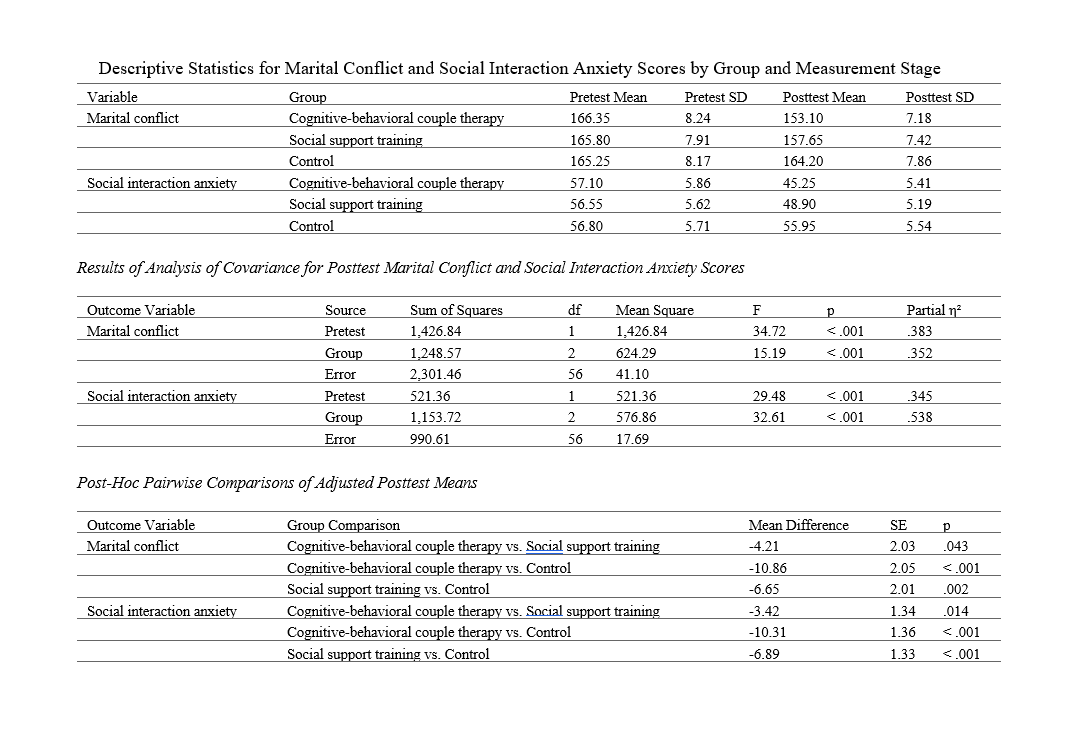
The present study aimed to investigate the effectiveness of cognitive-behavioral couple therapy and social support training on marital conflict and social interactions among mothers of children with specific learning disorders who attended counseling centers in Bushehr. The study employed a quasi-experimental pretest-posttest design with a control group. The statistical population consisted of mothers of children with specific learning disorders who attended counseling centers in Bushehr. The study sample comprised 60 participants selected through voluntary sampling. Data were collected using the Marital Conflict Questionnaire developed by Sanaei-Zaker and Bostanipour (2008) and the Social Interaction Anxiety Scale developed by Mattick and Clarke (1998). The results indicated a significant difference between the experimental and control groups in terms of marital conflict. In other words, cognitive-behavioral couple therapy and social support training resulted in greater improvement in marital conflict among participants in the experimental groups compared with those in the control group, demonstrating the effectiveness of cognitive-behavioral couple therapy and social support training in reducing marital conflict. A significant difference was also found between the experimental and control groups in terms of social interactions. In other words, cognitive-behavioral couple therapy and social support training improved social interactions among participants in the experimental groups compared with those in the control group, indicating the effectiveness of these interventions in enhancing social interactions.
Downloads
References
Abedi, A. S., Asad, N., Patel, H., Abedi, M. S., & Ali, R. (2025). Occurrence of Multiple Psychiatric Comorbidities in a Child With Neurofibromatosis Type 1 (NF1): A Case Report. Cureus. https://doi.org/10.7759/cureus.77745
Anthony, H., McLean, L., Rabba, A. S., & Reupert, A. (2025). What Language Should We Use When Talking About Children With Specific Learning Disorders? A Study Exploring the Preference of Australian Parents, Professionals and Adults Who Have a Specific Learning Disorder. Dyslexia, 31(1). https://doi.org/10.1002/dys.70000
Asdaq, S. M. B., Alhowail, A., Rabbani, S. I., Nayeem, N., Asdaq, S. M. E., & Nausheen, F. (2025). Learning Disabilities in the 21st Century: Integrating Neuroscience, Education, and Technology for Better Outcomes. Sage Open, 15(3). https://doi.org/10.1177/21582440251365483
Bozatlı, L., Aykutlu, H. C., Giray, A. S., Ataş, T., Özkan, Ç., Yıldırım, B. G., & Görker, İ. (2024). Children at Risk of Specific Learning Disorder: A Study on Prevalence and Risk Factors. Children, 11(7), 759. https://doi.org/10.3390/children11070759
Dattilio, F. M., & Collins, M. H. (2018). Cognitive-behavioral family therapy. In Science and practice in cognitive therapy: Foundations, mechanisms, and applications. (pp. 214-232). Guilford Press. https://awspntest.apa.org/record/2018-01399-013
Fruzzetti, A., & Payne, L. (2020). Assessment of parents, couples, and families in dialectical behavior therapy. Cognitive and Behavioral Practice. https://doi.org/10.1016/j.cbpra.2019.10.006
Kunwar, R. (2024). Fostering Student Success: A Prevailing Provision for Dyscalculia and Dyslexia in the School Curriculum and Strategies for Support. Nepal Journal of Neuroscience, 21(1), 29-35. https://doi.org/10.3126/njn.v21i1.63381
Llanos, L. F., & Anguita, M. M. d. (2025). Early Detection of Risks in Child Development in Spanish-Speaking Countries: Content Validity. Frontiers in Pediatrics, 13. https://doi.org/10.3389/fped.2025.1444104
Loredo, M., Luque, J. L., Almudena Giménez de la, P., & López-Pérez, P. J. (2025). Prevalence of Risk for Dyslexia, Risk for Dyscalculia, and Their Comorbidity in Spanish Primary Education: Gender Difference and Socioeconomic Status. Frontiers in psychology, 16. https://doi.org/10.3389/fpsyg.2025.1664437
Luciano, M., Yutong, A., McKinlay, M., Mubarak, R., & Paracchini, S. (2025). Shaping UK Research Priorities in the Area of Specific Learning Difficulties by Surveying People With Lived Experience. Neurodiversity, 3. https://doi.org/10.1177/27546330251348559
Mavutha, W., & Ramnund‐Mansingh, A. (2024). Online Education Adaptability for South African Learners With Dyscalculia and Dyslexia Using Digital Learning Methods. Clinical Sociology Review, 19(1), 51-80. https://doi.org/10.36615/qw8ax028
Megari, K., & Genova, K. D. (2026). Cognitive Pathways in Atypical Development: Executive Functions in Children With Attention‐Deficit/Hyperactivity Disorder and Specific Learning Disorders. International Journal of Developmental Neuroscience, 86(1). https://doi.org/10.1002/jdn.70094
Mohamed, S., Ben-Jaafar, A., Frimpong, M., Roy, S., Sanker, V., Nkrumah-Boateng, P. A., Imran, S., Mumeen, A. A., Mohamed, S., & Awuah, W. A. (2026). Applying Artificial Intelligence in Neurodevelopmental Disorders Management and Research. European Journal of Medical Research, 31(1). https://doi.org/10.1186/s40001-025-03740-8
Molise, D. C., & Luneta, K. (2024). An Overview of the Causes of Dyscalculia and Its Impact on Learners’ Arithmetic Ability. The Independent Journal of Teaching and Learning, 19(1), 124-144. https://doi.org/10.17159/ijtl.v19i1.18857
Niazi, E., Mami, S., & Ahmadi, V. (2019). Comparison of the Efficacy of the Integrative Behavioral Couple Therapy and Rational-Emotive Behavior Therapy on the Communication Beliefs among Maladjustment Couples [Original Research Article]. Middle Eastern Journal of Disability Studies, 9(0), 14-14. http://jdisabilstud.org/article-1-1403-en.html
Nikbakht, R., & Haghayegh, S. A. (2019). The Role of Parental Stress and Social Stigma in Parent-Child Interactions in Mothers of Children with Autism. Biannual Journal of Cultural Psychology, 3(124), 2-138.
Park, I., Park, U. I., & Lee, E. G. (2019). Effects of Familial Support on Parenting Efficacy Among Vietnamese Married Immigrant Women in Rural Korea: Sequential Mediation Effects of Social Participation and Psychological Well-Being. Korean Journal of Child Studies, 40(3), 53-67. https://doi.org/10.5723/kjcs.2019.40.3.53
Peisch, V., Dale, C., Parent, J., & Burt, K. B. (2019). Parent Socialization of Coping and Child Emotion Regulation Abilities: A Longitudinal Examination. Family Process, 59(4), 1722-1736. https://doi.org/10.1111/famp.12516
Polydoros, G. (2026). Investigating the Link Between Dyslexia and Dyscalculia: Teaching, Learning, And ICT Integration. Journal of Computer Assisted Learning, 42(3). https://doi.org/10.1002/jcal.70233
Rowhany, N. s., Jalali, M. R., & Mousavi, S. A. M. (2019). The Relationship between Personality Traits, Attachment Styles, and Parental Styles with Children's Physical Health. childmh, 6(3), 215-227. https://doi.org/10.29252/jcmh.6.3.19
Schultheis, A. M., Mayes, L. C., & Rutherford, H. J. V. (2019). Associations between Emotion Regulation and Parental Reflective Functioning. Journal of Child and Family Studies, 28(4), 1094-1104. https://doi.org/10.1007/s10826-018-01326-z
Downloads
Additional Files
Publication Timeline
- Submitted
- Revised
- Accepted