Effectiveness of Transcranial Direct Current Stimulation (tDCS) in Reducing Anxiety and Aggression in 6- to 10-Year-Old Boys With High-Functioning Autism Spectrum Disorder
Keywords:
Transcranial Direct Current Stimulation, tDCS, Autism Spectrum Disorder, Anxiety, Aggression, High-Functioning AutismAbstract
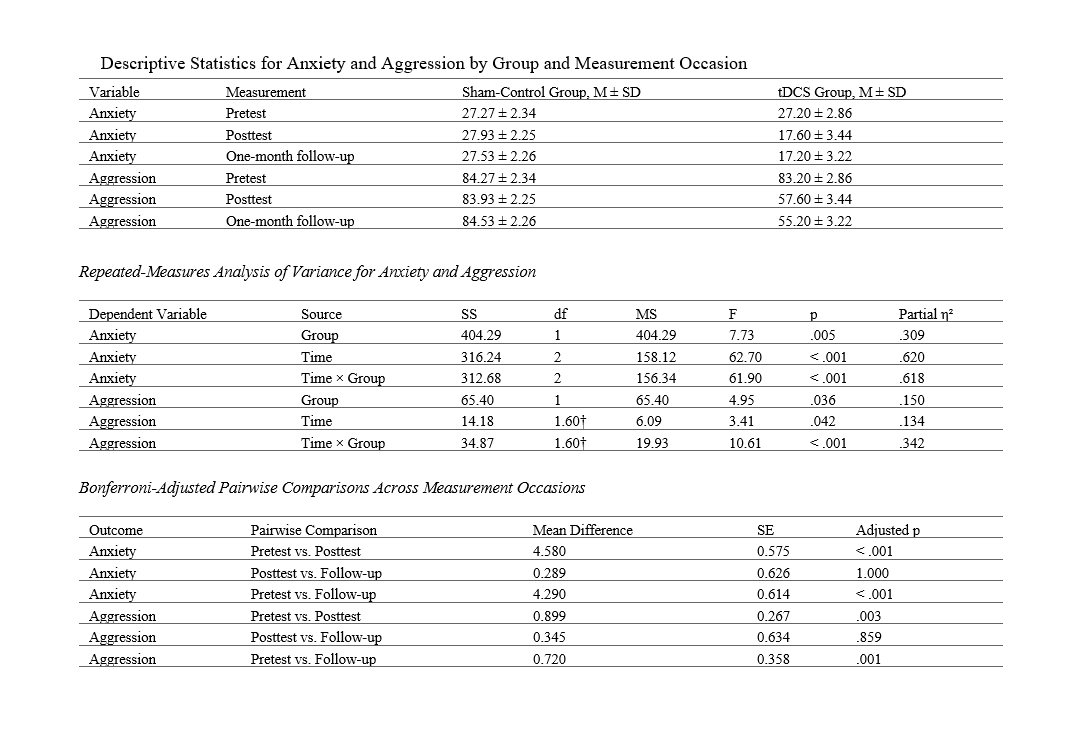
This study aimed to determine the effectiveness of transcranial direct current stimulation (tDCS) in reducing anxiety and aggression in 6- to 10-year-old boys with high-functioning autism spectrum disorder. This quasi-experimental study employed a pretest–posttest–follow-up design with an active intervention group and a sham-control group. The statistical population consisted of 6- to 10-year-old boys with high-functioning autism spectrum disorder attending specialized autism treatment and rehabilitation centers in Tehran, Iran, from late October 2025 to January 2026. Thirty eligible children were selected through purposive sampling and randomly assigned to an active tDCS group (n = 15) or a sham-control group (n = 15). The experimental group received 10 individual tDCS sessions over four weeks, with 1 mA anodal stimulation applied over the left dorsolateral prefrontal cortex for 20 minutes per session. In the sham condition, stimulation was discontinued after approximately 30 seconds. Anxiety was assessed using the Anxiety Scale for Children with Autism Spectrum Disorder–Parent Version, and aggression was measured using the Children’s Scale of Hostility and Aggression: Reactive/Proactive. Assessments were conducted at pretest, posttest, and one-month follow-up. Data were analyzed using repeated-measures analysis of variance and Bonferroni-adjusted pairwise comparisons in SPSS version 26. Repeated-measures analysis showed significant time × group interactions for anxiety, F(2, 56) = 61.90, p < .001, partial η² = .618, and aggression, F = 10.61, p < .001, partial η² = .342. Significant between-group effects were also observed for anxiety, F(1, 28) = 7.73, p = .005, and aggression, F(1, 28) = 4.95, p = .036. Bonferroni comparisons indicated significant pretest-to-posttest and pretest-to-follow-up reductions in both anxiety and aggression, whereas posttest-to-follow-up differences were nonsignificant, indicating maintenance of treatment effects. The findings indicate that repeated prefrontal tDCS can significantly reduce anxiety and aggression in boys with high-functioning autism spectrum disorder, with improvements remaining stable one month after treatment.
Downloads
References
Akbari, B. (2018). Effectiveness of Transcranial Direct Current Stimulation (tDCS) on Rumination, Negative Automatic Thoughts, and Psychological Symptoms (Anxiety and Depression) in Patients with Major Depression. Iranian Journal of Psychology and Behavioral Sciences(15), 52-58.
Allaert, J., Raedt, R. D., Sánchez-López, Á., Baeken, C., & Vanderhasselt, M. A. (2020). Mind the Social Feedback: Effects of tDCS Applied to the Left DLPFC on Psychophysiological Responses During the Anticipation and Reception of Social Evaluations. Social Cognitive and Affective Neuroscience, 17(1), 131-141. https://doi.org/10.1093/scan/nsaa066
Aparicio, L. V., Rosa, V., Razza, L. M., Sampaio-Junior, B., Borrione, L., Valiengo, L., & Gattaz, W. F. (2019). Transcranial direct current stimulation (tDCS) for preventing major depressive disorder relapse: Results of a 6‐month follow‐up. Depression and Anxiety, 36(3), 262-268. https://doi.org/10.1002/da.22878
Clarke, P. J. F., Sprlyan, B. F., Hirsch, C. R., Meeten, F., & Notebaert, L. (2020). tDCS increases anxiety reactivity to intentional worry. Journal of psychiatric research, 120, 34-39.
Dell'Osso, L. (2025). Autism spectrum disorder, social anxiety and obsessive-compulsive disorders: beyond the comorbidity. BMC psychiatry, 25(1). https://doi.org/10.1186/s12888-024-06340-8
Fattahi Andebil, A., Saberi, H., & kazemi kavaki, a. (2018). Effectiveness of Cognitive behavioral group Play therapy and Transcranial Direct Current Stimulation on Executive Function of Working Memory And Response Inhibition of Children with Attention Deficit- Hyperactivity Disorder. Neuropsychology, 4(14), 73-90. https://doi.org/10.30473/clpsy.2019.42393.1369
Fisher, E., Rob, P., MacLennan, K., Mullally, S., Rodgers, J., & Tzemou, E. (2026). School Anxiety Experienced by Autistic Children: A Systematic Review of Contributing Factors. School Mental Health. https://doi.org/10.1007/s12310-026-09852-8
Garcia, S., Nalven, M., Ault, A., & Eskenazi, M. A. (2020). tDCS as a treatment for anxiety and related cognitive deficits. International Journal of Psychophysiology, 158, 172-177. https://doi.org/10.1016/j.ijpsycho.2020.10.006
Gibson, B. C., Heinrich, M., Mullins, T. S., Yu, A. B., Hansberger, J. T., & Clark, V. P. (2021). Baseline Differences in Anxiety Affect Attention and tDCS-Mediated Learning. Frontiers in human neuroscience, 15. https://doi.org/10.3389/fnhum.2021.541369
Herrington, J. D., Maddox, B. B., Kerns, C. M., Rump, K., Worley, J. A., Bush, J. C., McVey, A. J., Schultz, R. T., & Miller, J. S. (2017). Amygdala Volume Differences in Autism Spectrum Disorder Are Related to Anxiety. Journal of Autism and Developmental Disorders, 47(12), 3682-3691. https://doi.org/10.1007/s10803-017-3206-1
Inci, R., & Saglam, M. (2025). Investigation of the effect of interactive art activity program on repetitive behaviors, social skills and parents' emotions in children with autism spectrum disorder. Advances in Autism, 11(1), 5-18. https://doi.org/10.1108/AIA-06-2024-0041
Jafari, R., & Yousefi, R. (2023). The effectiveness of social cognition training based on theory of mind on stereotyped behaviors, social interaction, and empathy in children with autism spectrum disorder. Tabriz University Psychology Journal, 18(1), 129-146. https://psychologyj.tabrizu.ac.ir/article_16944_30ea8f2366e42cca4192d031c63379c2.pdf
Jahedi Delivand, S., Tarkhan, M., Ahadhi, M., & Qodsi, P. (2024). The effectiveness of transcranial direct current stimulation (tDCS) treatment on the quality of life and anxiety of children with attention-deficit/hyperactivity disorder (ADHD). Scientific Research Journal of School and Virtual Learning, 12(3), 29-38. https://etl.journals.pnu.ac.ir/article_11639.html?lang=en
Jouy, L. (2025). The Effect of Resilience Skills Training on Improving Social Interactions in Children with Autism Spectrum Disorder. Neyshabur.
Karna, W., & Stefaniuk, I. (2024). The Influence of Peer Relationships on the Social Development of Children with Autism Spectrum Disorder. Iranian Journal of Neurodevelopmental Disorders, 2(4), 10-18. https://doi.org/10.61838/kman.jndd.2.4.2
Kiera, A. (2025). Experiences of Interoception and Anxiety in Autistic Adolescents: A Reflexive Thematic Analysis. Autism. https://doi.org/10.1177/13623613251314595
Lin, X., Lin, L., Wang, X., Li, X., Cao, M., & Jing, J. (2023). Association between Mothers’ Emotional Problems and Autistic Children’s Behavioral Problems: The Moderating Effect of Parenting Style. International journal of environmental research and public health, 20(5).
Moise, M., Andrei, L. E., Mihăilescu, I., Buică, A., & Rad, F. (2025). Aggression and Risk Behaviors in a Group of Adolescents With High-Functioning Autism. Children, 12(7), 852. https://doi.org/10.3390/children12070852
Narimani, M., Pouresmali, A., alizadeh goradel, j., & Mowlaie, M. (2017). The effect of trancecranial Direct Current Stimulation (tDCS) on reduction of craving, depression and anxiety in students with tramadol abuse: Preliminary study [Research]. Research on Addiction, 10(40), 87-102. http://etiadpajohi.ir/article-1-1115-en.html
Padrón, I., García‐Marco, E., Moreno, I., Birba, A., Silvestri, V., León, I., Álvarez, C. J., López, J., & Vega, M. d. (2021). Multisession Anodal tDCS on the Right Temporo-Parietal Junction Improves Mentalizing Processes in Adults With Autistic Traits. Brain Sciences, 12(1), 30. https://doi.org/10.3390/brainsci12010030
Reddy, P., & J, A. (2023). Diagnosis of Autism in Children Using Deep Learning Techniques by Analyzing Facial Features. Engineering Proceedings, 59(1).
Sergiou, C. S., Santarnecchi, E., Romanella, S. M., Wieser, M. J., Franken, I. H. A., Rassin, E., & Josanne, D. M. v. D. (2020). tDCS Targeting the Ventromedial Prefrontal Cortex Reduces Reactive Aggression and Modulates Electrophysiological Responses: A HD-tDCS/EEG Randomized Controlled Trial in a Forensic Population. https://doi.org/10.31234/osf.io/cjgdt
Shamsi Halasu, M., Tabatabaei, S. M., & Azmodeh, M. (2023). Comparing the Effectiveness of Transcranial Direct Current Stimulation (tDCS) and Cognitive Rehabilitation on Executive Functions in Children with Autism Spectrum Disorders. Scientific Journal of Pajouhan, 21(2), 113-121. https://doi.org/10.61186/psj.21.2.113
Smits, F., Geuze, E., Schutter, D. J., Honk, J. v., & Gladwin, T. E. (2021). Effects of tDCS During Inhibitory Control Training on Performance and PTSD, Aggression and Anxiety Symptoms: A Randomized-Controlled Trial in a Military Sample. Psychological medicine, 52(16), 3964-3974. https://doi.org/10.1017/s0033291721000817
Soqandi, K., Rezaei, M., & Amirabadizadeh, A. (2024). Effectiveness of Anodal Transcranial Direct Current Stimulation (tDCS) on Happiness and Symptoms of Military-Related Post-Traumatic Stress Disorder (PTSD). Seventh International Conference on Psychology, Educational Sciences, and Social Studies, Hamedan.
Tan, C., Song, H., Ma, S., Liu, X., & Zhao, Y. (2024). Autistic Traits and Aggressive Behavior in Chinese College Students: A Serial Mediation Model and the Gender Difference. Psychology research and behavior management, 1385-1397. https://doi.org/10.2147/PRBM.S451028
Tezcan, M. E., Çaltıner, Ş. N. İ., Demirel, H. R., Korucu, B. N., Şen, B., & Ekici, F. (2025). The Relationship Between Executive Functioning and Burnout, Depressive, Anxiety and Broad Autism Phenotype Symptoms in Parents of Children With Autism Spectrum Disorder. Online Türk Sağlık Bilimleri Dergisi, 10(2), 170-177. https://doi.org/10.26453/otjhs.1672755
Wu, Y., Tang, L., Shi, X., Zhou, Z., Li, Y., & Shan, C. (2022). Effects of tDCS on Depression and Comorbid Generalized Anxiety Disorder: A Brain Function Imaging Case Report. Frontiers in Neurology, 13. https://doi.org/10.3389/fneur.2022.879339
Yan, Y., & Abdullah, E. B. (2025). Clinical Interventions for Depression and Anxiety in Mothers of Children With Autism Spectrum Disorder in China. Ls, 1(3), 1-27. https://doi.org/10.71204/srdzv858
Yuan, B., Tolomeo, S., Yang, C., Wang, Y., & Yu, R. (2021). tDCS Effect on Prosocial Behavior: A Meta-Analytic Review. Social Cognitive and Affective Neuroscience, 17(1), 26-42. https://doi.org/10.1093/scan/nsab067
Zemestani, M., Hoseinpanahi, O., Salehinejad, M. A., & Nitsche, M. A. (2022). The Impact of Prefrontal Transcranial Direct Current Stimulation (tDCS) on Theory of Mind, Emotion Regulation and Emotional‐behavioral Functions in Children With Autism Disorder: A Randomized, Sham‐controlled, and Parallel‐group Study. Autism Research, 15(10), 1985-2003. https://doi.org/10.1002/aur.2803
Zhai, J., Li, X., Zhou, Y., Fan, L., Xia, W., Wang, X., Li, Y., Hou, M., Wang, J., & Wu, L. (2023). Correlation and Predictive Ability of Sensory Characteristics and Social Interaction in Children With Autism Spectrum Disorder. Frontiers in Psychiatry, 14. https://doi.org/10.3389/fpsyt.2023.1056051
Zoghipaydar, M., Hasany Khosh, Z., Yar Mohammadi Wasel, M., & Mohagheghi, H. (2022). Comparing of Transcranial Direct Current Stimulation (TDCS) and Methadone Maintenance Treatment(MMT) on Emotion Regulation, Distress Tolerance and Decreased Craving in People with Substance Use Disorder(SUD). Neuropsychology, 7(27), 95-109. https://doi.org/10.30473/clpsy.2021.59493.1606
Downloads
Additional Files
Publication Timeline
- Submitted
- Revised
- Accepted