Effectiveness of an Integrated Cognitive Control–Metacognitive Intervention on Obsessive–Compulsive Symptoms: The Roles of Executive Function, Inhibitory Control, Metacognition, and Neurophysiological Indices
Keywords:
obsessive–compulsive disorder, cognitive control, metacognitive therapy, response inhibition, executive functionAbstract
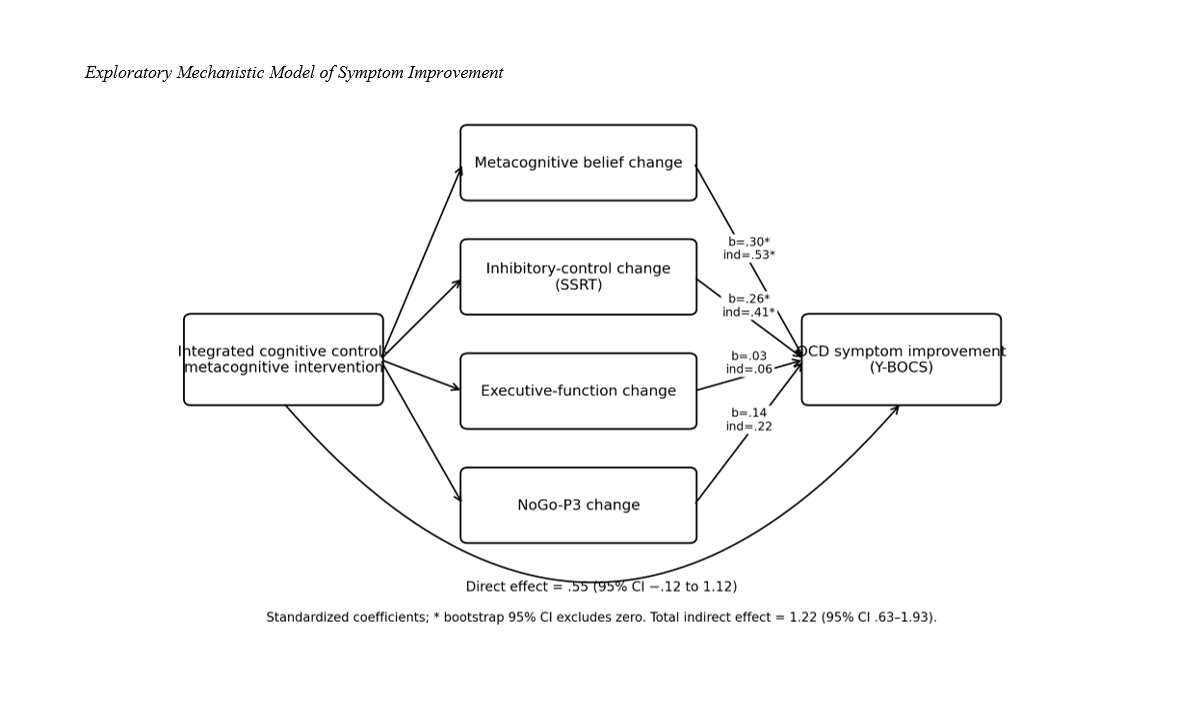
This study aimed to evaluate the effectiveness of an integrated cognitive control–metacognitive intervention (ICCMI) for reducing obsessive–compulsive symptoms and improving executive function, inhibitory control, metacognitive beliefs, and neurophysiological indices in adults with obsessive–compulsive disorder (OCD). An assessor-blinded, parallel-group randomized controlled trial was conducted with 80 adults aged 18–55 years who met DSM-5-TR criteria for OCD and had Yale–Brown Obsessive–Compulsive Scale (Y-BOCS) scores ≥16. Participants were randomly assigned to ICCMI or a wait-list control group in a 1:1 ratio. The intervention comprised eight weekly 120-minute group sessions integrating metacognitive therapy, attention regulation, goal-management strategies, response-inhibition training, and adaptive error monitoring. Assessments were conducted at baseline, post-treatment, and 8-week follow-up; EEG/ERP measures were obtained at baseline and post-treatment. Outcomes included Y-BOCS, Metacognitions Questionnaire-30, an executive-function composite, stop-signal reaction time (SSRT), Stroop interference, and NoGo-N2, NoGo-P3, ERN, and Pe amplitudes. Generalized estimating equations, baseline-adjusted EEG models, Hedges’ g, and exploratory bootstrap mediation analyses were used. Significant group × time effects favored ICCMI for Y-BOCS at post-treatment (B = −8.92, SE = 0.47, p < .001) and follow-up (B = −10.16, SE = 0.53, p < .001). Significant improvements were also observed for MCQ-30, executive functioning, SSRT, and Stroop interference (all p < .001). Baseline-adjusted EEG analyses showed significant effects for NoGo-N2 (+1.14 µV), NoGo-P3 (+1.43 µV), and Pe (+0.57 µV), all p < .001, whereas ERN change was nonsignificant (p = .062). Mediation analyses identified significant indirect effects through metacognitive belief change (0.53, 95% CI [0.16, 0.98]) and SSRT improvement (0.41, 95% CI [0.19, 0.69]). ICCMI produced substantial and sustained reductions in OCD symptoms while improving metacognitive, executive, inhibitory, and selected neurophysiological processes, with metacognitive change and response inhibition emerging as particularly important candidate mechanisms of therapeutic improvement.
Downloads
References
Abramovitch, A., Abramowitz, J. S., & Mittelman, A. (2013). The neuropsychology of adult obsessive-compulsive disorder: A meta-analysis. Clinical psychology review, 33(8), 1163-1171. https://doi.org/10.1016/j.cpr.2013.09.004
American Psychiatric, A. (2022). Diagnostic and statistical manual of mental disorders (5th , text rev. ed.). American Psychiatric Association Publishing.
Bahrami, F., & Yousefi, N. (2011). Females are more anxious than males: A metacognitive perspective. Iranian journal of psychiatry and behavioral sciences, 5(2), 83-90. https://pubmed.ncbi.nlm.nih.gov/24644451/
Bhattacharya, M., Kashyap, H., & Reddy, Y. C. J. (2024). Cognitive training in obsessive-compulsive disorder: A systematic review. Indian Journal of Psychological Medicine, 46(2), 110-118. https://doi.org/10.1177/02537176231207781
Chmiel, J., & Kładna, A. (2026). Electrophysiological correlates of cognitive dysfunction in obsessive-compulsive disorder (OCD): A systematic and mechanistic review of EEG, ERP, and QEEG evidence. Journal of clinical medicine, 15(15), 5994. https://doi.org/10.3390/jcm15155994
Exner, C., Kleiman, A., Haberkamp, A., Hansmeier, J., Milde, C., & Glombiewski, J. A. (2024). Metacognitive therapy versus exposure and response prevention for obsessive-compulsive disorder: A non-inferiority randomized controlled trial. Journal of anxiety disorders, 104, 102873. https://doi.org/10.1016/j.janxdis.2024.102873
Fisher, P. L., & Wells, A. (2005). Experimental modification of beliefs in obsessive-compulsive disorder: A test of the metacognitive model. Behaviour Research and Therapy, 43(6), 821-829. https://doi.org/10.1016/j.brat.2004.09.002
Fisher, P. L., & Wells, A. (2008). Metacognitive therapy for obsessive-compulsive disorder: A case series. Journal of Behavior Therapy and Experimental Psychiatry, 39(2), 117-132. https://doi.org/10.1016/j.jbtep.2006.12.001
Glombiewski, J. A., Hansmeier, J., Haberkamp, A., Rief, W., & Exner, C. (2021). Metacognitive therapy versus exposure and response prevention for obsessive-compulsive disorder: A pilot randomized trial. Journal of Obsessive-Compulsive and Related Disorders, 30, 100650. https://doi.org/10.1016/j.jocrd.2021.100650
Levine, B., Schweizer, T. A., O’Connor, C., Turner, G., Gillingham, S., Stuss, D. T., Manly, T., & Robertson, I. H. (2011). Rehabilitation of executive functioning in patients with frontal lobe brain damage with Goal Management Training. Frontiers in human neuroscience, 5, 9. https://doi.org/10.3389/fnhum.2011.00009
Li, Z., Tong, G., Wang, Y., Ruan, H., Zheng, Z., Cheng, J., & Wang, Z. (2024). Task fMRI studies investigating inhibitory control in patients with obsessive-compulsive disorder and eating disorders: A comparative meta-analysis. World Journal of Biological Psychiatry, 25(1), 26-42. https://doi.org/10.1080/15622975.2023.2251057
Mar, K., Townes, P., Pechlivanoglou, P., Arnold, P., & Schachar, R. (2022). Obsessive compulsive disorder and response inhibition: Meta-analysis of the stop-signal task. Journal of Psychopathology and Clinical Science, 131(2), 152-161. https://doi.org/10.1037/abn0000732
Myers, S. G., Fisher, P. L., & Wells, A. (2009). An empirical test of the metacognitive model of obsessive-compulsive symptoms: Fusion beliefs, beliefs about rituals, and stop signals. Journal of anxiety disorders, 23(4), 436-442. https://doi.org/10.1016/j.janxdis.2008.08.007
Riesel, A. (2019). The erring brain: Error-related negativity as an endophenotype for OCD—A review and meta-analysis. Psychophysiology, 56(4), e13348. https://doi.org/10.1111/psyp.13348
Tajizadegan, F., & Sharifi Isfahani, M. (2026). The effectiveness of schema therapy on metacognitive beliefs and positive and negative emotional dimensions in married women with symptoms of obsessive-compulsive disorder. International Journal of Body, Mind and Culture, e2026-2673. https://doi.org/10.61838/ijbmc.v13i8.673
Verbruggen, F., & Logan, G. D. (2008). Response inhibition in the stop-signal paradigm. Trends in Cognitive Sciences, 12(11), 418-424. https://doi.org/10.1016/j.tics.2008.07.005
Yazdi-Ravandi, S., Shamsaei, F., Matinnia, N., Moghimbeigi, A., Shams, J., Ahmadpanah, M., & Ghaleiha, A. (2018). Executive functions, selective attention and information processing in patients with obsessive compulsive disorder: A study from west of Iran. Asian Journal of Psychiatry, 37, 140-145. https://doi.org/10.1016/j.ajp.2018.09.002
Zargarinejad, G., Mokhtari, S., Mahdavi, S., Bakizadeh, F., Nohesara, S., Akbari Koli, P., Keshavarz-Akhlaghi, A. A., & Shalbafan, M. (2025). Combining cognitive remediation and metacognitive therapy for improving cognitive functions and reducing symptoms severity of adult patients with obsessive-compulsive disorder in Tehran, Iran: Study protocol for a randomized, controlled trial. Trials, 26, 494. https://doi.org/10.1186/s13063-025-09219-5
Downloads
Additional Files
Publication Timeline
- Submitted
- Revised
- Accepted