Structural Model of Adolescent Happiness Based on the Five Facets of Mindfulness: The Mediating Roles of Emotion Regulation, Resilience, and Social Support
Keywords:
adolescence, happiness, mindfulness, emotion regulation, resilience, perceived social supportAbstract
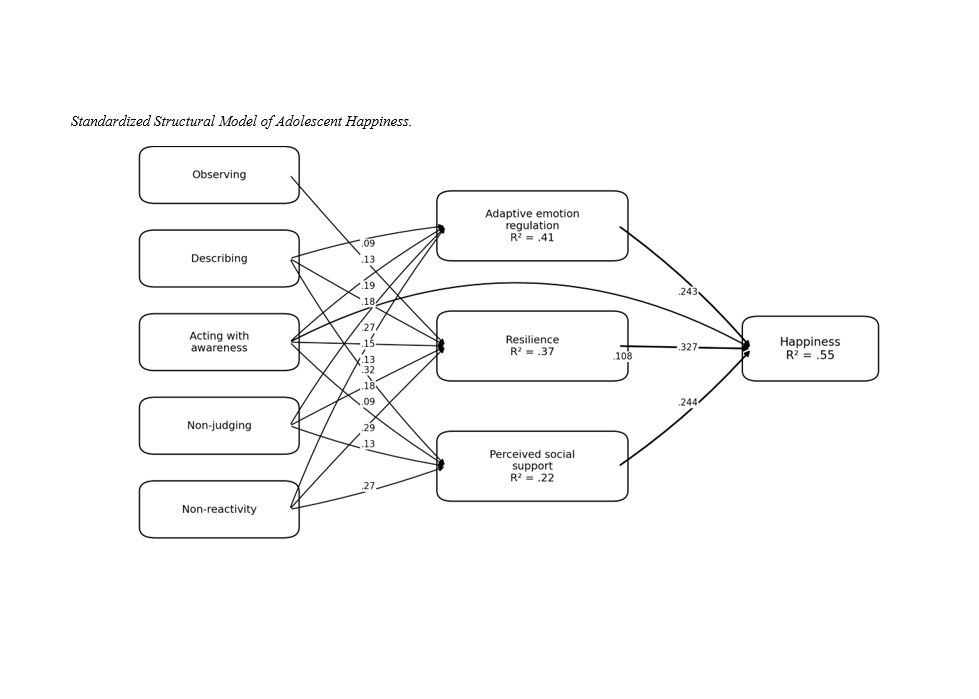
This study aimed to test a structural model of adolescent happiness based on the five facets of mindfulness and to examine the simultaneous mediating roles of adaptive emotion regulation, resilience, and perceived social support. A cross-sectional correlational design using structural equation modeling was employed. Participants were 604 adolescents aged 15–18 years enrolled in Grades 10–12 in public high schools in Tehran, Iran, who were selected through multistage cluster sampling. Data were collected using the Five Facet Mindfulness Questionnaire, Cognitive Emotion Regulation Questionnaire–Short Form, Connor–Davidson Resilience Scale, Multidimensional Scale of Perceived Social Support, and Oxford Happiness Questionnaire. Pearson correlations and an observed-variable structural equation model were used to examine direct and indirect associations. Indirect effects were evaluated using 2,000 bias-corrected bootstrap resamples. The hypothesized model demonstrated excellent fit, χ²(3) = 3.94, p = .269, CFI = .999, TLI = .993, RMSEA = .023, and SRMR = .009, and explained 55.5% of the variance in happiness. Resilience (β = .327, p < .001), perceived social support (β = .244, p < .001), and adaptive emotion regulation (β = .243, p < .001) independently predicted happiness. Non-reactivity was the strongest predictor of emotion regulation (β = .318), resilience (β = .291), and social support (β = .268), all p < .001, and showed the largest total indirect effect on happiness (β = .238, 95% CI [.193, .285]). Non-judging, Acting with Awareness, and Describing also showed significant indirect effects through all three mediators. Observing showed a significant total indirect effect primarily through resilience. After the mediators were included, only Acting with Awareness retained a significant direct effect on happiness (β = .108, p = .001). Adolescent happiness appears to be associated with distinct mindfulness facets through multiple psychological and interpersonal pathways, particularly resilience, adaptive emotion regulation, and perceived social support, with Non-reactivity emerging as the most influential indirect predictor.
Downloads
References
Ayllón-Negrillo, E., Salamanca-Villate, A., Cava, M. J., & Lascorz-Lozano, L. (2024). Resilience and social support as predictors of life satisfaction in preadolescents: A gender analysis. Current Psychology, 43, 18982-18991. https://doi.org/10.1007/s12144-024-05673-7
Azpiazu Izaguirre, L., Rodríguez Fernández, A., & Goñi Palacios, E. (2021). Adolescent life satisfaction explained by social support, emotion regulation, and resilience. Frontiers in psychology, 12, 694183. https://doi.org/10.3389/fpsyg.2021.694183
Buric, I., Zderić, L., Onicas, A., Kolanovic, M., & Collin, G. (2024). Psychological mechanisms and neural correlates of trait mindfulness in emotion regulation: Testing a novel approach to the monitor and acceptance theory. International Journal of Clinical and Health Psychology, 24, 100507. https://doi.org/10.1016/j.ijchp.2024.100507
Carneiro, B. D., & Pozza, D. H. (2025). Mindfulness in mental health and psychiatric disorders of children and adolescents: A systematic review and meta-analysis of randomized controlled trials. Pediatric Reports, 17(3), 59. https://doi.org/10.3390/pediatric17030059
D’Souza, F., & Smyth, L. (2025). The array of outcomes associated with mindfulness interventions in schools: A systematic review and meta-analysis. Mindfulness, 16, 2132-2155. https://doi.org/10.1007/s12671-025-02627-3
Diener, E., Oishi, S., & Tay, L. (2018). Advances in subjective well-being research. Nature Human Behaviour, 2, 253-260. https://doi.org/10.1038/s41562-018-0307-6
Garnefski, N., & Kraaij, V. (2006). Cognitive emotion regulation questionnaire—Development of a short 18-item version (CERQ-short). Personality and individual differences, 41(6), 1045-1053. https://doi.org/10.1016/j.paid.2006.04.010
Kline, R. B. (2023). Principles and practice of structural equation modeling (5 ed.). Guilford Press.
Lindsay, E. K., & Creswell, J. D. (2017). Mechanisms of mindfulness training: Monitor and Acceptance Theory (MAT). Clinical psychology review, 51, 48-59. https://doi.org/10.1016/j.cpr.2016.10.011
Mendola, E., Meuleman, B., Smith, M. M., Ivanova, V., Pham, E., & Savary, V. (2026). Mindfulness shapes emotion regulation in non-clinical adolescents: Secondary outcomes of a randomized controlled trial. Clinical Child Psychology and Psychiatry, 31(1), 195-211. https://doi.org/10.1177/13591045251377898
Miller-Chagnon, R. L., Shomaker, L. B., & Prince, M. A. (2024). The benefits of mindfulness training for momentary mindfulness and emotion regulation: A randomized controlled trial for adolescents exposed to chronic stressors. Journal of consulting and clinical psychology, 92(12), 800-813. https://doi.org/10.1037/ccp0000910
Navidi Moghadam, M. (2025). The effects of mindfulness training on resilience and emotional regulation in adolescents: A quasi-experimental study. International Journal of Body, Mind and Culture, 12(3), 166-173. https://doi.org/10.61838/ijbmc.v12i3.799
Piguet, C., Celen, Z., & Meuleman, B. (2025). Impact of a mindfulness-based intervention on symptoms and emotion regulation strategies in young adolescents from the general population: A randomized controlled trial. Depression and Anxiety, 2025, 2679049. https://doi.org/10.1155/da/2679049
Qvick, J., Hintsanen, M., & Vahlberg, T. (2026). Effect of a universal mindfulness program on well-being in adolescents: A cluster randomized controlled trial. Journal of Happiness Studies, 27, 17. https://doi.org/10.1007/s10902-025-01003-1
Scheepbouwer, V., Hanssen, I., Schuling, R., Huijbers, M. J., Collin, G., Westerhof, G. J., & Speckens, A. E. M. (2026). Change of self-schemas following mindfulness-based compassionate living for recurrent depression: A qualitative study. Acta Psychologica, 268, 107183. https://doi.org/10.1016/j.actpsy.2026.107183
Schepers, M., Lagerweij, P., Geurts, D., Krause, F., den Ouden, H., Cools, R., Speckens, A., & Collin, G. (2025). Promoting Resilience in Youth through Mindfulness mEditation (PRYME): Study protocol for a randomized controlled trial investigating the effects of mindfulness training as add-on to care-as-usual on internalizing problems, mental illness development, and associated brain and cognitive processes in help-seeking youth. BMC psychiatry, 25, 126. https://doi.org/10.1186/s12888-024-06430-7
Sharma, N., Agrawal, M., Rushi, Ayyub, S., & Rai, D. (2026). Mindfulness-based interventions for emotional dysregulation in adolescents: A systematic review. Annals of Neurosciences, 33(2), 259-267. https://doi.org/10.1177/09727531251355311
Zhou, W., & McLellan, R. (2024). The effectiveness of taught, self-help mindfulness-based interventions on Chinese adolescents’ well-being, mental health, prosocial and difficult behavior, and coping strategy. Applied Psychology: Health and Well-Being, 16(3), 1024-1045. https://doi.org/10.1111/aphw.12517
Downloads
Additional Files
Publication Timeline
- Submitted
- Revised
- Accepted