Feature Importance Ranking in Machine Learning Models Predicting Help-Seeking Intentions for Mental Health Issues in Women with High Public Self-Awareness
DOI:
https://doi.org/10.61838/kman.pwj.1351Keywords:
Machine Learning, Help-Seeking Intention, Public Self-Awareness, Mental Health Stigma, Women’s Mental HealthAbstract
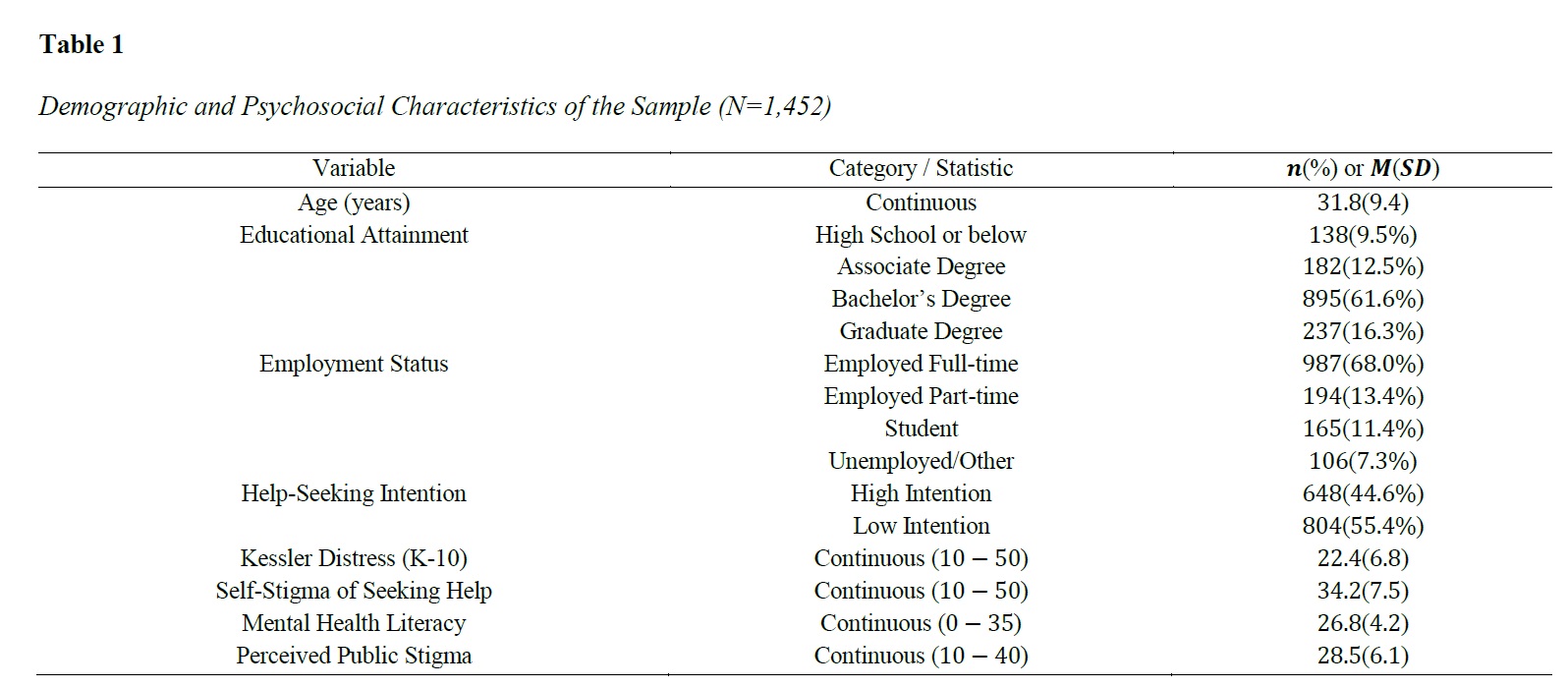
Objective: The objective of this study was to utilize machine learning algorithms to predict professional psychological help-seeking intentions and robustly rank the importance of various psychosocial and demographic features among Taiwanese women exhibiting high public self-awareness. Methods and Materials: This cross-sectional study recruited N=1,452Taiwanese women identified with high public self-awareness via purposive sampling. Data were collected using validated instruments translated into Traditional Chinese, including the Self-Consciousness Scale, the Mental Help Seeking Intention Scale, and the Kessler Distress Scale. The analytical pipeline was executed using Python (Scikit-learn and XGBoost libraries) for data preprocessing, model training, and performance evaluation across four algorithms (Logistic Regression, Support Vector Machine, Random Forest, and XGBoost). Finally, SHapley Additive exPlanations (SHAP) were employed to extract and rank the importance of each feature in the optimal predictive model. Findings: The participant cohort presented a mean age of 31.8years, with 77.9%holding at least a bachelor’s degree, and 44.6%demonstrating high intentions to seek professional psychological help. The XGBoost algorithm achieved superior predictive performance on the test set compared to traditional models, yielding an Area Under the Curve (AUC) of 0.91. SHAP value analysis identified “Self-Stigma of Seeking Help” (Mean ∣SHAP∣=1.24) and “Perceived Public Stigma” (Mean ∣SHAP∣=0.98) as the most paramount negative predictors paralyzing help-seeking intentions, whereas “Mental Health Literacy” (Mean ∣SHAP∣=0.85) emerged as the strongest positive predictor mitigating these barriers. Conclusion: Internalized and public stigma profoundly override clinical need and demographic factors in highly self-aware women, necessitating the implementation of highly confidential, low-barrier mental health interventions that circumvent the fear of social evaluation.
Downloads
References
Apatinga, G. A., & Tenkorang, E. Y. (2021). Barriers to Help-Seeking for Sexual Violence Among Married or Cohabiting Women in Ghana. Violence Against Women, 28(15-16), 3844-3864. https://doi.org/10.1177/10778012211060861
Banasova, R., Noskova, E., Vodickova, R., Hasto, J., & Sebela, A. (2023). Emotional difficulties, coping strategies, and help-seeking patterns among Czech perinatal women. Midwifery, 116, 103526. https://doi.org/10.1016/j.midw.2022.103526
Boyd‐Bais, R. L., & Papps, F. A. (2025). Correlates of Mental Health Help-Seeking Attitudes Among Farming and Nonfarming Rural Women. Rural Mental Health, 49(1), 10-20. https://doi.org/10.1037/rmh0000277
Brockdorf, A. N., Holland, K. J., Kumar, S. A., Jaffe, A. E., & DiLillo, D. (2022). Alcohol Use Before Sexual Violence and Cognitive Appraisals: Differential Associations With Barriers to Help-Seeking. Violence Against Women, 29(5), 777-799. https://doi.org/10.1177/10778012221097144
Cacciola, E., & Psouni, E. (2020). Insecure Attachment and Other Help-Seeking Barriers Among Women Depressed Postpartum. International journal of environmental research and public health, 17(11), 3887. https://doi.org/10.3390/ijerph17113887
Fischbein, R., Cook, H., Baughman, K. R., & Díaz, S. (2022). Using Machine Learning to Predict Help-Seeking Among 2016–2018 Pregnancy Risk Assessment Monitoring System Participants With Postpartum Depression Symptoms. Women S Health, 18. https://doi.org/10.1177/17455057221139664
Harper, S. B. (2021). “I'm Just Like, You Know What, It’s Now or Never”: Exploring How Women of Color Experiencing Severe Abuse and Homicide Risk Journey Toward Formal Help-Seeking. Journal of interpersonal violence, 37(15-16), NP13729-NP13765. https://doi.org/10.1177/08862605211005150
Hereth, J. (2021). “Where Is the Safe Haven?” Transgender Women’s Experiences of Victimization and Help-Seeking Across the Life Course. Feminist Criminology, 16(4), 461-479. https://doi.org/10.1177/15570851211010951
Kamal, R., Inayat, A., Khan, R., Mushtaq, A., & Masoom, K. (2025). Prevalence, Awareness, and Help-Seeking Behavior Regarding Antenatal Depression Among Pregnant Women in Quetta: A Cross-Sectional Study. JHWCR, 1-6. https://doi.org/10.61919/g6hcc527
Lin, C. Y., Broström, A., Årestedt, K., Mårtensson, J., Steinke, E. E., & Pakpour, A. H. (2020). Using Extended Theory of Planned Behavior to Determine Factors Associated with Help-Seeking Behavior of Sexual Problems in Women with Heart Failure: A Longitudinal Study. Journal of Psychosomatic Obstetrics & Gynecology, 41(1), 54-61. https://doi.org/10.1080/0167482X.2019.1572743
Masuda, A., Goodnight, B. L., Ng, S. Y., Schaefer, L. W., Tully, E. C., Chan, W. Y., & Drake, C. E. (2017). Help-Seeking Stigma in Asian American College Women: the Role of Disordered Eating Cognitions and Psychological Inflexibility. International Journal for the Advancement of Counselling, 39(2), 188-201. https://doi.org/10.1007/s10447-017-9291-1
Nelson, T., Gebretensay, S. B., Sellers, A. M., & Moreno, O. (2024). Contextualizing Help-Seeking Attitudes and Help-Seeking Intention: The Role of Superwoman Schema Among Black College Women. Journal of Racial and Ethnic Health Disparities. https://doi.org/10.1007/s40615-024-02075-0
Petty, S. (2020). Women's experience of perinatal anxiety and help-seeking in the context of the COVID-19 pandemic http://hdl.handle.net/1993/37632
Place, J. M., Renbarger, K. M., Griend, K. V. D., Guinn, M., Wheatley, C., & Holmes, O. (2024). Barriers to Help-Seeking for Postpartum Depression Mapped Onto the Socio-Ecological Model and Recommendations to Address Barriers. Frontiers in Global Women S Health, 5. https://doi.org/10.3389/fgwh.2024.1335437
Rohn, E., & Tenkorang, E. Y. (2022). Motivations and Barriers to Help-Seeking Among Female Victims of Intimate Partner Violence in Ghana. Violence Against Women, 30(2), 524-550. https://doi.org/10.1177/10778012221137924
Silva, S., Canavarro, M. C., & Fonseca, A. (2018). Why Women Do Not Seek Professional Help for Anxiety and Depression Symptoms During Pregnancy or Throughout the Postpartum Period? Barriers and Facilitators of the Help-Seeking Process. The Psychologist Practice & Research Journal, 1(1), 58. https://doi.org/10.33525/pprj.v1i1.17
Sultana, R., Husain, N., Allen, O., & Taylor, P. (2024). Barriers and Facilitators for Help-Seeking Behaviors in British South Asian Women Who Have Experienced Domestic Violence: A Qualitative Study. Families in Society the Journal of Contemporary Social Services. https://doi.org/10.1177/10443894241272176
Sultana, R., Özen‐Dursun, B., Femi-Ajao, O., Husain, N., Varese, F., & Taylor, P. (2022). A Systematic Review and Meta-Synthesis of Barriers and Facilitators of Help-Seeking Behaviors in South Asian Women Living in High-Income Countries Who Have Experienced Domestic Violence: Perception of Domestic Violence Survivors and Service Providers. Trauma Violence & Abuse, 24(5), 3187-3204. https://doi.org/10.1177/15248380221126189
Ussher, J. M., & Perz, J. (2017). Evaluation of the relative efficacy of a couple cognitive-behaviour therapy (CBT) for Premenstrual Disorders (PMDs), in comparison to one-to-one CBT and a wait list control: A randomized controlled trial. PLoS One, 12(4), e0175068. https://doi.org/10.1371/journal.pone.0175068
Win, A. M. M. (2025). Exploring Influencing Factors on Help-Seeking Behaviors for Intimate Partner Violence: Insights From Ethnic Women Survivors in Myanmar. International journal of environmental research and public health, 22(6), 899. https://doi.org/10.3390/ijerph22060899
Wright, A., Kalogeropoulos, D., & Mata, G. (2025). Factors Influencing Help-Seeking Behavior in Women With Postpartum Depression. PWJ, 6(3), 1-9. https://doi.org/10.61838/kman.pwj.6.3.6
Xiao, M., Huang, S., Tang, G., Hu, Y., & Lei, J. (2025). Status and Perceived Barriers of Psychological Help-Seeking Behaviors for Perinatal Depressive Symptoms Among Chinese Women: A Cross-Sectional Study. Journal of Psychosocial Nursing and Mental Health Services, 1-10. https://doi.org/10.3928/02793695-20250416-01
Downloads
Additional Files
Publication Timeline
- Submitted
- Revised
- Accepted