The Effectiveness of Group Logotherapy on Developmental Challenges in Middle-Aged Married Women
DOI:
https://doi.org/10.61838/kman.pwj.6.2.5Keywords:
Group Training, Logotherapy, Developmental Challenges of Middle Age, Married WomenAbstract
Objective: The present study aimed to examine the effectiveness of group logotherapy on developmental challenges in middle-aged married women.
Methods and Materials: Methodologically, this research employed a quasi-experimental design with a pre-test, post-test, and a control group. The statistical population consisted of middle-aged married women aged 40 to 65 years, residing in a 300-unit residential complex in District 2 of Tehran. A total of 30 participants were selected through convenience sampling and voluntary participation. The selected participants were randomly assigned to experimental and control groups, each consisting of 15 individuals. The experimental group received an eight-session intervention based on the logotherapy protocol within the framework of Schulenberg’s (2010) logotherapy model, while the control group received no intervention. Data collection was conducted using the Middle-Aged Developmental Challenges Questionnaire (Ali Roozbehani & Mahnaz Ali Akbar Dehkordi, 2017), which was administered as both a pre-test and post-test to both experimental and control groups. The data were analyzed using the Statistical Package for the Social Sciences (SPSS) version 26. In the descriptive analysis section, statistical indices such as mean and standard deviation were employed. Additionally, to assess the normality of research variables, the skewness and kurtosis test was used, while Levene’s test was applied to examine the homogeneity of variances. In the inferential statistics section, univariate and multivariate analysis of covariance (ANCOVA) was utilized to compare the mean scores of the experimental and control groups while controlling for the effect of pre-test scores.
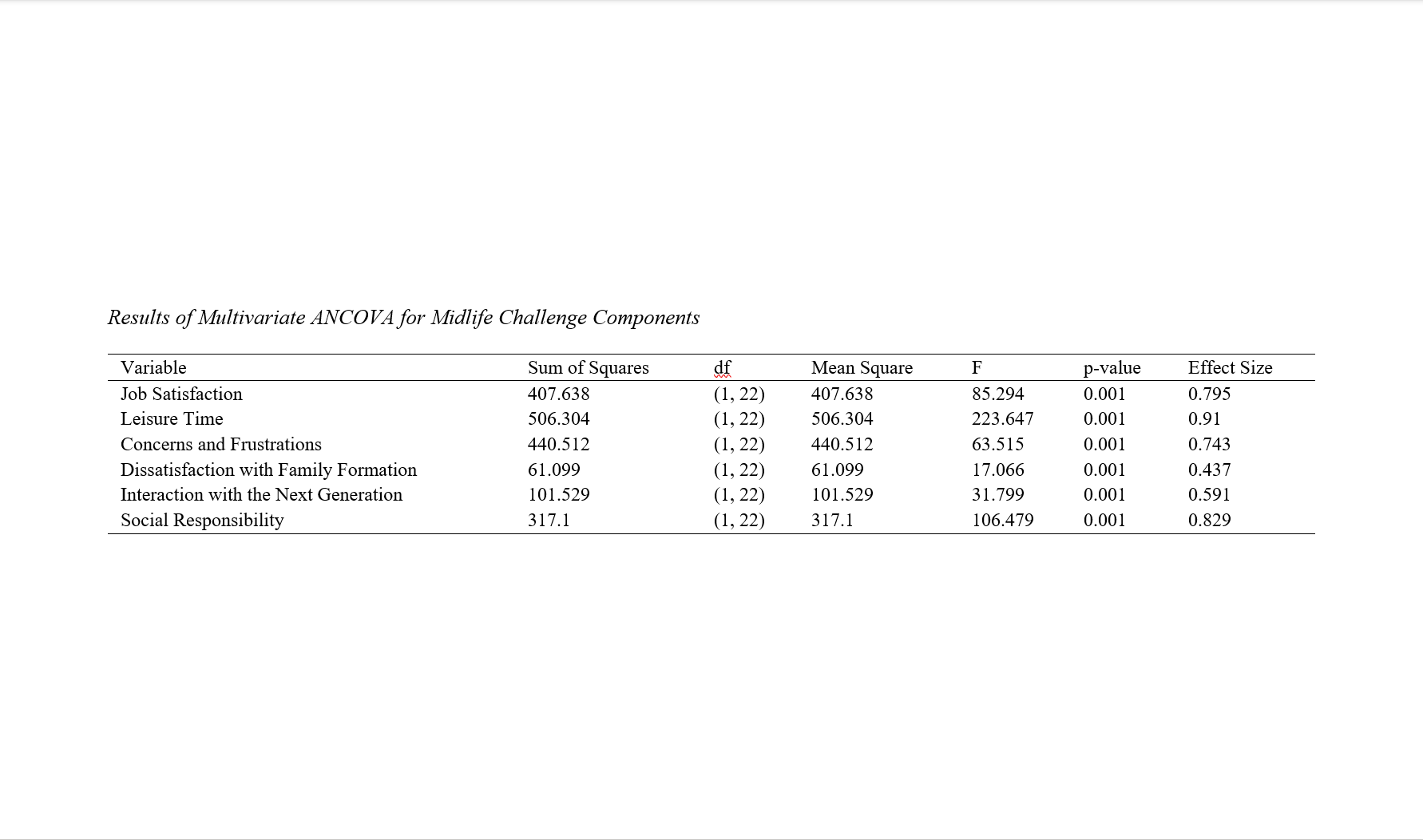
Findings: The findings indicated that group logotherapy had a significant impact on the developmental challenges of middle-aged married women and its components.
Conclusion: Group logotherapy significantly reduces midlife challenges in married women, improving their psychological well-being, adaptation to midlife crises, and enhancing life satisfaction by promoting meaning-seeking and responsibility.
Downloads
References
Asadolahi, A., Sajjadi, S. H., Nikaeen, Z., & Zarei, A. (2023). Designing a model of physical activity of Iranian women in leisure time at different stages of life. Strategic Studies on Youth and Sports, 22(60), 9-32. https://faslname.msy.gov.ir/article_682.html?lang=en
Chan, W. C. H. (2024). Applying Logotherapy in teaching meaning in life in professional training and social work education. The British Journal of Social Work, 54(1), 77-94. https://doi.org/10.1093/bjsw/bcad181
Čolović, M., Gadžić, A., Ilić, R., & Petrović, M. (2020). Physical activity as one of the most optimal ways of active fatigue elimination and overcoming midlife crisis. Facta Universitatis, Series: Physical Education and Sport(1), 239-247. https://doi.org/10.22190/FUPES190630021C
Costello, S. J. (2015). The spirit of logotherapy. Religions, 7(1), 3. https://doi.org/10.3390/rel7010003
Diah, N. M. (2019). Physical changes as part of midlife crisis: The case of urban Malay women. Jurnal Sains Sosial, 3(1), 67-76. http://unimel.edu.my/journal/index.php/JSS/article/view/465
Dieser, R. B. (2023). A Logotherapy Meaning-Centered Approach to Therapeutic Recreation Rooted in Centripetal Leisure. Therapeutic Recreation Journal, 57(1). https://js.sagamorepub.com/index.php/trj/article/view/11128
Dunaeva, V. (2020). Women and men in midlife crisis. PEOPLE: International Journal of Social Sciences, 6(2), 436-443. https://doi.org/10.20319/pijss.2020.62.436443
Etaugh, C. (2018). Midlife transitions. https://psycnet.apa.org/record/2017-45479-025
Fatchurahman, M., Setiawan, M. A., & Karyanti, K. (2023). Intervention group logotherapy and performance measures for reducing phubbing in Generation Z. Estudos De Psicologia (Campinas), 40, e200244. https://doi.org/10.1590/1982-0275202340e200244
Freund, A. M., & Ritter, J. O. (2009). Midlife crisis: A debate. Gerontology, 55(5), 582-591. https://doi.org/10.1159/000227322
Giuntella, O., McManus, S., Mujcic, R., Oswald, A. J., Powdthavee, N., & Tohamy, A. (2023). The midlife crisis. Economica, 90(357), 65-110. https://doi.org/10.1111/ecca.12452
Infurna, F. J., Gerstorf, D., & Lachman, M. E. (2020). Midlife in the 2020s: Opportunities and challenges. American psychologist, 75(4), 470. https://doi.org/10.1037/amp0000591
Infurna, F. J., Staben, O. E., Gardner, M. J., Grimm, K. J., & Luthar, S. S. (2023). The accumulation of adversity in midlife: Effects on depressive symptoms, life satisfaction, and character strengths. Psychology and Aging, 38(3), 230. https://doi.org/10.1037/pag0000725
Kiesow, H., Uddin, L. Q., Bernhardt, B. C., Kable, J., & Bzdok, D. (2021). Dissecting the midlife crisis: disentangling social, personality and demographic determinants in social brain anatomy. Communications Biology, 4(1), 728. https://doi.org/10.1038/s42003-021-02206-x
Kwee, J., & Längle, A. (2019). Challenges and New Developments in Logotherapy and Existential Analysis The Wiley World Handbook of Existential Therapy. https://doi.org/10.1002/9781119167198.ch24
Längle, A. (2019). The history of logotherapy and existential analysis The Wiley World Handbook of Existential Therapy. https://doi.org/10.1002/9781119167198.ch19
Lymankina, A. (2023). Psychological features of women's codependency during the midlife crisis. Sci Bull Mukach State Univer Ser Ped Psychol, 9, 80-86. https://pp-msu.com.ua/en/journals/tom-9-1-2023/psikhologichni-risi-spivzalezhnosti-zhinok-u-period-krizi-serednogo-viku
Mihandoust, S., Radfar, M., & Soleymani, M. (2021). Logotherapy to improve parent-child relationship among mothers of autistic children: a randomized clinical trial. European Review of Medical and Pharmacological Sciences, 25(21), 6642-6651. https://pubmed.ncbi.nlm.nih.gov/34787868/
Miraclin, M., & Nizam, S. P. (2023). Midlife Crisis Research and Its Relation to Depression and Psychological Capital Research. Latin American Journal of Pharmacy: A Life Science Journal, 42(10), 211-220. https://scholar.google.com/citations?view_op=view_citation&hl=en&user=z90vKfwAAAAJ&citation_for_view=z90vKfwAAAAJ:d1gkVwhDpl0C
Otterbach, S., Sousa-Poza, A., & Møller, V. (2018). A cohort analysis of subjective well-being and ageing: heading towards a midlife crisis? Longitudinal and Life Course Studies, 9(4), 382-411. https://doi.org/10.14301/llcs.v9i4.509
Parker, G. (2022). In search of logotherapy. Australian & New Zealand Journal of Psychiatry, 56(7), 742-744. https://doi.org/10.1177/00048674211062830
Rahgozar, S., & Giménez-Llort, L. (2020). Foundations and Applications of Logotherapy to Improve Mental Health of Immigrant Populations in the Third Millennium. Frontiers in Psychiatry. https://www.frontiersin.org/journals/psychiatry/articles/10.3389/fpsyt.2020.00451/full
Riethof, N., & Bob, P. (2019). Burnout syndrome and logotherapy: Logotherapy as a useful conceptual framework for explanation and prevention of burnout. Frontiers in Psychiatry, 10, 382. https://doi.org/10.3389/fpsyt.2019.00382
Schulenberg, S. E., Hutzell, R. R., Nassif, C., & Rogina, J. M. (2008). Logotherapy for clinical practice. Psychotherapy (Chic), 45(4), 447-463. https://doi.org/10.1037/a0014331
Sharaf, R. (2021). Explaining the Necessity of Philosophical Counseling in Logotherapy. Philosophical Investigations, 15(34). https://philpapers.org/rec/SHAETN-5
Sun, F. K., Chiu, N. M., Yao, Y., Wu, M. K., Hung, C. F., Chen, C. C., Lee, Y. H., & Chiang, C. Y. (2022). The effects of logotherapy on meaning in life, depression, hopelessness, and suicidal ideation, in patients with depression: An intervention study. Perspectives in psychiatric care, 58(4), 1891-1899. https://doi.org/10.1111/ppc.13003
Thomas, A. J., Mitchell, E. S., & Woods, N. F. (2018). The challenges of midlife women: themes from the Seattle midlife women's health study. https://doi.org/10.1186/s40695-018-0039-9
Wolfram, H. J. (2023). Meaning in life, life role importance, life strain, and life satisfaction. Current Psychology, 42(34), 29905-29917. https://doi.org/10.1007/s12144-022-04031-9
Yang, X., Zhang, P., Jing, S., Cheng, Y., & Cavaletto, A. (2024). Logotherapy-Based Interventions for Chinese Family Caregivers of Older Adults with Dementia Through Online Groups: A Mixed-Methods Study. Journal of Gerontological Social Work, 1-16. https://doi.org/10.1080/01634372.2024.2326689
Yıldız, H. V. (2023). The Impact of the Logotherapy-Based Spiritually Oriented Group Counseling on Meaning in Life and Multi-Measure Agentic Personality Levels of Emerging Adults. Spiritual Psychology and Counseling, 8(1), 27-45. https://doi.org/10.37898/spc.2023.8.1.184
Downloads
Additional Files
Publication Timeline
- Submitted
- Revised
- Accepted
Issue
Section
License
Copyright (c) 2025 Solmaz Masiha (Author); Afsaneh Khodayari Moghadam (Corresponding Author)

This work is licensed under a Creative Commons Attribution-NonCommercial 4.0 International License.