Causal Discovery Methods to Map the Longitudinal Relationship Between Workplace Microaggressions, Social Support Networks, and Leadership Efficacy in Women
DOI:
https://doi.org/10.61838/kman.pwj.3719Keywords:
Workplace Microaggressions, Social Support Networks, Leadership EfficacyAbstract
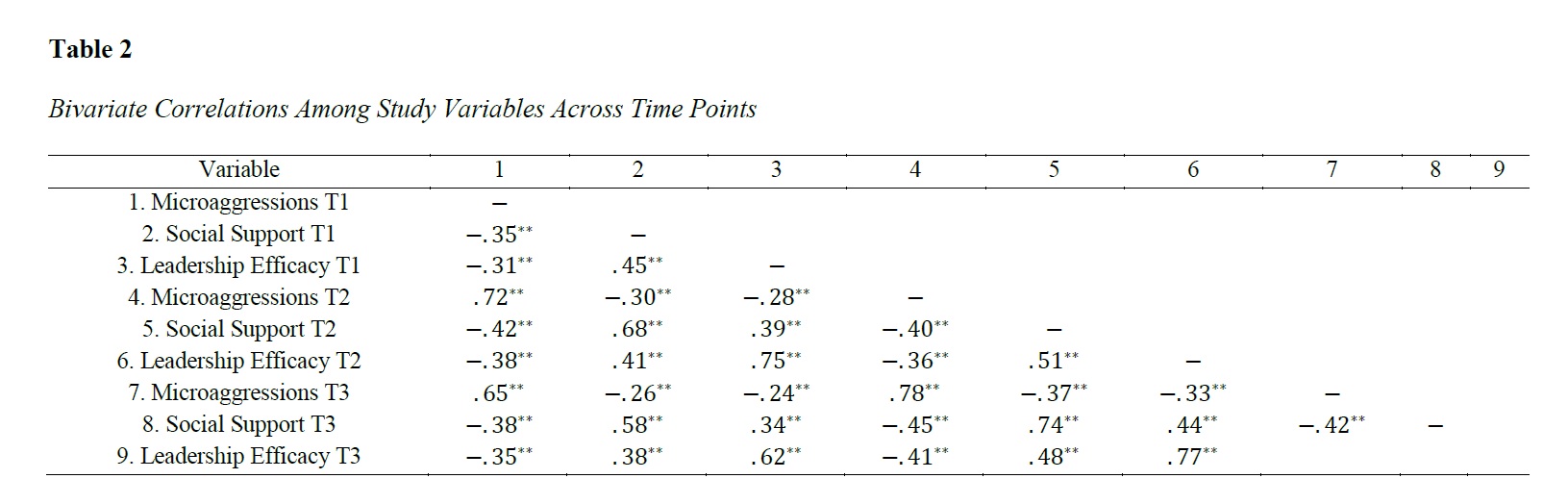
Objective: The objective of this study is to utilize advanced causal discovery methods on three-wave longitudinal data to precisely map the temporal and structural relationships between workplace microaggressions, the subsequent erosion of social support networks, and the resulting decline in leadership efficacy among professional women. Methods and Materials: This study employed a three-wave longitudinal panel design over a one-year period, collecting data from a sample of 482 professional and managerial women in Mexico. Validated self-report surveys were administered at three distinct time points, each separated by a 6-month interval, to capture the temporal dynamics of the psychological and interpersonal constructs. To transition beyond traditional correlational associations and establish structural directionality, the Peter-Clark (PC) causal discovery algorithm was utilized alongside robust bootstrapping techniques on the R statistical platform, supplemented by formal mediation analysis to quantify indirect pathways. Findings: The causal discovery algorithm successfully identified a robust, fully mediated indirect pathway, eliminating the direct long-term path between early hostilities and later leadership confidence. Specifically, exposure to workplace microaggressions at Time 1significantly eroded social support networks at Time 2, a directed causal edge that was retained in 92.4%of the bootstrap samples. Subsequently, this diminished social support at Time 2directly reduced leadership efficacy at Time 3, a structural path present in 88.7%of the bootstrap samples. Formal mediation analysis confirmed that social support networks act as a significant and critical mediating mechanism in this detrimental dynamic, yielding a standardized indirect effect of -0.046. Conclusion: Subtle workplace hostilities do not merely cause immediate distress, but structurally dismantle the professional social support networks fundamentally required to sustain and cultivate women’s leadership efficacy over time.
Downloads
References
Awom, T. E. S., & Komboy, M. N. I. (2025). Gender Inequality in Women Leadership of Public Sector Institutions in Papua, Indonesia. International Journal of Social Science, 4(5), 589-594. https://doi.org/10.53625/ijss.v4i5.9707
Ayat, M., Mollaei, E., Javanfekr, E., & Shafiee, S. (2020). A Study of Relationship Between Managerial Roles and Personality Traits of Women in Islamic Teachings. Women's Studies Sociological and Psychological, 18(4), 201-238. https://doi.org/10.22051/jwsps.2021.32839.2283
Barua, B., Larios Arias, A. M., & Robinson, C. M. (2023). Women Social Entrepreneurs: A Conceptual Model Based on Collaborative and Authentic Leadership Styles. Entrepren Organiz Manag, 12, 440. https://www.researchgate.net/publication/378178894_Women_Social_Entrepreneurs_a_Conceptual_Model_Based_on_Collaborative_and_Authentic_Leadership_Styles
Bhatti, A., & Ali, R. (2020). Gender, Culture and Leadership: Learning From the Experiences of Women Academics in Pakistani Universities. Journal of Education & Social Sciences, 8(2), 16-32. https://doi.org/10.20547/jess0822008202
Bonifacio, L., Gushue, G. V., & Mejia-Smith, B. X. (2018). Microaggressions and Ethnic Identity in the Career Development of Latina College Students. The counseling psychologist, 46(4), 505-529. https://doi.org/10.1177/0011000018776909
Browning, M. E., Lloyd‐Richardson, E. E., Satterfield, S. L., & Trisal, A. V. (2023). A Pilot Study of Experiencing Racial Microaggressions, Obsessive-Compulsive Symptoms, and the Role of Psychological Flexibility. Behavioural and Cognitive Psychotherapy, 51(5), 396-413. https://doi.org/10.1017/s1352465823000188
Carone, N., Innocenzi, E., & Lingiardi, V. (2025). Microaggressions and Dropout When Working With Sexual Minority Parents in Clinical Settings: The Working Alliance as a Mediating Mechanism. Psychology of Sexual Orientation and Gender Diversity, 12(1), 113-122. https://doi.org/10.1037/sgd0000651
Cherry, M., & Wilcox, M. M. (2020). Sexist Microaggressions: Traumatic Stressors Mediated by Self-Compassion. The counseling psychologist, 49(1), 106-137. https://doi.org/10.1177/0011000020954534
Constantine, M. G. (2007). Racial Microaggressions Against African American Clients in Cross-Racial Counseling Relationships. Journal of counseling psychology. https://doi.org/10.1037/0022-0167.54.1.1
Darvin, L., Hancock, M. G., & Williams, S. (2021). Perceptions of the Sport Leadership Labyrinth Through the Career Pathways of Intercollegiate Women Administrators. Sn Social Sciences, 1(12). https://doi.org/10.1007/s43545-021-00289-1
Gordon, R. (2020). Transformative Grassroots Leadership: Understanding the Role of Rojiroti’s Women Leaders in Supporting Social Change. Politics and Governance, 8(4), 180-190. https://doi.org/10.17645/pag.v8i4.3560
Harini, S. (2019). The Role of Women'S Transformative Political Leadership in Deconstructing Patriarchy During Covid-19 Pandemic. Journal of Gender and Social Inclusion in Muslim Societies, 1(1), 1-12. https://scholar.archive.org/work/dk6y3agrlnfk5iolpx7hgmsgve/access/wayback/http://jurnal.uinsu.ac.id/index.php/psga/article/download/10954/5048
Hariri, S. (2020). The influence of women's leadership style and competence in decision-making management of organizations. The Fifth International Conference on Management, Accounting, Economics and Social Sciences, Hamedan.
Harwiki, W. (2015). The Impact of Servant Leadership on Organization Culture, Organizational Commitment, Organizational Citizenship Behavior (OCB) and Employee Performance in Women Cooperatives. Procedia - Social and Behavioral Sciences, 219, 283-290. https://doi.org/10.1016/j.sbspro.2016.04.032
Johnson, N. N. (2019). Microaggressions and Implicit Bias in the Workplace. https://doi.org/10.13140/rg.2.2.13716.24967
Kim, S., Kantamneni, N., Ridzuan, N. H. A., & Miramonti, A. A. (2024). Work-Family Conflict and Burnout for Mothers of Color: Exploring the Role of Microaggressions and Gender Role Beliefs. Journal of Career Assessment. https://doi.org/10.1177/10690727241307957
Lomash, E. F., Brown, T. D., & Galupo, M. P. (2018). "A WholeBunch of Love the Sinner Hate the Sin": LGBTQ Microaggressions experienced in religious and spiritual context. Journal ofHomosexuality, 66(10), 1-17. https://doi.org/10.1080/00918369.2018.1542204
Meade, M. R., & Lund, E. M. (2024). The Impact of Ableist Microaggressions on Identity Formation Among Adults With Disabilities. Rehabilitation Counselors and Educators Journal, 13(2). https://doi.org/10.52017/001c.123807
Neumeyer, X., Santos, S. C., & Morris, M. H. (2019). Who is left out: exploring social boundaries in entrepreneurial ecosystems. The Journal of Technology Transfer, 44(2), 462-484. https://doi.org/10.1007/s10961-018-9694-0
Perkins, T. R., & Durkee, M. I. (2025). Impostor Phenomenon Among Black Undergraduates: Contributions of Microaggressions, Gender, and School Belonging. Cultural Diversity and Ethnic Minority Psychology, 31(4), 637-648. https://doi.org/10.1037/cdp0000694
Shahabi, S., Maharlouei, N., Joulaei, H., & Bagheri Lankarani, K. (2021). Improving the Women's Mental Health Status in Iran: A Policy Brief. Sadra Medical Journal, 9(3), 325-332. https://doi.org/10.30476/smsj.2021.84945.1099
Sinyosi, L. B., & Potokri, O. C. (2021). Women in Leadership: Insights From Female Principals of Rural Secondary Schools in Vhembe District of South Africa. Pertanika Journal of Social Sciences and Humanities, 29(3). https://doi.org/10.47836/pjssh.29.3.10
Walker, V. P., Hodges, L. M., Perkins, M., Sim, M. S., & Harris, C. (2022). Taking the VITALS to Interrupt Microaggressions. Mededportal. https://doi.org/10.15766/mep_2374-8265.11202
Watton, E., Stables, S., & Kempster, S. (2019). How Job Sharing Can Lead to More Women Achieving Senior Leadership Roles in Higher Education: A UK Study. Social Sciences. https://doi.org/10.3390/socsci8070209
Zhang, Y., & Rios, K. (2022). Exploring the Effects of Promoting Feminine Leaders on Women’s Interest in STEM. Social Psychological and Personality Science, 14(1), 40-50. https://doi.org/10.1177/19485506211069808
Downloads
Additional Files
Publication Timeline
- Submitted
- Revised
- Accepted