Fear of Abandonment as a Mediator Between Attachment Trauma and Conflict Sensitivity in Romantic Relationships among Women
DOI:
https://doi.org/10.61838/Keywords:
Attachment trauma, fear of abandonment, conflict sensitivity, romantic relationshipsAbstract
Objective: This study aimed to investigate whether fear of abandonment mediates the relationship between attachment trauma and conflict sensitivity in romantic relationships among women.
Methods and Materials: A descriptive correlational design was used, and the study sample consisted of 505 women from Poland, selected based on the Morgan and Krejcie table. Participants completed validated self-report measures assessing attachment trauma, fear of abandonment, and conflict sensitivity. Data were analyzed using SPSS-27 for Pearson correlation and AMOS-21 for Structural Equation Modeling (SEM). Assumptions of normality, linearity, homoscedasticity, and multicollinearity were tested and confirmed prior to analysis.
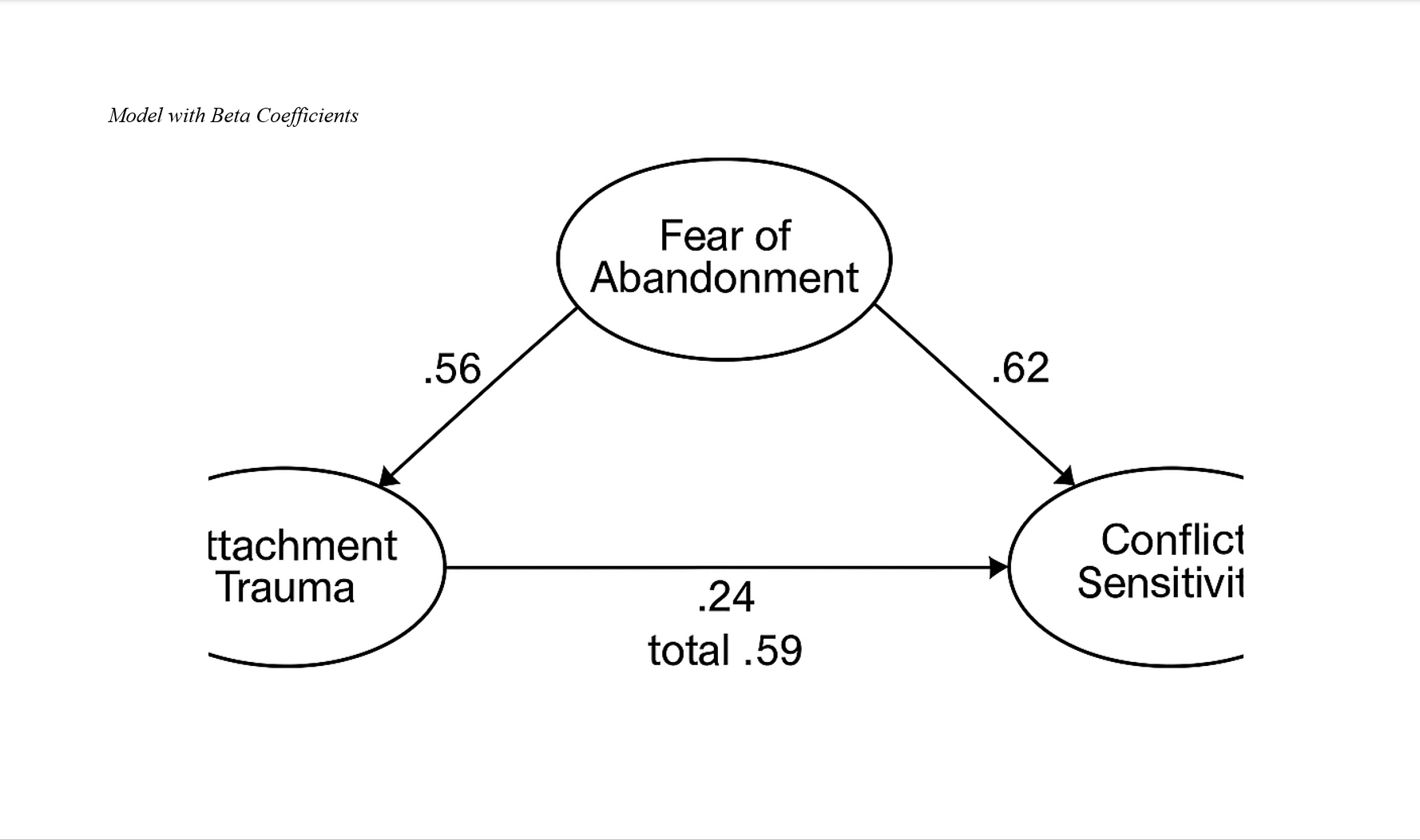
Findings: Results from Pearson correlation showed significant positive associations between attachment trauma and fear of abandonment (r = .56, p < .001), attachment trauma and conflict sensitivity (r = .49, p < .001), and fear of abandonment and conflict sensitivity (r = .62, p < .001). SEM analysis revealed that the structural model had an acceptable fit (χ²(46) = 98.35, χ²/df = 2.14, CFI = 0.96, RMSEA = 0.047). Attachment trauma significantly predicted fear of abandonment (β = 0.56, p < .001), which in turn significantly predicted conflict sensitivity (β = 0.62, p < .001). The direct path from attachment trauma to conflict sensitivity was also significant (β = 0.24, p < .001), and the indirect effect through fear of abandonment (β = 0.35, p < .001) indicated partial mediation. The total effect of attachment trauma on conflict sensitivity was β = 0.59 (p < .001).
Conclusion: The findings suggest that fear of abandonment partially mediates the relationship between attachment trauma and conflict sensitivity in romantic relationships among women. These results highlight the importance of addressing abandonment-related fears in therapeutic settings to mitigate the emotional impact of past trauma on adult romantic functioning.
Downloads
References
Bélanger, J. J., Collier, K. E., Nisa, C. F., & Schumpe, B. M. (2021). Crimes of Passion: When Romantic Obsession Leads to Abusive Relationships. Journal of personality, 89(6), 1159-1175. https://doi.org/10.1111/jopy.12642
Berenji, S. (2020). Sadat and the Road to Jerusalem: Bold Gestures and Risk Acceptance in the Search for Peace. International Security, 45(1), 127-163. https://doi.org/10.1162/isec_a_00381
Choi, S.-S., & Kweon, H. (2023). The Mediating Effects of Mentalization in the Effect of Chilhood Attachment Trauma on Self-Injury in Female Adolescent. The Association of Korea Counseling Psychology Education Welfare, 10(6), 237-249. https://doi.org/10.20496/cpew.2023.10.6.237
DiClemente, R. J., Wingood, G. M., Rose, E., Sales, J. M., & Crosby, R. A. (2010). Evaluation of an HIV/STD Sexual Risk-Reduction Intervention for Pregnant African American Adolescents Attending a Prenatal Clinic in an Urban Public Hospital: Preliminary Evidence of Efficacy. Journal of Pediatric and Adolescent Gynecology, 23(1), 32-38. https://doi.org/10.1016/j.jpag.2009.05.003
Dijke, A. v., Hopman, J. A. B., & Ford, J. D. (2018). Affect Dysregulation, Psychoform Dissociation, and Adult Relational Fears Mediate the Relationship Between Childhood Trauma and Complex Posttraumatic Stress Disorder Independent of the Symptoms of Borderline Personality Disorder. European Journal of Psychotraumatology, 9(1). https://doi.org/10.1080/20008198.2017.1400878
Helms, C. B., Turan, J. M., Atkins, G. C., Kempf, M.-C., Clay, O. J., Raper, J. L., Mugavero, M. J., & Turan, B. (2016). Interpersonal Mechanisms Contributing to the Association Between HIV-Related Internalized Stigma and Medication Adherence. AIDS and Behavior, 21(1), 238-247. https://doi.org/10.1007/s10461-016-1320-2
Jahanzeb, S., Bouckenooghe, D., & Baig, M. U. A. (2022). Does Attachment Anxiety Accentuate the Effect of Perceived Contract Breach on Counterproductive Work Behaviors? Journal of Applied Social Psychology, 52(9), 809-822. https://doi.org/10.1111/jasp.12879
Jalili, M., Saadi, Z. E., Pasha, R., Asgari, P., & Hafezi, F. (2022). Comparing the Effectiveness of Imago-Therapy and Transactional Analysis in Improving Communication Skills, Conflict Resolution and Rejection Sensitivity of Couples Referred to Masjed Soleiman Counseling Centers. Journal of counseling research. https://doi.org/10.18502/qjcr.v21i81.9493
Lee, J. Y., & Kim, M. (2012). The Impact of Marital Conflict Between Parent as Perceived by Adolescents on Their Depression and Aggression: Focusing on the Mediating Effects of Shame and Fear of Abandonment. Journal of Asia Pacific Counseling, 2(1), 121-131. https://doi.org/10.18401/2012.2.1.8
Macfie, J., & Kurdziel, G. (2020). The Experience of Maltreatment in Young Children Whose Mothers Have Borderline Personality Disorder: Reflections in Their Narrative Representations. Journal of personality disorders, 34(6), 750-763. https://doi.org/10.1521/pedi_2019_33_407
Macfie, J., Swan, S. A., Fitzpatrick, K. L., Watkins, C. D., & Rivas, E. M. (2014). Mothers With Borderline Personality and Their Young Children: Adult Attachment Interviews, Mother–child Interactions, and Children's Narrative Representations. Development and Psychopathology, 26(2), 539-551. https://doi.org/10.1017/s095457941400011x
Miano, A., Fertuck, E. A., Arntz, A., & Stanley, B. (2013). Rejection Sensitivity Is a Mediator Between Borderline Personality Disorder Features and Facial Trust Appraisal. Journal of personality disorders, 27(4), 442-456. https://doi.org/10.1521/pedi_2013_27_096
O’Hara, K. L., Rhodes, C. A., Wolchik, S. A., Sandler, I. N., & Yun‐Tein, J. (2021). Longitudinal Effects of PostDivorce Interparental Conflict on Children’s Mental Health Problems Through Fear of Abandonment: Does Parenting Quality Play a Buffering Role? Child development, 92(4), 1476-1493. https://doi.org/10.1111/cdev.13539
O’Hara, K. L., Wolchik, S. A., Rhodes, C. A., Uhlman, R. N., Sandler, I. N., & Tein, J. Y. (2023). Preventing Adverse Outcomes for Bereaved Youth: Indirect Effects From a Randomized Trial of the Family Bereavement Program on Fear of Abandonment, Grief, and Mental Health. Journal of Pediatric Psychology, 49(4), 247-258. https://doi.org/10.1093/jpepsy/jsad052
Rogers, P., & Lowrie, E. (2016). Varieties of Childhood Maltreatment as Predictors of Adult Paranormality and New Age Orientation. Personality and individual differences, 92, 37-45. https://doi.org/10.1016/j.paid.2015.12.019
Szczęśniak, M., Bielecka, G., Bajkowska, I., Czaprowska, A., & Madej, D. (2019). Religious/Spiritual Struggles and Life Satisfaction Among Young Roman Catholics: The Mediating Role of Gratitude. Religions, 10(6), 395. https://doi.org/10.3390/rel10060395
Taherifard, M., Basharpoor, S., Hajloo, N., Narimani, M., & Alizadeh Gorade, J. l. (2021). Modeling Substance Use Relapse Based on Risky Decision Making, Attentional Bias, and Reward Sensitivity: with the Mediating Role of Craving: A Descriptive Study. RUMS_JOURNAL, 20(7), 747-766. https://doi.org/10.52547/jrums.20.7.747
Warach, B., & Josephs, L. (2021). The aftershocks of infidelity: A review of infidelity-based attachment trauma. Sexual and Relationship Therapy, 36(1), 1-23. https://doi.org/10.1080/14681994.2019.1577961
Wilkinson, L. L., Rowe, A. C., Robinson, E., & Hardman, C. A. (2018). Explaining the Relationship Between Attachment Anxiety, Eating Behaviour and BMI. Appetite, 127, 214-222. https://doi.org/10.1016/j.appet.2018.04.029
Wolchik, S. A., Ma, Y., Tein, J. Y., Sandler, I. N., & Ayers, T. (2008). Parentally Bereaved Children's Grief: Self-System Beliefs as Mediators of the Relations Between Grief and Stressors and Caregiver–Child Relationship Quality. Death Studies, 32(7), 597-620. https://doi.org/10.1080/07481180802215551
Downloads
Additional Files
Publication Timeline
- Submitted
- Revised
- Accepted
Issue
Section
License

This work is licensed under a Creative Commons Attribution-NonCommercial 4.0 International License.