Modelling the Relationships between Coping Styles, Illness Perception, Perceived Social Support, and Psychological Resilience in Patients with Chronic Migraine
DOI:
https://doi.org/10.61838/kman.pwj.4121Keywords:
chronic migraine, psychological resilience, coping styles, illness perception, social support, women’s healthAbstract
Objective: This study aimed to model the relationships between coping styles, illness perception, perceived social support, and psychological resilience in women diagnosed with chronic migraine.
Methods and Materials: A correlational descriptive design was employed with a sample of 400 women aged 18–60 years, all medically diagnosed with chronic migraine and residing in Tehran. Participants were selected using convenience sampling, and data were collected using validated self-report instruments: the Connor-Davidson Resilience Scale (CD-RISC), Coping Inventory for Stressful Situations (CISS), Illness Perception Questionnaire-Revised (IPQ-R), and Multidimensional Scale of Perceived Social Support (MSPSS). Data were analyzed using SPSS version 27. Descriptive statistics, Pearson correlation coefficients, and multiple linear regression analysis were conducted to explore associations and predictive relationships among the variables.
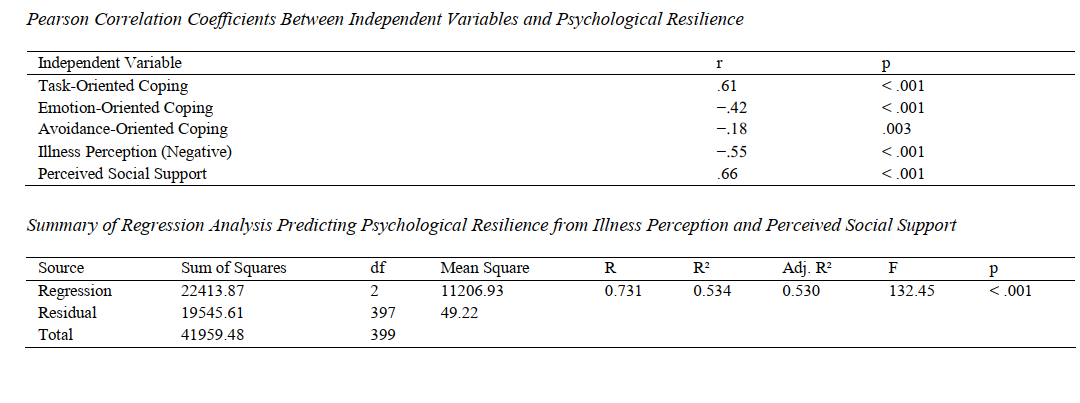
Findings: Descriptive statistics showed moderate to high levels of psychological resilience and perceived social support among participants. Pearson correlation analysis revealed that psychological resilience was positively correlated with task-oriented coping (r = .61, p < .001) and perceived social support (r = .66, p < .001), and negatively correlated with emotion-oriented coping (r = −.42, p < .001), avoidance-oriented coping (r = −.18, p = .003), and negative illness perception (r = −.55, p < .001). The multiple regression model including all five predictors was significant, F(5, 394) = 178.98, p < .001, explaining 70.2% of the variance in psychological resilience. Perceived social support (β = .44) and task-oriented coping (β = .32) were the strongest positive predictors, while illness perception (β = −.29), emotion-oriented coping (β = −.19), and avoidance-oriented coping (β = −.09) were significant negative predictors.
Conclusion: The findings underscore the importance of adaptive coping strategies, positive illness beliefs, and strong social support in enhancing psychological resilience among women with chronic migraine. Interventions targeting these psychosocial factors may improve patients’ adaptive capacity and overall well-being.
Downloads
References
Balottin, L., Mannarini, S., Candeloro, D., Mita, A., Chiappedi, M., & Balottin, U. (2018). Rorschach Evaluation of Personality and Emotional Characteristics in Adolescents With Migraine Versus Epilepsy and Controls. Frontiers in Neurology, 9. https://doi.org/10.3389/fneur.2018.00160
Chiros, C. E., & O’Brien, W. H. (2011). Acceptance, Appraisals, and Coping in Relation to Migraine Headache: An Evaluation of Interrelationships Using Daily Diary Methods. Journal of Behavioral Medicine, 34(4), 307-320. https://doi.org/10.1007/s10865-011-9313-0
Darbani, S. A., & Atapour, N. (2023). The Impact of Early Attachment Styles on Chronic Illness Adjustment: A Qualitative Approach. JPPR, 1(4), 30-37. https://doi.org/10.61838/kman.jppr.1.4.5
Ferrari, R., & Pieschl, S. (2011). An Examination of Coping Styles and Expectations for Whiplash Injury in Germany: Comparison With Canadian Data. Clinical Rheumatology, 30(9), 1209-1214. https://doi.org/10.1007/s10067-011-1736-z
Ferrari, R., & Russell, A. S. (2010). Correlations Between Coping Styles and Symptom Expectation for Whiplash Injury. Clinical Rheumatology, 29(11), 1245-1249. https://doi.org/10.1007/s10067-010-1443-1
Gürsoy, B. K., & Toksoy, C. K. (2023). Psychological Resilience and Stress Coping Styles in Migraine Patients. Neuropsychiatric Disease and Treatment, Volume 19, 63-72. https://doi.org/10.2147/ndt.s398838
Hall, A. L., Karvounides, D., Gelfand, A. A., Mankin, H., Kessel, S., Corroo, J., Malavolta, C. P., Pezzuto, T., Chadehumbe, M., & Szperka, C. L. (2019). Improving the Patient Experience With Migraine Camp, a One‐Day Group Intervention for Adolescents With Chronic Headache and Their Parents. Headache the Journal of Head and Face Pain, 59(8), 1392-1400. https://doi.org/10.1111/head.13570
Huang, E., Jones, K. D., Bennett, R. M., Hall, G. C. N., & Lyons, K. S. (2018). The Role of Spousal Relationships in Fibromyalgia Patients’ Quality of Life. Psychology Health & Medicine, 23(8), 987-995. https://doi.org/10.1080/13548506.2018.1444183
Huang, Z., & Wu, S. (2021). Acceptance of Disability, Coping Style, Perceived Social Support and Quality of Life Among Patients With Chronic Lymphedema: A Cross-Sectional Study. https://doi.org/10.21203/rs.3.rs-1002210/v1
Imai, N., Osanai, A., Moriya, A., Katsuki, M., & Kitamura, E. (2022). Classification of Odorant Substances That Trigger Migraine Attacks: A Cross-Sectional Study. https://doi.org/10.21203/rs.3.rs-2316711/v1
McPhee, D. P., & Robinson, W. D. (2019). Couples Living With Chronic Migraines: A Phenomenological Study. Contemporary Family Therapy, 42(3), 271-283. https://doi.org/10.1007/s10591-019-09513-w
Park, S. Y., & Chen, Y. (2015). Individual and Social Recognition. 1540-1551. https://doi.org/10.1145/2675133.2675248
Pistoia, F., Salfi, F., Saporito, G., Ornello, R., Frattale, I., D’Aurizio, G., Tempesta, D., Ferrara, M., & Sacco, S. (2022). Behavioral and Psychological Factors in Individuals With Migraine Without Psychiatric Comorbidities. The Journal of Headache and Pain, 23(1). https://doi.org/10.1186/s10194-022-01485-x
Radat, F., Lantéri‐Minet, M., Nachit‐Ouinekh, F., Massiou, H., Lucas, C., Pradalier, A., Mercier, F., & Hasnaoui, A. E. (2009). The GRIM2005 Study of Migraine Consultation in France. III: Psychological Features of Subjects With Migraine. Cephalalgia, 29(3), 338-350. https://doi.org/10.1111/j.1468-2982.2008.01718.x
Seifert, L. S. (2012). Self-Regulation in Disability: Migraine Management as Action Research. Action Research, 10(4), 336-355. https://doi.org/10.1177/1476750312467835
Seifpour, T., Morshedi, H., & Zeidi, I. M. (2019). The Effect of Stage of Change Education Based on the Use of Pain Coping Mechanisms in Female Patients With Migraine. Journal of Birjand University of Medical Sciences, 26(4), 300-314. https://doi.org/10.32592/jbirjandunivmedsci.2019.26.4.102
Shahverdi, A., Omidi, M., & Nik, M. M. (2023). Effect of Mindfulness-Based Cognitive Therapy on Cognitive Emotion Regulation, Psychosomatic Symptom Severity of Migraine, and Stress Coping Styles of Women With Migraine. Iranian Journal of Psychiatry and Clinical Psychology, 29(1), 18-31. https://doi.org/10.32598/ijpcp.29.1.4414.1
Sirois, F. M., Molnar, D. S., & Hirsch, J. K. (2015). Self-Compassion, Stress, and Coping in the Context of Chronic Illness. Self and identity, 14(3), 334-347. https://doi.org/10.1080/15298868.2014.996249
Wolters, G., Stapert, S., Brands, I., & Heugten, C. v. (2010). Coping Styles in Relation to Cognitive Rehabilitation and Quality of Life After Brain Injury. Neuropsychological Rehabilitation, 20(4), 587-600. https://doi.org/10.1080/09602011003683836
Wolters, G., Stapert, S., Brands, I., & Heugten, C. v. (2011). Coping Following Acquired Brain Injury. Journal of Head Trauma Rehabilitation, 26(2), 150-157. https://doi.org/10.1097/htr.0b013e3181e421dc
Xue, J.-M., Yang, L., Sun, F., & Su, J. (2024). Family Function and Depression in Older Adults With Chronic Comorbidities: The Chain‐mediated Role of Cognitive Fusion and Coping Styles. Psychogeriatrics, 25(1). https://doi.org/10.1111/psyg.13217
Yan, J., Long, Z., Song, G., & Yuan, Y. (2025). The Chain Mediating Role of Social Support and Yielding Coping Style Between Health Literacy and Symptom Burden in Patients With Chronic Heart Failure. Frontiers in Cardiovascular Medicine, 12. https://doi.org/10.3389/fcvm.2025.1518175
Yu, X., & Zhao, J. (2023). How Rumination Influences Meaning in Life Among Chinese High School Students: The Mediating Effects of Perceived Chronic Social Adversity and Coping Style. Frontiers in Public Health, 11. https://doi.org/10.3389/fpubh.2023.1280961
Yuan, Y., Lü, L., Wang, H., Xie, C., Chen, Q. Y., Li, H., & Tian, L. (2022). Related Factors to the Coping Style of Patients With Sudden Sensorineural Hearing Loss. International Health, 15(2), 198-206. https://doi.org/10.1093/inthealth/ihac046
Zimmermann, T., Alsleben, M., & Heinrichs, N. (2012). Progredienzangst Gesunder Lebenspartner Von Chronisch Erkrankten Patienten. PPMP - Psychotherapie · Psychosomatik · Medizinische Psychologie, 62(09/10), 344-351. https://doi.org/10.1055/s-0032-1321880
Головачева, В. А., & Головачева, А. А. (2021). Treatment of Chronic Migraine and Neck Pain With Cognitive-Behavioral Therapy. Case Report. Consilium Medicum, 23(11), 852-857. https://doi.org/10.26442/20751753.2021.11.201137
Головачева, В. А., Головачева, А. А., Парфенов, В. А., Табеева, Г. Р., Романов, Д. В., Osipova, V. В., & Katsarava, Z. (2021). Cognitive Behavioral Therapy in the Treatment of Chronic Migraine: A Clinical Case Report. Neurology Neuropsychiatry Psychosomatics, 13(1), 74-80. https://doi.org/10.14412/2074-2711-2021-1-74-80
Downloads
Additional Files
Publication Timeline
- Submitted
- Revised
- Accepted
Issue
Section
License
Copyright (c) 2025 Ezzatollah Kordmirza Nikoozadeh, Fatemeh Karfeh Raveshi, Saranaz Moghimi (Author); Amin Rafiepoor (Corresponding Author)

This work is licensed under a Creative Commons Attribution-NonCommercial 4.0 International License.