Perceived Helplessness as a Mediator Between Domestic Violence and PTSD Symptoms in Women
DOI:
https://doi.org/10.61838/kman.pwj.6.2.14Keywords:
Domestic violence, PTSD symptoms, perceived helplessnessAbstract
Objective: This study aimed to examine the mediating role of perceived helplessness in the relationship between domestic violence and PTSD symptoms among women.
Methods and Materials: A descriptive correlational research design was employed, involving a sample of 425 women from France selected based on the Morgan and Krejcie sample size table. Participants completed standardized questionnaires assessing domestic violence (CTS2), perceived helplessness (PSS subscale), and PTSD symptoms (PCL-5). Data were analyzed using SPSS-27 for descriptive and inferential statistics and AMOS-21 for structural equation modeling (SEM). Pearson correlation analysis was conducted to assess bivariate relationships, and the SEM approach was used to test the mediating effect of perceived helplessness on PTSD outcomes.
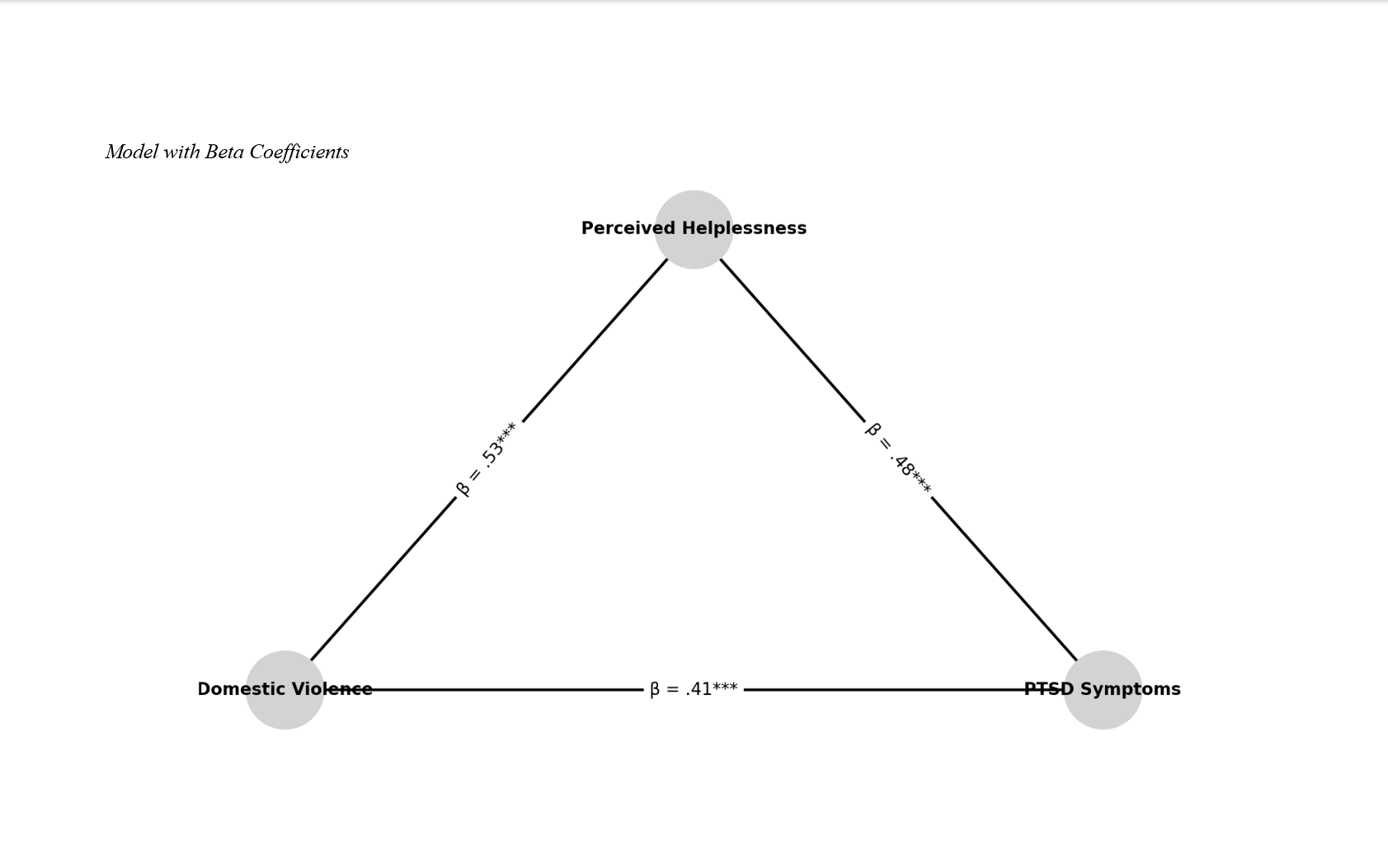
Findings: The results revealed significant positive correlations between domestic violence and perceived helplessness (r = .53, p < .001), domestic violence and PTSD symptoms (r = .59, p < .001), and perceived helplessness and PTSD symptoms (r = .61, p < .001). The SEM analysis demonstrated good model fit (χ² = 104.38, df = 48, χ²/df = 2.17, GFI = .96, CFI = .97, RMSEA = .051). All direct paths were significant: domestic violence to perceived helplessness (β = .53, p < .001), domestic violence to PTSD symptoms (β = .41, p < .001), and perceived helplessness to PTSD symptoms (β = .48, p < .001). The indirect effect of domestic violence on PTSD symptoms via perceived helplessness was also significant (β = .25, p < .001), confirming the mediating role.
Conclusion: The findings indicate that perceived helplessness is a key psychological mechanism through which domestic violence contributes to PTSD symptoms in women. Addressing helplessness in therapeutic and policy interventions may be essential for reducing trauma-related distress in survivors of intimate partner violence.
Downloads
References
Başak, N., & Serin, N. B. (2023). Analysis of the Rate of Working Women’s Acceptance of Partner Violence and Cultural Reflections in Cypriot Society. Frontiers in psychology, 13. https://doi.org/10.3389/fpsyg.2022.962423
Choi, S., Lee, M. H., Lee, E., Park, S., & Kim, H. K. (2021). A Gambling Addiction Process in Adults Who Experienced Domestic Violence in Childhood. Journal of Korean Academy of Psychiatric and Mental Health Nursing, 30(2), 168-179. https://doi.org/10.12934/jkpmhn.2021.30.2.168
Ghadiri Niari, M., & Moshkbid Haghighi, M. (2023). The Effectiveness of Life Skills Training on Psychological Helplessness and Improving the Psychological Capital of Patients with Diabetes in Gilan Province. jnip, 15(19), 1-17. http://jnip.ir/article-1-850-fa.html
Jati, L. P., Joebagio, H., & Prasetya, H. (2019). Social Cognitive Theory on the Domestic Violence in Yogyakarta. Journal of Maternal and Child Health, 4(5), 316-324. https://doi.org/10.26911/thejmch.2019.04.05.04
Jumaidin, L., Amin, H., & Darni, D. (2022). Discourse Helplessness and Power Relations Women’s in the Film 7 Hearts 7 Love 7 Women Movie. International Journal of Qualitative Research, 1(3), 188-195. https://doi.org/10.47540/ijqr.v1i3.411
Kalinina, S. (2022). Adherence to Stereotypes as a Prerequisite for Acceptance of the Situation of Domestic Violence in Civil and Military University Students. Science Culture Society, 28(2S), 58-70. https://doi.org/10.19181/nko.2022.28.2s.5
Karakuş, C., & Göncü-Köse, A. (2023). Relationships of domestic violence with bullying, silencing-the-self, resilience, and self-efficacy: Moderating roles of stress-coping strategies. Current Psychology, 42(16), 13913-13926. https://doi.org/10.1007/s12144-022-02726-7
Khatibi, P., & Meghrazi, P. (2023). Predicting psychological helplessness based on initial maladaptive schemas and coping strategies in women affected by marital infidelity. Journal of Applied Family Therapy, 4(2), 487-506. https://doi.org/10.22034/aftj.2022.304757.1200
Khizer, U., Bukhari, F. K., & Fahd, S. (2020). Impact of Perceived Social Support and Domestic Violence on Mental Health Among Housewives. Journal of Business and Social Review in Emerging Economies, 6(3), 1153-1157. https://doi.org/10.26710/jbsee.v6i3.1382
Lu, M.-Y., Ahorsu, D. K., Kukreti, S., Strong, C., Lin, Y. H., Kuo, Y. J., Chen, Y. P., Lin, C. Y., Chen, P. L., Ko, N. Y., & Ko, W. C. (2021). The Prevalence of Post-Traumatic Stress Disorder Symptoms, Sleep Problems, and Psychological Distress Among COVID-19 Frontline Healthcare Workers in Taiwan. Frontiers in Psychiatry, 12. https://doi.org/10.3389/fpsyt.2021.705657
Makiyah, U. N., Hayya, L. u., & Qisthina, D. S. N. (2024). Politik Representasi Identitas Perempuan Dalam Media: Wacana Kritis Pemberitaan KDRT Di suara.com. Academic Journal of Da Wa and Communication, 5(1), 65-84. https://doi.org/10.22515/ajdc.v5i1.8158
Mordas, E. S. (2024). Domestic Violence and Maternal Perversion. Психолог(4), 28-44. https://doi.org/10.25136/2409-8701.2024.4.69150
Najamuddin, N., Haris, H., Tamrin, S., & Nurdia, N. (2023). Implementasi Hukum Dan Perlindungan Sosial Bagi Korban Kekerasan Dalam Rumah Tangga. Supremasi Jurnal Pemikiran Penelitian Ilmu-Ilmu Sosial Hukum Dan Pengajarannya, 18(1), 086. https://doi.org/10.26858/supremasi.v18i1.45646
Nguyệt, P. T. T., & Daud, M. (2022). Domestic Violence During the COVID-19 Pandemic: Evidences From Vietnamese Families. Proceedings of International Conference on Multidiciplinary Research, 5(2), 43-49. https://doi.org/10.32672/pic-mr.v5i2.5405
Niknam, M., Karimi, G. Z., & Amiri, F. (2023). Effectiveness of Training to Overcome the Learned Helplessness on Academic Procrastination and Self-efficacy of Adolescent girls. Journal of Adolescent and Youth Psychological Studies (JAYPS), 4(4), 71-80. http://journals.kmanpub.com/index.php/jayps/article/view/1144
Overmeire, R. V. (2021). Comment on Tyson, G.; Wild, J. Post-Traumatic Stress Disorder Symptoms Among Journalists Repeatedly Covering COVID-19 News. Int. J. Environ. Res. Public Health 2021, 18, 8536. International journal of environmental research and public health, 18(21), 11421. https://doi.org/10.3390/ijerph182111421
Rahman, A., Astuti, K., Verasari, M., Hidayati, I., & Wahyuni, R. (2022). Peningkatan Resiliensi Psikologis Penyintas Kekerasan Rumah Tangga Melalui Psikoterapi Positif. Psyche 165 Journal, 158-163. https://doi.org/10.35134/jpsy165.v15i4.211
Rakubu, K., & Olofinbiyi, S. A. (2022). Review of Exponential Rise in Domestic Violence Amid COVID-19: Theories and Perspectives. Sciencerise Juridical Science(1(19)), 46-56. https://doi.org/10.15587/2523-4153.2022.254309
Sadeghi, K., Goodarzi, G., & Foroughi, A. (2023). Recovering from Post-Traumatic Stress Disorder symptoms: A study on the combination of art and mindfulness. Shenakht, 9(6), 131-145. https://doi.org/10.32598/shenakht.9.6.131
Samosir, N., & Sirait, K. (2025). Psychological Impact of Victim of Psychical Violence in Household. International Journal of Multidisciplinary Approach Research and Science, 3(01), 315-325. https://doi.org/10.59653/ijmars.v3i01.1444
Shamsaie, Z., Karimi, Q., & Akbari, M. (2022). Causal modeling of domestic violence based on marital intimacy, inhibition and marital conflict. Rooyesh-e-Ravanshenasi Journal (RRJ), 11(8), 59-68. https://frooyesh.ir/article-1-4077-en.html
Sumanto, D., Zainuddin, A., Suyitno, M., & Mahera, V. (2022). Domestic Violence Against Women During the Covid 19 Pandemic in Gorontalo Province. Musamus Law Review, 5(1), 27-36. https://doi.org/10.35724/mularev.v5i1.4650
Talani, N. S., Rahmatiah, R., Kerebungu, F., & Wiroto, D. W. (2023). Kategorisasi Media Siber Hulondalo.Id Dalam Framing Pemberitaan Kekerasan Dalam Rumah Tangga Di Gorontalo. Communicatus Jurnal Ilmu Komunikasi, 7(1), 43-64. https://doi.org/10.15575/cjik.v7i1.19946
Tasnim, F., Abedin, S., & Rahman, M. M. (2023). Mediating Role of Perceived Stress on the Association Between Domestic Violence and Postpartum Depression: Cross-Sectional Study in Bangladesh. BJPsych Open, 9(1). https://doi.org/10.1192/bjo.2022.633
Thamizhmathi, J., Vedapriya, D. R., & Bhuvaneswari, N. S. (2024). Prevalence of Domestic Violence and Perceived Stress Among Married Women in an Urban Area of Puducherry: A Cross Sectional Study. Nbejms, 2(7), 678-692. https://doi.org/10.61770/nbejms.2024.v02.i07.005
Viejo, C. M., Ruiz, M. Á. M., & Burgueño, F. (2023). Intimate Partner Violence in Vulnerable Contexts: A Case Study. Societies, 13(3), 53. https://doi.org/10.3390/soc13030053
Downloads
Publication Timeline
- Submitted
- Revised
- Accepted
Issue
Section
License

This work is licensed under a Creative Commons Attribution-NonCommercial 4.0 International License.