
Investigating the Role of the Generation Gap in the Emergence of Emerging Social Harms among Female Beneficiaries under Support in Semnan County
DOI:
https://doi.org/10.61838/Keywords:
Generational gap, social isolation, prostitution, female beneficiaries, social harms, Iran, Family cohesion and flexibility, conflict resolution strategies, sexual satisfactionAbstract
Objective: This study aims to investigate the role of the generational gap in the emergence of new social harms, with a particular emphasis on prostitution, among female beneficiaries supported by welfare institutions in Semnan County, Iran.
Methods and Materials: The study employed a descriptive-survey research design using a standardized questionnaire to collect data from 260 female beneficiaries aged 20 to 29 years, selected through simple random sampling based on Cochran's formula. The study was conducted in Semnan County during spring to autumn 2021. Validity was confirmed through expert review, and reliability was verified using Cronbach’s alpha (α = 0.89). Data analysis was conducted using SPSS version 25, employing Pearson correlation, regression analysis, and t-tests to explore the relationships among the variables: family cohesion, social isolation, depression, and the generational gap.
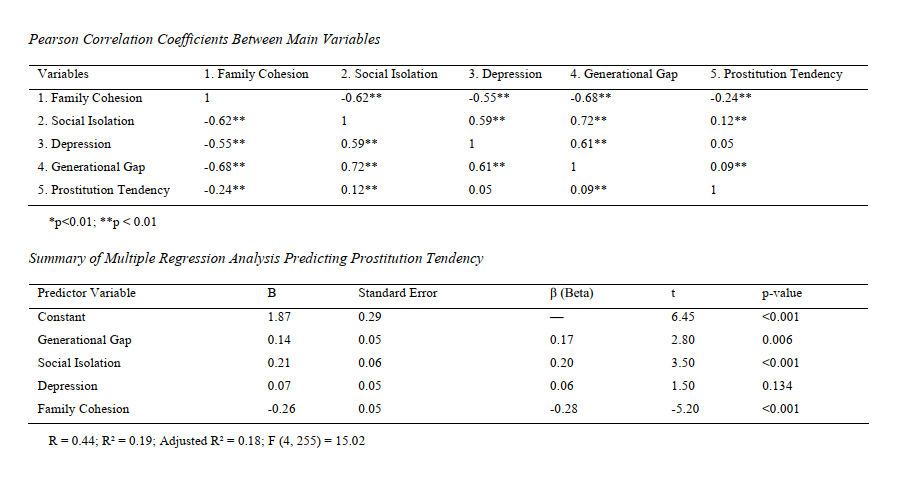
Findings: Results indicated that the generational gap was significantly and negatively associated with family cohesion (r = -0.68, p < 0.01) and positively associated with both social isolation (r = 0.72, p < 0.01) and depression (r = 0.61, p < 0.01). Regression analysis showed that the generational gap (β = 0.17, p = 0.006), social isolation (β = 0.20, p < 0.001), and family cohesion (β = -0.28, p < 0.001) significantly predicted prostitution tendency. Depression, however, was not a significant predictor in the multivariate model (β = 0.06, p = 0.134). The model explained 19% of the variance in prostitution tendency (R² = 0.19).
Conclusion: The study concludes that generational gaps and social isolation significantly contribute to increased prostitution tendency, while family cohesion serves as a protective factor. These findings underscore the need for holistic, intergenerational interventions targeting family dynamics and communication in vulnerable populations.
Downloads
References
Afrough, E. (2010). The impact of rapid cultural changes and generational gaps on the emergence of social harms. Iranian Sociology Journal, 2(4), 45-62. https://doi.org/10.1177/1749975509356754
Aghaei, F. (2016). Examining the role of isolation and depression in social harms: A study on beneficiaries in deprived areas.
Amin, M., Javanmard, K., & Sharbatian, Y. (2024). An analysis of the image of religion and strategies for religious action on virtual social networks (Case study: Girls aged 14-18 in Khorramabad). Research on Women's and Family Social Issues, 12(1), 59-97. https://www.google.com/url?sa=t&source=web&rct=j&opi=89978449&url=https://www.noormags.ir/view/en/articlepage/2209766/
Berger, A. (2014). Cultural Diversity and Family Structure in Modern Societies. Cambridge University Press.
Boichuk, O., & Stadnik, M. (2023). Actual problems of youth socialization in in the family. Features of the social adaptive influence of the older generation on youth socialization. International Science Journal of Jurisprudence & Philosophy, 2(1), 24-32. https://doi.org/10.46299/j.isjjp.20230201.03
Castells, M. (2014). Networks and Power: The Impact of New Technologies on the Creation of Social Divides.
Darreshti, H., Najafi, A., & Ramazani, Z. (2022). Investigating the reasons for the inclination of women and girls in Tehran towards alcohol consumption. Research on Women's and Family Social Issues, 10(2), 361-386. https://www.google.com/url?sa=t&source=web&rct=j&opi=89978449&url=https://www.magiran.com/paper/2534170/
Duncan, R. (2005). The Role of Social Isolation and Family Interaction in Adolescent Depression and Risky Behavior. American Journal of Sociology, 110(4), 874-893.
Formandan, N. (2017). The impact of social institutions on family cohesion and the reduction of social harms in Iranian society. Iranian Social Research, 4(1), 11-30.
Ghorbani, I., Kermani, M., Behrovan, H., & Akbari, H. (2021). Prostitution in the context of unfinished development: A qualitative analysis. Comprehensive Cognitive Studies, 29(1), 369-389. https://www.google.com/url?sa=t&source=web&rct=j&opi=89978449&url=https://jsr.ut.ac.ir/article_88966.html&ved=2ahUKEwjp4sy7w42OAxVbgf0HHTVnHBIQFnoECBsQAQ&usg=AOvVaw2F_JE9rMLsPhoojM_7Gv5w
Grelle, K., Shrestha, N. R., Ximenes, M. C., Perrotte, J. K., Cordaro, M., Deason, R. G., & Howard, K. (2023). The Generation Gap Revisited: Generational Differences in Mental Health, Maladaptive Coping Behaviors, and Pandemic-Related Concerns During the Initial COVID-19 Pandemic. Journal of Adult Development, 30(4), 381-392. https://doi.org/10.1007/s10804-023-09442-x
Hosseini, M. (2018). Family cohesion and its impact on reducing or increasing risky behaviors in low-income families.
Misaghi, E., Sadipour, E., Dortaj, F., & Motamedi, A. (2020). Structural Model of Monitoring Style and Social Media Addiction Mediated by Generation Gap. Communication Research, 27(102), 61-93. https://doi.org/10.22082/cr.2020.118928.1977
Mohammadi, M. (2011). Generational gaps and social harms in families supported by social institutions. Iranian Social Studies, 3(2), 125-140.
Rezaei, P. (2019). Challenges faced by families supported by the Imam Khomeini Relief Foundation and their relationship with social harms. Journal of Sociology of Harms and Social Development, 5(3), 120-138.
Sarami, S. (2015). Examining the relationship between technological growth and generational gaps with social harms. Journal of Sociology of Harms, 7(3), 34-50.
Shalchi, P. D. B., & Kolahi Hamed, S. (2018). The Structural Relationship between Generation Gap and Internet Addiction among Adolescents. qjfr, 15(3), 97-112. http://qjfr.ir/article-1-776-en.html
Soleimani, S., & colleagues. (2019). Analyzing the effects of generational gaps on social and cultural crises.
Thomason, S. J., Weeks, M. R., & Galperin, B. (2022). An exploratory analysis of generational differences in the World Values Surveys and their application to business leaders. 357-370. https://doi.org/10.1177/00048658422.2022.2086872
Wimshurst, K. (2013). Age, Prostitution and Punishment in the Late Nineteenth Century. 47(1), 813497208. https://doi.org/10.1177/0004865813497208
Downloads
Additional Files
Publication Timeline
- Submitted
- Revised
- Accepted
Issue
Section
License
Copyright (c) 2025 Jamshid Heydarian, Mansour Sharifi, Yaghoub Sharbatian (Author)

This work is licensed under a Creative Commons Attribution-NonCommercial 4.0 International License.