Investigating the Mediating Role of Negative Repetitive Thoughts in the Relationship Between Behavioral Brain Systems and Sleep Quality With Mental Fatigue in Women With Type 2 Diabetes
DOI:
https://doi.org/10.61838/kman.pwj.4288Keywords:
Negative repetitive thoughts, behavioral brain systems, sleep quality, mental fatigue, type 2 diabetesAbstract
Objective: The present study aimed to determine the mediating role of negative repetitive thoughts in the relationship between behavioral brain systems and sleep quality with mental fatigue in women with type 2 diabetes.
Materials and Methods: This study was a correlational design using structural equation modeling. The statistical population included all women with type 2 diabetes who were members of the Diabetes Patients Support Association in Tehran Province in 2025. A total of 265 women were selected as the research sample through convenience sampling. The instruments used in this study included the Negative Repetitive Thoughts Questionnaire (McEvoy, Mahoney, & Moulds, 2012), the Behavioral Inhibition/Activation Systems Scale (Carver & White, 1994), the Pittsburgh Sleep Quality Index (Buysse et al., 1989), and the Mental Fatigue Questionnaire (Smets, 1996). The data were analyzed using path analysis.
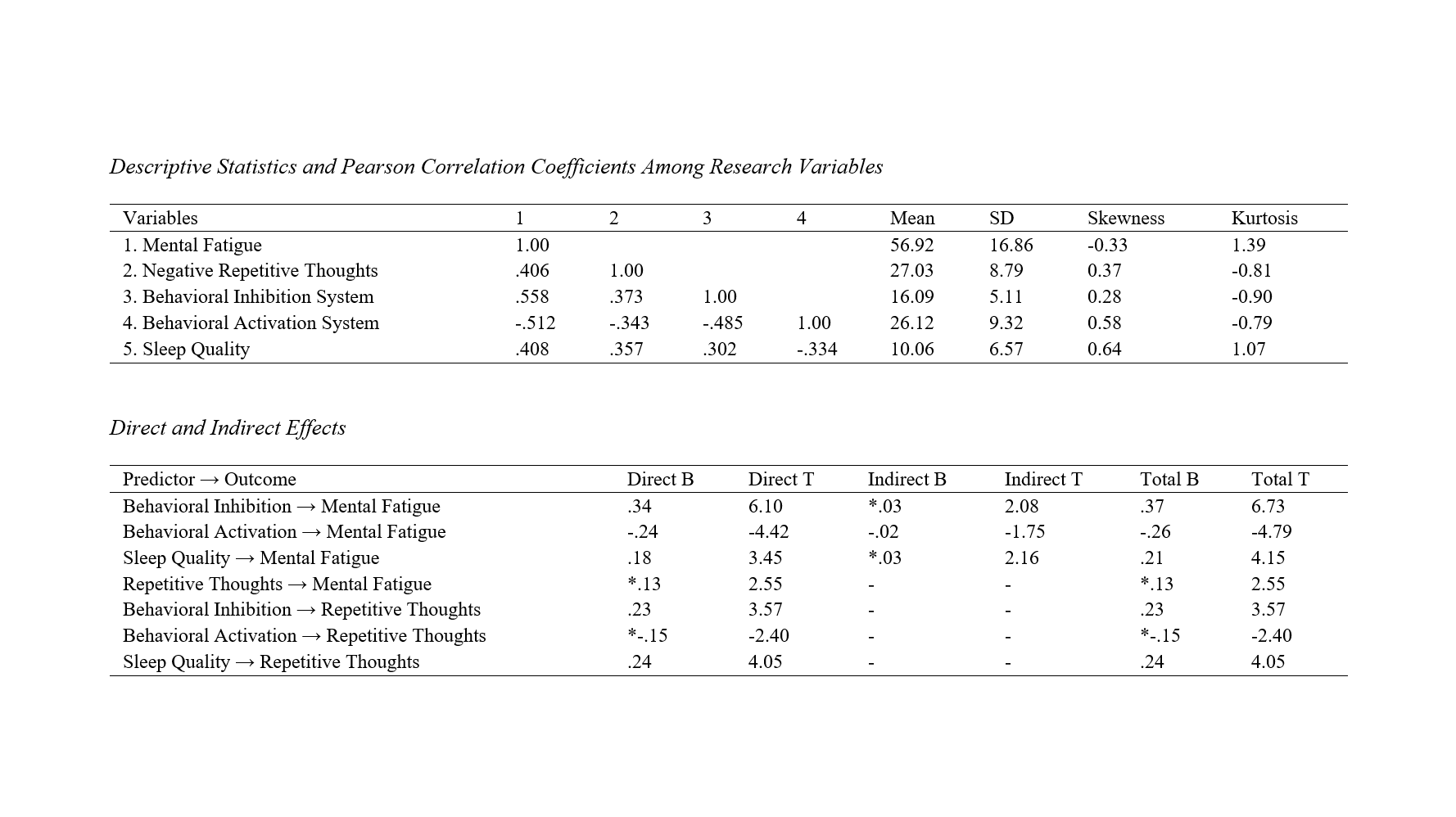
Findings: The results showed that there was a significant and positive relationship between behavioral brain systems and sleep quality with mental fatigue through the mediation of negative repetitive thoughts. However, negative repetitive thoughts did not play a significant mediating role in the relationship between the behavioral activation system and mental fatigue.
Conclusion: Our findings suggest that negative repetitive thoughts, behavioral brain systems, and sleep quality can be considered fundamental constructs in chronic illnesses such as type 2 diabetes. It can be concluded that these mechanisms may play a critical role in the persistence of the disease, and considering these relationships could be beneficial for the etiology and treatment of individuals with type 2 diabetes.
Downloads
References
Buysse, D. J., Reynolds, C. F., III, Monk, T. H., Berman, S. R., & Kupfer, D. J. (1989). The Pittsburgh Sleep Quality Index: a new instrument for psychiatric practice and research. Psychiatry research, 28(2), 193-213. https://doi.org/10.1016/0165-1781(89)90047-4
Carver, C. S., & White, T. L. (1994). Behavioral inhibition, behavioral activation, and affective responses to impending reward and punishment: the BIS/BAS scales. Journal of personality and social psychology, 67(2), 319. https://doi.org/10.1037//0022-3514.67.2.319
Chang, X., Guo, C., Zhou, H., & Liu, L. (2023). Impact of rumination on sleep quality among patients with non-alcoholic fatty liver disease: a moderated mediation model of anxiety symptoms and resilience. BMC psychiatry, 23(1), 84. https://doi.org/10.1186/s12888-023-04572-8
Che, Q., Yang, P., Gao, H., Liu, M., Zhang, J., & Cai, T. (2020). Application of the Chinese Version of the BIS/BAS Scales in Participants with a Substance Use Disorder: An Analysis of Psychometric Properties and Comparison with Community Residents. Frontiers in psychology, 11, 912. https://doi.org/10.3389/fpsyg.2020.00912
Clancy, F., Prestwich, A., Caperon, L., Tsipa, A., & O'Connor, D. B. (2020). The association between worry and rumination with sleep in non-clinical populations: A systematic review and meta-analysis. Health Psychology Review, 14, 427-448. https://doi.org/10.1080/17437199.2019.1700819
Cox, R. C., & Olatunji, B. O. (2020). Sleep in the anxiety-related disorders: A meta-analysis of subjective and objective research. Sleep Medicine Reviews, 51, 101282. https://doi.org/10.1016/j.smrv.2020.101282
Dittner, A. J., Wessely, S. C., & Brown, R. G. (2004). The assessment of fatigue: a practical guide for clinicians and researchers. Journal of psychosomatic research, 56(2), 157-170. https://doi.org/10.1016/S0022-3999(03)00371-4
Forgan, G. (2010). Psychophysiological insomnia and idiopathic insomnia: The role of self-regulatory behaviour systems. University of Glasgow, England. https://theses.gla.ac.uk/id/eprint/2211
Foroghian-Yazdi, F., Askarizadeh, G., & Pourmohammad-Ghouchani, K. (2020). Effectiveness of Mindfulness Training with Islamic Approach on Spiritual Well-being and Loneliness in Women with Type 2 Diabetes. Journal of Research on Religion & Health, 6(4), 32-44. https://doi.org/10.22037/jrrh.v6i4.26588
Ghanbarizarandi, Z., Hasani, J., Mohammadkhani, S., & Hatami, M. (2018). The Assessment of Difficulty in Emotion Regulation and Craving based on the Sensitivity of Brain-Behavioral Systems and Levels of Loneliness. Neuropsychology, 4(13), 47-66. https://clpsy.journals.pnu.ac.ir/article_5203_506835449c323cba1d5ea8e9b70f0434.pdf
Gray, J., & McNaughton, N. (2003). The neuropsychology of anxiety: An enquiry into the functions of the septo-hippocampal system. Oxford: Oxford University Press. https://doi.org/10.1093/acprof:oso/9780198522713.001.0001
Hafezi, S., Zare, H., Mehri, S. N., & Mahmoodi, H. (2010). The Multidimensional Fatigue Inventory validation and fatigue assessment in Iranian distance education students.
Harris, A. L., Carmona, N. E., Moss, T. G., & Carney, C. E. (2021). Testing the contiguity of the sleep and fatigue relationship: A daily diary study. Sleep, 44(5). https://doi.org/10.1093/sleep/zsaa252
Li, S. H., Lloyd, A. R., & Graham, B. M. (2021). Subjective sleep quality and characteristics across the menstrual cycle in women with and without Generalized Anxiety Disorder. Journal of psychosomatic research, 148, 110570. https://doi.org/10.1016/j.jpsychores.2021.110570
Mafsari, M. R., Isisazadegan, A., & Soleimani, I. (2022). The relationship between the activity of brain-behavioral systems and illness anxiety disorder with the mediating role of uncertainty intolerance. Cognitive Sciences Monthly, 21(114), 1198-1213. https://doi.org/10.52547/JPS.21.114.1193
McCallum, S. M., Batterham, P. J., Calear, A. L., Sunderland, M., Carragher, N., & Kazan, D. (2019). Associations of fatigue and sleep disturbance with nine common mental disorders. Journal of psychosomatic research, 123, 109727. https://doi.org/10.1016/j.jpsychores.2019.05.005
McEvoy, P. M., Mahoney, A. E., & Moulds, M. L. (2010). Are worry, rumination, and post-event processing one and the same?: Development of the Repetitive Thinking Questionnaire. Journal of anxiety disorders, 24(5), 509-519. https://doi.org/10.1016/j.janxdis.2010.03.008
Pourmohammad Ghouchani, K., Mandanizadeh Safi, S., & Noori, J. (2023). The Effectiveness of Positive Psychotherapy on Alexithymia and Recurrent Negative Thoughts in Cardiovascular Patients. Health Psychology, 12(45), 7-20. https://doi.org/10.30473/hpj.2023.61537.5396
Soleimany, M., Masoodi, R., Sadeghi, T., Bahrami, N., Ghorban, M., & Hassanpoor, A. (2008). General health and its association with sleep quality in two groups of nurses with and without shift working in educational centers of Iran University of Medical Sciences (IUMS). Journal of Shahrekord University of Medical Sciences, 10(3), 70-75. https://www.sid.ir/paper/58269/en
Spitzer, R. L., Kroenke, K., Williams, J. B. W., & Lowe, B. (2006). A Brief measure for assessing generalized anxiety disorder. Archives of internal medicine, 166, 1092-1097. https://doi.org/10.1001/archinte.166.10.1092
Stein, K. D., Jacobsen, P. B., Blanchard, C. M., & Thors, C. (2004). Further validation of the multidimensional fatigue symptom inventory-short form. Journal of Pain and Symptom Management, 27(1), 14-23. https://doi.org/10.1016/j.jpainsymman.2003.06.003
Sun, J., Luo, Y., Chang, H., Zhang, R., Liu, R., Jiang, Y., & Xi, H. (2020). The mediating role of cognitive emotion regulation in BIS/BAS sensitivities, depression, and anxiety among community-dwelling older adults in China. Psychology research and behavior management, 13, 939. https://www.tandfonline.com/doi/abs/10.2147/PRBM.S269874
Tsay, S. L., Cho, Y. C., & Chen, M. L. (2004). Acupressure and Transcutaneous Electrical Acupoint Stimulation in improving fatigue, sleep quality and depression in hemodialysis patients. American Journal of Chinese Medicine, 32(3), 407-416. https://doi.org/10.1142/S0192415X04002065
Wahl, K., Ehring, T., Kley, H., Lieb, R., Meyer, A., Kordon, A., & Schönfeld, S. (2019). Is repetitive negative thinking a transdiagnostic process? A comparison of key processes of RNT in depression, generalized anxiety disorder, obsessive-compulsive disorder, and community controls. Journal of Behavior Therapy and Experimental Psychiatry, 64, 45-53. https://doi.org/10.1016/j.jbtep.2019.02.006
Zhang, J., Li, X., Tang, Z., Xiang, S., Tang, Y., Hu, W., Tan, C., & Wang, X. (2024). Effects of stress on sleep quality: multiple mediating effects of rumination and social anxiety. Psicologia, Reflexao e Critica : revista semestral do Departamento de Psicologia da UFRGS, 37(1), 10. https://doi.org/10.1186/s41155-024-00294-2
Downloads
Additional Files
Publication Timeline
- Submitted
- Revised
- Accepted