Exploring the Contextual Meaning of Silence in Emotionally Abused Married Women
DOI:
https://doi.org/10.61838/kman.pwj.4298Keywords:
Emotional abuse, Silence, Intimate partner violence, Women's psychologyAbstract
Objective: This study aimed to explore the contextual meanings and psychological functions of silence among emotionally abused married women within the sociocultural context of Taiwan.
Methods and Materials: A qualitative research design based on a phenomenological approach was employed to capture the lived experiences of silence among emotionally abused women. Eighteen married women residing in Taiwan, aged between 28 and 52, participated in semi-structured in-depth interviews. Participants were selected through purposive sampling based on their self-reported experiences of emotional abuse in marriage. Interviews were conducted in Mandarin, transcribed, and translated into English. Thematic analysis following Braun and Clarke’s six-phase approach was conducted using NVivo 14 software. Data collection continued until theoretical saturation was achieved. Trustworthiness was ensured through member checking, peer debriefing, and reflexive memoing.
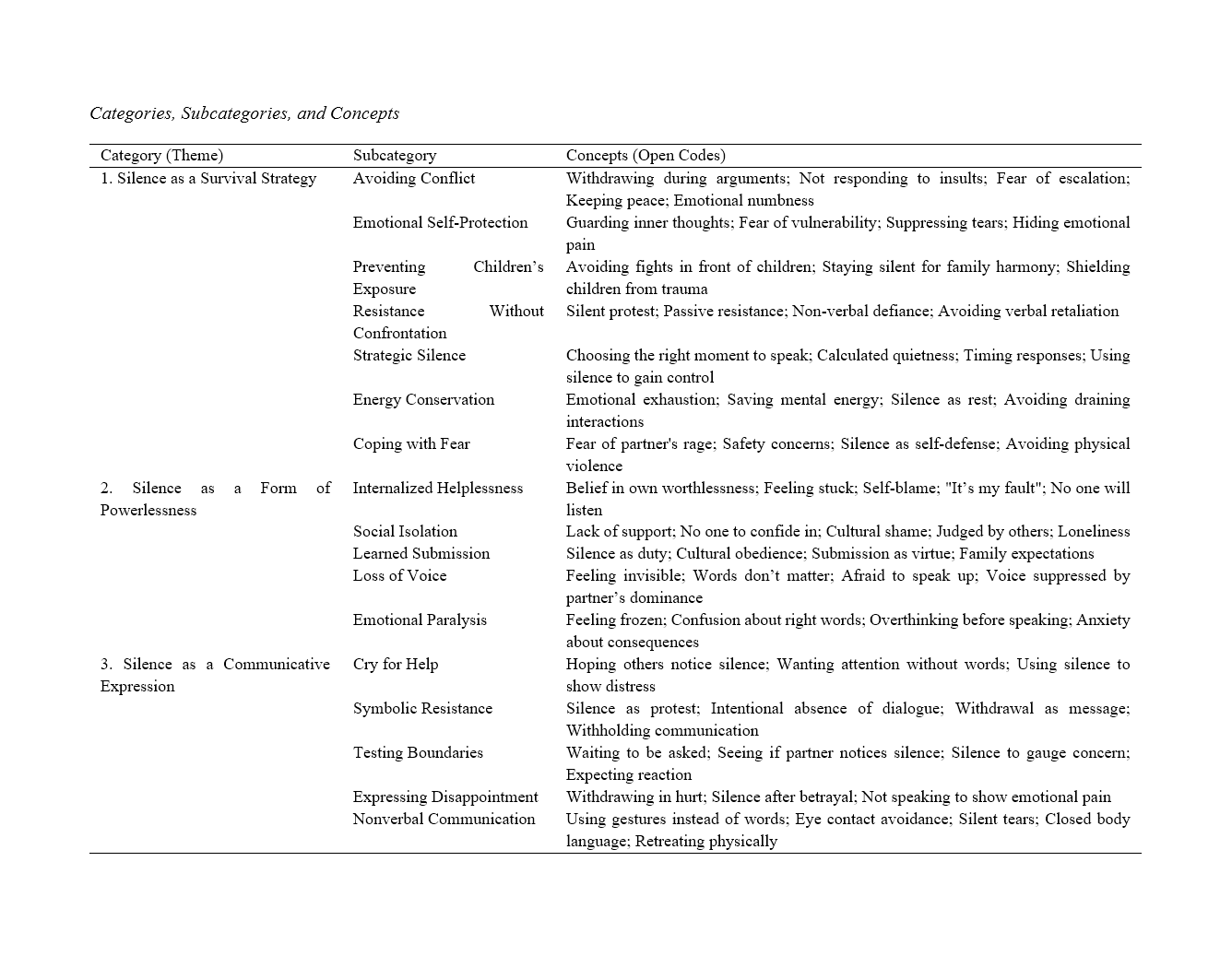
Findings: Analysis revealed three overarching themes: (1) Silence as a Survival Strategy, which included subthemes such as avoiding conflict, emotional self-protection, and coping with fear; (2) Silence as a Form of Powerlessness, encompassing internalized helplessness, social isolation, and emotional paralysis; and (3) Silence as a Communicative Expression, including symbolic resistance, testing boundaries, and expressing disappointment. Participants articulated silence as both a protective behavior and a means of emotional regulation, shaped by cultural norms, relational dynamics, and personal history. Selected interview quotations supported each thematic category.
Conclusion: Silence among emotionally abused married women is a multidimensional phenomenon that reflects adaptive coping, emotional suffering, and sociocultural conditioning. Rather than viewing silence as passive submission, practitioners and researchers should recognize it as a complex and context-sensitive response.
Downloads
References
Bäcklin, E. (2022). Me Too! A Case Study of Gendered Victimization and Feminist Development in a Swedish Peer Support Organization for People With Experiences of Criminalization and Substance Abuse. Frontiers in Psychiatry, 13. https://doi.org/10.3389/fpsyt.2022.937228
Barnes, R., & Aune, K. (2021). Gender and Domestic Abuse Victimisation Among Churchgoers in North West England: Breaking the Church’s Gendered Silence. Journal of Gender-Based Violence, 5(2), 271-288. https://doi.org/10.1332/239868021x16137365557039
Boxall, H., & Morgan, A. (2020). The Prevalence of Domestic Violence Among Women During the COVID-19 Pandemic. https://doi.org/10.52922/sb04718
Ezelote, J., Eleanor, A., Ezeonyi, E. I., Rita, C., Martin-Remy, C., & Mary, U. (2021). Domestic Violence Among Women in Nigeria and Its Health Implication - Review. International Journal of Gender Studies, 6(1), 80-101. https://doi.org/10.47604/ijgs.1413
Gilbert, B. (2020). Exploring the Experiences of Domestic Abuse Survivors Working in the Field of Domestic Abuse Support: Assisting Recovery or Re-Victimisation Revisited? Journal of Gender-Based Violence, 4(1), 73-87. https://doi.org/10.1332/239868019x15750194039901
Ginzburg, K., Talmon, A., Brenner, I., Lurie, I., Tomashev, R., Golan, A., Igawa, M. S., Betser, M., & Padoa, A. (2024). Self and Body Representation Among Women Survivors of Childhood Abuse and Its Relation to Their Infant’s Temperament. Psychological Trauma Theory Research Practice and Policy. https://doi.org/10.1037/tra0001820
Guermazi, F., Tabib, F., Chérif, F., Masmoudi, R., Mnif, D., Féki, I., Baâti, I., & Masmoudi, J. (2024). Intimate Partner Violence in Tunisia: Emotional Abuse and Dependency, Alexithymia, and Self-Esteem in Female Victims. Social Sciences, 13(10), 503. https://doi.org/10.3390/socsci13100503
Jurs, P., Ročāne, M., Kulberga, I., Striguna, S., & Titrek, O. (2023). Recognising Emotional Abuse and Mobbing in Adolescents: Causes and Impacts. Society Integration Education Proceedings of the International Scientific Conference, 1, 441-451. https://doi.org/10.17770/sie2023vol1.7065
Kaur, A. R. (2022). A Study of Abusive Relationships of Women in Modern Era. International Journal for Multidisciplinary Research, 04(05). https://doi.org/10.36948/ijfmr.2022.v04i05.003
Oppong-Adjei, D., & Essah-Ntiful, D. (2023). “I Am His Pawn, His Slave and His Property”: A Stylistic Analysis of the Abuse of Women in Amma Darko's Beyond the Horizon. Drumspeak International Journal of Research in the Humanities, 74-94. https://doi.org/10.47963/drumspeak.v6i2.1270
Samardžić, T., Barata, P. C., Morton, M., & Yen, J. (2024). Young Women’s Silencing-Type Behaviors in Heterosexual Relationships. Journal of interpersonal violence, 40(13-14), 3014-3043. https://doi.org/10.1177/08862605241265417
Serin, H. (2020). Non-Abusing Mothers’ Agency After Disclosure of the Child’s Extra-Familial Sexual Abuse. European Journal of Women S Studies, 28(4), 532-546. https://doi.org/10.1177/1350506820944432
Sridadi, A. R., Admojo, R. T. C., Himmawan, M. F., & Fuciu, M. (2022). The Effect of Abusive Supervision on Employee Silence With the Mediation Role of Emotional Exhaustion and Moderate Leader-Member Exchange. Bisma (Bisnis Dan Manajemen), 15(1), 78-95. https://doi.org/10.26740/bisma.v15n1.p78-95
Srivastav, B. (2021). Emotional Abuse Forms, Process, Patterns and Ways to Overcome. SSRN Electronic Journal. https://doi.org/10.2139/ssrn.3846710
Sukoon, W. H. (2020). The Levels of Perceived Emotional Abuse Among Pakistani Husbands and Wives. GDT, 1-3. https://doi.org/10.31487/j.gdt.2020.01.05
Downloads
Additional Files
Publication Timeline
- Submitted
- Revised
- Accepted
Issue
Section
License

This work is licensed under a Creative Commons Attribution-NonCommercial 4.0 International License.