Relational and Intrapersonal Factors Driving Women’s Engagement in High-Risk Relationships
DOI:
https://doi.org/10.61838/kman.pwj.6.3.18Keywords:
High-risk relationships, women, emotional vulnerability, intimate partner dynamics, psychological dependencyAbstract
Objective: This study aimed to explore the relational, intrapersonal, and sociocultural factors that contribute to women’s engagement in and persistence within high-risk intimate relationships.
Methods and Materials: A qualitative research design was employed using semi-structured, in-depth interviews with 23 women residing in Mexico who had experienced at least one high-risk romantic relationship characterized by emotional harm, dependency, or coercive dynamics. Participants were recruited through purposive sampling, and data collection continued until theoretical saturation was reached. Interviews were transcribed verbatim and analyzed using thematic analysis supported by NVivo 14 software. Rigor was maintained through member checking, reflexive journaling, and peer debriefing.
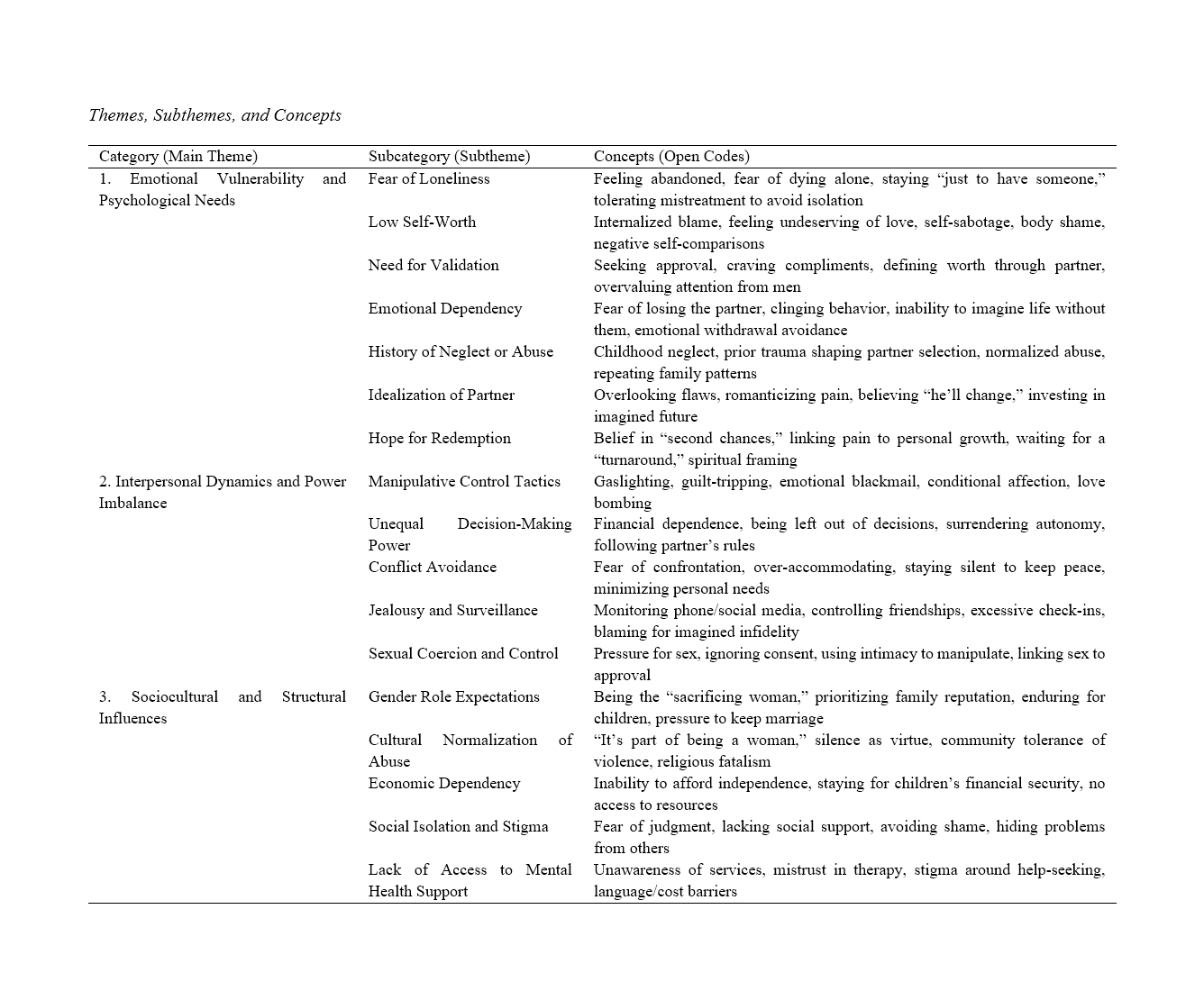
Findings: Three overarching themes emerged: (1) Emotional Vulnerability and Psychological Needs, including subthemes such as fear of loneliness, low self-worth, emotional dependency, and a need for validation; (2) Interpersonal Dynamics and Power Imbalance, highlighting manipulative control tactics, sexual coercion, and unequal decision-making power; and (3) Sociocultural and Structural Influences, encompassing traditional gender role expectations, economic dependence, stigma, and limited access to mental health support. Participants described enduring harmful relationships due to internalized relational schemas, structural constraints, and cultural narratives that framed endurance as moral strength. Emotional idealization of the partner and hope for redemption were also key drivers for continued engagement in high-risk dynamics.
Conclusion: Understanding these multilayered factors is critical for designing culturally responsive, trauma-informed interventions that promote safety, autonomy, and healing. Interventions must address not only individual emotional needs but also systemic barriers to support and empowerment.
Downloads
References
Asby, A. T., Heads, A. M., & Dickson, J. W. (2016). Living With Maternal HIV: Spirituality, Depression, and Family Functioning. American Journal of Health Sciences (Ajhs), 7(1), 15-22. https://doi.org/10.19030/ajhs.v7i1.9693
Basirat, Z., Sagalaksari, S. F. B., Sepidarkish, M., kashifard, m., & Faramarzi, M. (2023). Psychiatric Symptoms in Women With High-Risk Pregnancy in the Postpartum Period: A Case-Control Study. Revista Brasileira De Ginecologia E Obstetrícia / Rbgo Gynecology and Obstetrics, 45(04), 186-191. https://doi.org/10.1055/s-0043-1768997
Benkouider, A., & Lawati, E. A. (2023). Early Maladaptive Schemas as a Risk Factor for Breast Cancer in Algerian Women. Journal of Southwest Jiaotong University, 58(3). https://doi.org/10.35741/issn.0258-2724.58.3.53
Biagio, L. D., Devakumar, D., Silva, P. L. d., López, R. V. M., Argentato, P. P., Luzia, L. A., & Patrícia Helen de Carvalho, R. (2024). Violence, Mental Health and Nutritional Status in Pregnant Women: The Araraquara Cohort Study. Public Health Nutrition, 1-29. https://doi.org/10.1017/s1368980024002295
Costa, E. C. V., Moreira, L., Castanheira, E., Correira, P., Ribeiro, D., & Pereira, M. G. (2019). Demographic, Psychological and Relationship Factors Are Associated With Resource Loss Among Pregnant Women. Journal of Reproductive and Infant Psychology, 37(4), 429-443. https://doi.org/10.1080/02646838.2019.1577957
Deroncele-Acosta, Á., Figueroa, R. P. N., & Norabuena-Figueroa, E. D. (2025). Women’s Mental Health in the Doctoral Context: Protective Function of the Psychological Capital and Academic Motivation. Women S Health, 21. https://doi.org/10.1177/17455057251315318
Grocott, L. R., Brick, L. A., Stuart, G. L., & Shorey, R. C. (2024). Same-Day and Next-Day Associations Between Relational Factors and Intimate Partner Violence in Young Adult Couples. Psychology of violence, 14(2), 107-116. https://doi.org/10.1037/vio0000496
Handberg, E., Eastwood, J. A., Eteiba, W., Johnson, B. D., Krantz, D. S., Thompson, D. V., Vaccarino, V., Bittner, V., Sopko, G., Pepine, C. J., Merz, C. N. B., & Rutledge, T. (2013). Clinical Implications of the Women's Ischemia Syndrome Evaluation: Inter-Relationships Between Symptoms, Psychosocial Factors and Cardiovascular Outcomes. Women S Health, 9(5), 479-490. https://doi.org/10.2217/whe.13.50
Heijer, M. d., Gopie, J. P., & Tibben, A. (2013). Risk Factors for Psychological Distress in Women at Risk for Hereditary/Familial Breast Cancer: A Systematic Review. Breast Cancer Management, 2(2), 149-162. https://doi.org/10.2217/bmt.12.70
Jin, X., Xu, X., Qiu, J., Xu, Z., Lixue, S., Wang, Z., & Shan, L. (2021). Psychological Resilience of Second-Pregnancy Women in China: A Cross-Sectional Study of Influencing Factors. Asian Nursing Research, 15(2), 121-128. https://doi.org/10.1016/j.anr.2021.01.002
Kreis, M. K. F., Schwannauer, M., & Gillings, K. (2014). Relational Risk Factors for Reoffending in Women: A Systematic Review. International Journal of Forensic Mental Health, 13(4), 381-393. https://doi.org/10.1080/14999013.2014.962713
Downloads
Additional Files
Publication Timeline
- Submitted
- Revised
- Accepted
Issue
Section
License

This work is licensed under a Creative Commons Attribution-NonCommercial 4.0 International License.