Prediction of Covert Relational Aggression Based on Early Maladaptive Schemas and Fear of Intimacy in Married Women
DOI:
https://doi.org/10.61838/kman.pwj.4394Keywords:
aggression, covert relational aggression, early maladaptive schemas, intimacy, fear of intimacyAbstract
Objective: The present study was conducted with the aim of examining the role of early maladaptive schemas and fear of intimacy in the emergence of covert relational aggression in married women.
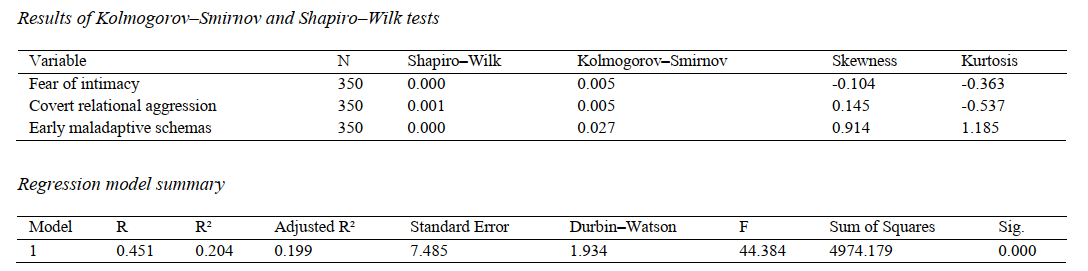
Methods and Materials: The study design was correlational, and data were collected using both library and field methods through standardized questionnaires. The statistical population consisted of married women residing in Tehran, from which a sample of 350 participants was selected using cluster sampling from districts 22, 1, 7, and 8. Data were analyzed at descriptive and inferential levels using the Kolmogorov–Smirnov test, multiple linear regression, and correlation analysis in SPSS version 23.
Findings: The results of multiple regression analysis showed that only fear of intimacy could significantly predict covert relational aggression (β = 0.428, p < 0.001), whereas early maladaptive schemas did not have a significant role in predicting this variable. Moreover, the results of the two subsidiary hypotheses indicated that there was a significant relationship between early maladaptive schemas and covert relational aggression, as well as between fear of intimacy and covert relational aggression. Consequently, fear of intimacy can be considered an influential factor in the occurrence of covert aggression.
Conclusion: It is suggested that psychological interventions aimed at reducing fear of intimacy be incorporated into programs designed to improve the quality of couples’ relationships.
Downloads
References
Afshin, A., Ganji, F., & Yaghobiyan, R. (2024). Predicting Marital Intimacy Based on Attachment Styles, Early Maladaptive Schemas, and Love Styles in Married Female Students. Aftj, 5(1), 108-114. https://doi.org/10.61838/kman.aftj.5.1.12
Clifford, C. E. (2013). Attachment and Covert Relational Aggression in Marriage with Shame as a Potential Moderating Variable: A Two Wave Panel Study https://search.proquest.com/openview/4be097da28c54e670809cffb5ba1f6d7/1?pq-origsite=gscholar&cbl=18750&diss=y
Cramer, C. M. (2015). Relational Aggression/Victimization and Depression in Married Couples https://search.proquest.com/openview/34630b0b3093bfa712ed75270c2dd604/1?pq-origsite=gscholar&cbl=18750
Din Doost, M., & Aghamohammadian Shoar Baf, H. R. (2022). Predicting fear of intimacy and covert relational aggression based on emotional expression styles in married offspring with parental experience of extramarital relationships. Proceedings of the 4th National Congress of the Iranian Scientific Association of Family Psychology: Successful Marriage and Healthy Parenting,
Frankel, L. A., Umemura, T., Jacobvitz, D., & Hazen, N. (2015). Marital conflict and parental responses to infant negative emotions: relations with toddler emotional regulation. Infant Behavior and Development, 40, 73-83. https://doi.org/10.1016/j.infbeh.2015.03.004
Gharibi, H., Emami, N., & Nabii, S. (2024). Effectiveness of empathy training on shame, guilt, and fear of intimacy in women with insecure attachment. Royesh Psychology, 13(2), 201-210. https://frooyesh.ir/article-1-4939-fa.html&sw=
GÜLer, K. (2024). The Mediating Role of Sexual Satisfaction and Anger in the Relationship Between Partner-Related Obsessive Compulsive Symptoms and Sexual Self-Schema. İstanbul Gelişim Üniversitesi Sağlık Bilimleri Dergisi(23), 522-537. https://doi.org/10.38079/igusabder.1492251
Hamidi Kian, P., Niknam, M., & Jahangir, P. A. (2021). Predicting covert marital aggression and fear of intimacy based on self-compassion with the mediating role of guilt in married individuals. Applied Family Therapy, 2(1), 65-90. https://doi.org/10.61838/kman.aftj.2.1.4
Heydari, H., Karimian, N., & Salari, S. (2015). Examining the relationship between fear of intimacy and identity styles with marital commitment in married individuals. Family Studies, 11(41), 73-86. https://www.sid.ir/fa/VEWSSID/J_pdf/78913944104.pdf
Khudamoradi, M., & Esmaeili, A. (2019). Effectiveness of marital life enrichment training on reducing fear of intimacy and improving sexual functioning. Assessment and Research in Counseling and Psychology, 1(2), 83-100. https://doi.org/10.61838/kman.jarac.1.2.6
Koppers, D., Van, H., Peen, J., & Dekker, J. J. M. (2021). Psychological symptoms, early maladaptive schemas and schema modes: Predictors of the outcome of group schema therapy in patients with personality disorders. Psychotherapy Research, 31(7), 831-842. https://doi.org/10.1080/10503307.2020.1852482
Majdi, F., Asadi, J., & Azizi, L. S. (2021). The relationship between early maladaptive schemas and fear of intimacy in couples aged 20 to 40 in Sari. Proceedings of the 6th International Conference on New Research in Counseling, Educational Sciences, and Psychology, Tehran,
Makarianpour, N., & Ghorbani, S. (2022). The role of early maladaptive schemas in predicting marital conflicts with the mediating role of fear of intimacy and resilience https://elmnet.ir/doc/10574124-13525
Malekimajd, M., Ameri, F., Pivastehgar, M., & Farahbijari, A. (2024). Examining the effectiveness of schema therapy on alexithymia, dysfunctional relationship beliefs, and sexual intimacy in married women with persistent depressive disorder. Disability Studies, 13(1), 1-10. https://jdisabilstud.org/browse.php?a_id=3130&slc_lang=en&sid=1&printcase=1&hbnr=1&hmb=1
Masoumi Tabar, S., Javaheri Amir, S., Nejati, S. Z., & Kamali, H. (2024). Investigating aggression within the family. Psychological and Educational Studies (Negareh Institute of Higher Education), 110(6), 361-367. https://www.noormags.ir/view/en/articlepage/2148712
Parrott, D. J., Halmos, M. B., Stappenbeck, C. A., & Moino, K. (2022). Intimate partner aggression during the COVID-19 pandemic: Associations with stress and heavy drinking. Psychology of violence, 12(2), 95-103. https://doi.org/10.1037/vio0000395
Rada, C., Gheonea, D., Ţieranu, C. G., & Popa, D. E. (2022). Diagnosis and Psychotherapeutic Needs by Early Maladaptive Schemas in Patients With Inflammatory Bowel Disease [Original Research]. Frontiers in psychology, 12. https://doi.org/10.3389/fpsyg.2021.807107
Roshampour, M. (2022). Effectiveness of cognitive-behavioral therapy on reducing covert relational aggression and increasing family resilience among women with marital conflicts in Khorramabad. Journal of Advances in Behavioral Sciences, 7(55), 277-289. http://ijndibs.com/browse.php?a_id=718&sid=1&slc_lang=fa
Saeedi Asl, S., & Rabati, F. (2021). Effectiveness of yoga therapy on early maladaptive schemas and emotional inhibition in depressed women: A semi-experimental study. Ibn Sina Nursing and Midwifery Care Journal (Scientific Journal of the Faculty of Nursing and Midwifery, Hamedan), 29(2), 137-145. https://doi.org/10.30699/ajnmc.29.2.137
Sifizadeh, H., Zarei Mahmoudabadi, H., & Bakhshayesh, A. (2019). The relationship between early maladaptive schemas and marital adjustment with the mediating role of fear of intimacy in married individuals. Family Studies, 15(4), 467-486. http://journals.sbu.ac.ir/article_97783.html
Solvati, M., & Yekeyezdan Doost, R. (2022). Schema Therapy: A Practical Guide for Clinical Psychology Specialists. Danjeh Publishing. https://www.arjmandpub.com/Book/522
Timoshkin, D. (2023). Nationalism, Purity, and Danger: “Cross-Border Intimacy” in Russian Digital Media. Sotsiologicheskoe Obozrenie / Russian Sociological Review, 22(2), 154-178. https://doi.org/10.17323/1728-192x-2023-2-154-178
Yoo, J. H., & Hong, J.-S. (2024). The Mediating Effect of Relationship Authenticity on the Relationship Between the Disconnection and Rejection Schema and Marital Intimacy: Actor and Partner Effects. Korean Association for Learner-Centered Curriculum and Instruction, 24(18), 935-952. https://doi.org/10.22251/jlcci.2024.24.18.935
Downloads
Additional Files
Publication Timeline
- Submitted
- Revised
- Accepted
Issue
Section
License
Copyright (c) 2026 Khadijeh Peyvasteh Hajimahalleh (Author); Mansooreh Fazilati (Corresponding Author)

This work is licensed under a Creative Commons Attribution-NonCommercial 4.0 International License.