Comparing the Effectiveness of Paradoxical Therapy and Cognitive-Behavioral Therapy on Body image in Women with Body Dysmorphic Disorder
DOI:
https://doi.org/10.61838/kman.pwj.4458Keywords:
paradoxical therapy, cognitive-behavioral therapy, body dysmorphic disorder, Body imageAbstract
Objective: The aim of this study was to compare the effectiveness of paradoxical therapy and cognitive-behavioral therapy (CBT) on body image in women with body dysmorphic disorder (BDD).
Methods and Materials: A quasi-experimental design with pretest, posttest, and three-month follow-up and a control group was used. The statistical population comprised all women seeking cosmetic surgery who attended aesthetic clinics in Tehran between October–December 2023. To identify individuals with BDD symptoms, the Body Dysmorphic Evaluation Scale (Rabaii et al., 2011) was administered to all clinic visitors. After scoring, those with elevated scores were evaluated through a diagnostic interview by a clinical psychologist. Ultimately, 45 participants were purposively selected and randomly assigned to two experimental groups and one control group. Research instruments included the Body image Questionnaire (Soweto and Garcia, 2002) and the BDD scale (Rabaii et al., 2020). Data were analyzed in SPSS-2 using repeated-measures ANOVA.
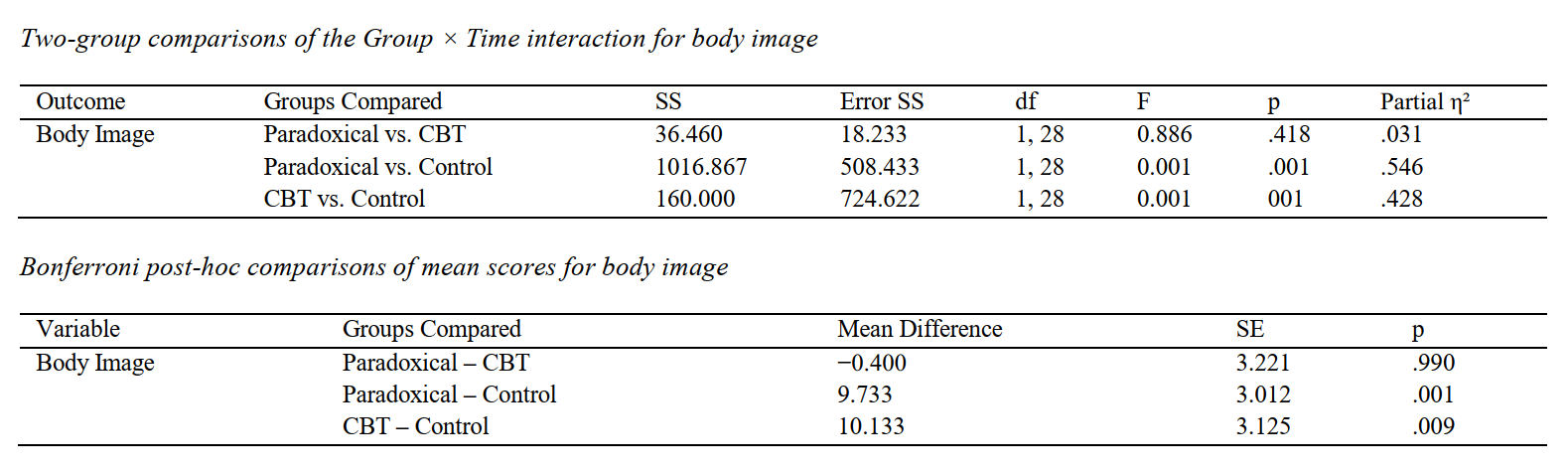
Findings: Results indicated no significant difference between the Paradoxical therapy and CBT groups in body image scores (F = 0.886, p > .05). However, the statistical analyses confirmed that both interventions significantly reduced body image relative to the control condition among women with body dysmorphic disorder.
Conclusion: Based on these findings, it can be concluded that the effectiveness of Paradoxical therapy and CBT in improving body image among women with body dysmorphic disorder does not differ significantly.
Downloads
References
Ahmadi, S., Rezaei, A., Samani, S., & Kazemi, S. (2020). Comparing the Effect of Exposure and Response Prevention and Paradoxical Time Table Therapy Techniques on the Obsessive-Compulsive Disorder Patients [Original]. Internal Medicine Today, 26(3), 244-259. https://doi.org/10.32598/hms.26.3.3093.3
Aliasgari, S., Farhangi, A., & Sedaghat, M. (2024). Comparison of the Effectiveness of Schema Therapy and Cognitive-Behavioral Therapy on Body Dysmorphic Disorder in Young Women with Body Dysmorphic Disorder. Journal of Psychological Dynamics in Mood Disorders (PDMD), 3(1), 30-40. https://doi.org/10.22034/pdmd.2024.448850.1062
Aliyari Khanshan Vatan, F., Ahadi, H., Kalhornia Golkar, M., & Sedaghat, M. (2023). Comparison of the effectiveness of cognitive behavioral therapy and emotion-oriented therapy on physical self-concept and distress tolerance of women with coronary heart disease. frooyesh, 12(9), 117-128. http://frooyesh.ir/article-1-4614-en.html
Babaei, V., Aboualmali Hosseini, K., & Habib Mohammad, B. (2023). Investigating the Effectiveness of Paradoxical Time Management Therapy on Anxiety Sensitivity and Attention Focus in Individuals with Social Anxiety Disorder. Psychological Sciences Journal, 22(125), 983-967. https://psychologicalscience.ir/article-1-2074-fa.html
Basharat, M. A. (2019a). The Application of Paradoxical Therapy for Treating Body Dysmorphic Disorder: A Case Study. Psychological Sciences Journal, 19(95), 1387-1371. https://psychologicalscience.ir/article-1-1025-fa.html
Basharat, M. A. (2019b). Assessing the Effectiveness of Paradoxical Therapy on Social Anxiety Disorder: A Case Study. Psychological Sciences Journal, 18(76), 396-383. https://psychologicalscience.ir/article-1-383-fa.html
Bernstein, E. E. (2024). The Use of Coaching in Smartphone App-Based Cognitive Behavioral Therapy for Body Dysmorphic Disorder. Internet Interventions, 36, 100743. https://doi.org/10.1016/j.invent.2024.100743
Besharat, M. A. (2020). Evaluating the effectiveness of paradoxical couple therapy for the treatment of couple problems: A case study. Iranian Journal of Family Psychology, 7(1), 1-18. https://doi.org/10.52547/ijfp.7.1.1
Besharat, M. A. (2023). The Effective Mechanisms of the Paradoxical Timetable. In M. A. Besharat (Ed.), Paradoxical Psychotherapy: A Practitioner’s Guide (pp. 23-27). Springer International Publishing. https://doi.org/10.1007/978-3-031-27717-7_5
Chitgarzadeh, M. J., Asayesh, M. H., Besharat, M. A., & Hakkak, F. (2023). Investigating the effectiveness of paradoxical couple therapy (PTC) on marital conflicts and emotion regulation in conflicting couples [Research]. Rooyesh-e-Ravanshenasi Journal(RRJ), 12(2), 39-50. http://frooyesh.ir/article-1-4107-en.html
Dargahi-Kafshgari, H., Yaghoubi-Hasankola, G., & Habibzadeh-Ahangarkolaei, Z. (2022). The effectiveness of cognitive-behavioral therapy on psychological distress and self-efficacy in patients with irritable bowel syndrome. International Journal of Body, Mind and Culture, 9(1), 22-28. https://doi.org/10.22122/ijbmc.v9i1.297
Dehaghin, V., Basharat, M. A., Gholam Ali Lavasani, M., & Naqsh, Z. (2023). The effectiveness of paradoxical therapy on relational practical obsessive-compulsive symptoms. Journal of Adolescent and Youth Psychological Studies, 4(4), 164-183. https://www.magiran.com/paper/2592864
Greenberg, J. L., Jacobson, N. C., Hoeppner, S. S., Bernstein, E. E., Snorrason, I., Schwartzberg, A., Steketee, G., Phillips, K. A., & Wilhelm, S. (2022). Early response to cognitive behavioral therapy for body dysmorphic disorder as a predictor of outcomes. Journal of psychiatric research, 152, 7-13. https://www.sciencedirect.com/science/article/pii/S0022395622002989
Greenberg, J. L., Phillips, K. A., Hoeppner, S. S., Jacobson, N. C., Fang, A., & Wilhelm, S. (2023). Mechanisms of cognitive behavioral therapy vs. supportive psychotherapy in body dysmorphic disorder: An exploratory mediation analysis. Behaviour Research and Therapy, 161, 104251. https://doi.org/10.1016/j.brat.2022.104251
Gu, Y. Q., & Zhu, Y. (2023). A randomized controlled trial of mindfulness-based cognitive therapy for body dysmorphic disorder: Impact on core symptoms, emotion dysregulation, and executive functioningJO - Journal of Behavior Therapy and Experimental Psychiatry. https://doi.org/10.1016/j.jbtep.2023.101869
Han, A., & Kim, T. H. (2022). Efficacy of Internet-Based Acceptance and Commitment Therapy for Depressive Symptoms, Anxiety, Stress, Psychological Distress, and Quality of Life: Systematic Review and Meta-analysis [Review]. J Med Internet Res, 24(12), e39727. https://doi.org/10.2196/39727
Jassi, A., & Krebs, G. (2023). Body Dysmorphic Disorder. Psychiatric Clinics of North America, 46(1), 197-209. https://doi.org/10.1016/j.psc.2022.10.005
Lundström, L., Flygare, O., Ivanova, E., Mataix-Cols, D., Enander, J., Pascal, D., Chen, L. L., Andersson, E. M., & Rück, C. (2023). Effectiveness of Internet-based cognitive-behavioural therapy for obsessive-compulsive disorder (OCD-NET) and body dysmorphic disorder (BDD-NET) in the Swedish public health system using the RE-AIM implementation framework. Internet Interventions, 31, 100608. https://doi.org/10.1016/j.invent.2023.100608
Mohammadi, Z., Soleimani, A., Fathi Ashtiani, A., Ashrafi, E., & Mokhaberi, K. (2019). Comparing the Effectiveness of Paradoxical Time Therapy, Exposure Therapy, Response Prevention, and Medication on Reducing Symptoms in Patients with Obsessive-Compulsive Disorder. Disability Studies Journal, 9, 63-63. https://jdisabilstud.org/browse.php?a_id=1637&sid=1&slc_lang=fa
Rabiei, M., Salahian, A., Bahrami, F., & Palahang, H. (2011). Construction and Standardization of the Body Dysmorphic Metacognition Questionnaire. J-Mazand-Univ-Med-Sci, 21(83), 43-52. http://jmums.mazums.ac.ir/article-1-688-en.html
Ritter, V., Schüller, J., Berkmann, E. M., von Soosten-Höllings-Lilge, L., & Stangier, U. (2023). Efficacy of Cognitive Therapy for Body Dysmorphic Disorder: A Randomized Controlled Pilot Trial. Behavior therapy, 54(1), 65-76. https://www.sciencedirect.com/science/article/pii/S0005789422000910
Downloads
Additional Files
Publication Timeline
- Submitted
- Revised
- Accepted
Issue
Section
License
Copyright (c) 2025 Elham Mahboubi (Author); Ali Shaker Dioulagh (Corresponding Author); Ali Khademi, Mohammad Hassan Asayesh (Author)

This work is licensed under a Creative Commons Attribution-NonCommercial 4.0 International License.