Contexts of Silence and Disclosure in Women’s Experiences of Workplace Harassment
DOI:
https://doi.org/10.61838/kman.pwj.4595Keywords:
Workplace harassment, silence, disclosure, women, ChileAbstract
Objective: This study aimed to explore how women in Chile experience, interpret, and navigate silence and disclosure in the context of workplace harassment.
Methods and Materials: Using a qualitative, interpretive design, the study employed semi-structured in-depth interviews with 17 women from diverse professional sectors in Chile, including education, healthcare, public administration, and corporate organizations. Participants were selected through purposive sampling, and data collection continued until theoretical saturation was achieved. Interviews were conducted in Spanish, transcribed verbatim, and analyzed using thematic analysis in NVivo 14 software following Braun and Clarke’s (2006) framework. The analysis identified recurrent patterns and contextual dynamics shaping participants’ decisions to remain silent or disclose their experiences. Ethical approval was secured to ensure confidentiality, informed consent, and voluntary participation.
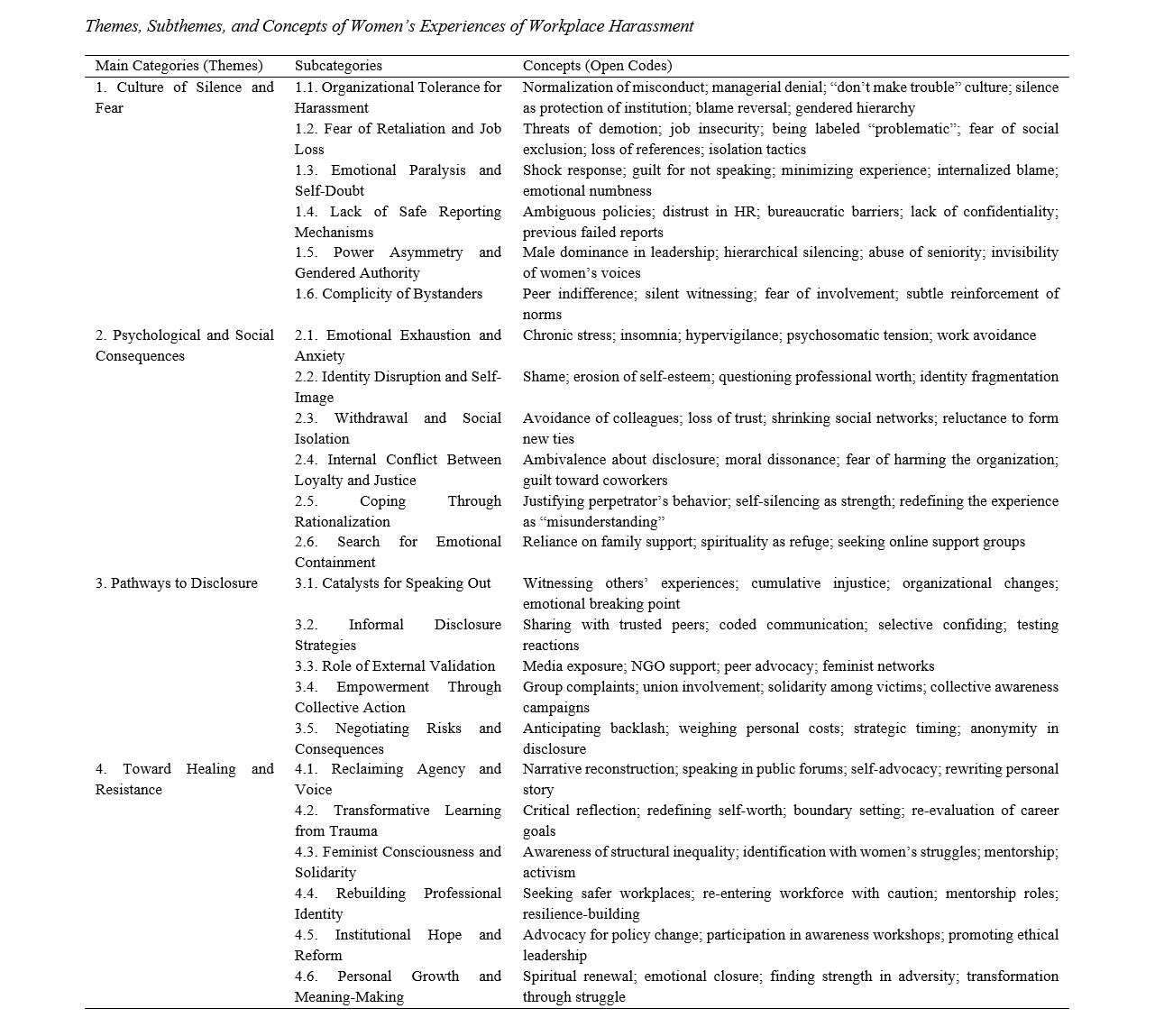
Findings: The analysis generated four major themes: (1) Culture of Silence and Fear, reflecting institutional tolerance, power asymmetry, and fear of retaliation; (2) Psychological and Social Consequences, encompassing emotional exhaustion, identity disruption, and withdrawal; (3) Pathways to Disclosure, illustrating incremental, strategic, and collective disclosure processes; and (4) Healing and Resistance, describing women’s efforts to reclaim agency through storytelling, solidarity, and advocacy. Findings revealed that silence was a learned survival strategy shaped by structural inequities, while disclosure emerged as a negotiated act dependent on social support, trust, and contextual safety.
Conclusion: The study highlights that workplace harassment is sustained by systemic silence rooted in fear, gender hierarchy, and institutional neglect. However, women’s acts of disclosure and resistance signify transformative pathways toward empowerment and organizational change.
Downloads
References
Anwar, S. M., Khan, A. A., & Sardar, Q. A. (2021). Workplace Harassment and Job Satisfaction: A Sociological Study Among Female Employees of Quetta (Balochistan). Journal of Management Practices Humanities and Social Sciences. https://doi.org/10.33152/jmphss-5.5.3
Ayesha, A., Zonia, Z., & Naqvi, S. (2020). Women Politicians Navigating the ‘Hostile Environment’ in Pakistan. Ids Bulletin, 51(2). https://doi.org/10.19088/1968-2020.129
Cassino, D., & Besen‐Cassino, Y. (2019). Race, Threat and Workplace Sexual Harassment: The Dynamics of Harassment in the United States, 1997–2016. Gender Work and Organization, 26(9), 1221-1240. https://doi.org/10.1111/gwao.12394
Fernando, D., & Prasad, A. (2018). Sex-Based Harassment and Organizational Silencing: How Women Are Led to Reluctant Acquiescence in Academia. Human Relations, 72(10), 1565-1594. https://doi.org/10.1177/0018726718809164
Gawali, S. B. (2023). Narratives From the Margin: Sexual Harassment and Strategies of Resistance. Caste / a Global Journal on Social Exclusion, 4(2), 403-416. https://doi.org/10.26812/caste.v4i2.603
Hadi, A. (2022). Workplace Sexual Harassment and Its Underreporting in Pakistan. European Journal of Interdisciplinary Studies, 8(2), 126-136. https://doi.org/10.26417/ejis.v10i1.p148-153
Hershcovis, M. S., Vranješ, I., Berdahl, J. L., & Cortina, L. M. (2021). See No Evil, Hear No Evil, Speak No Evil: Theorizing Network Silence Around Sexual Harassment. Journal of Applied Psychology, 106(12), 1834-1847. https://doi.org/10.1037/apl0000861
Lee, H., Moon, S.-Y., & Lee, N.-Y. (2023). Industry Culture Matters: Sexual Harassment in the South Korean Film Industry. Violence Against Women, 30(15-16), 4080-4100. https://doi.org/10.1177/10778012231203001
Liu, Q., Peng, Y., Shu, Z., Xie, Y., & Zhao, R. (2024). Female Non-Resistance to Sexual Harassment -- An Evolutionary Psychology Perspective. Communications in Humanities Research, 31(1), 85-91. https://doi.org/10.54254/2753-7064/31/20231922
McLaughlin, H., Uggen, C., & Blackstone, A. (2012). Sexual Harassment, Workplace Authority, and the Paradox of Power. American Sociological Review, 77(4), 625-647. https://doi.org/10.1177/0003122412451728
Mercado-Aravena, M. (2025). Workplace Harassment, Mental Health Challenges and Gender Equality. A Systematic Review. Salud Ciencia Y Tecnología, 5, 1182. https://doi.org/10.56294/saludcyt20251182
Paudel, M. (2022). Perceptions and Experiences of Sexual Harassment Among Educated Female in Kathmandu Nepal. Journal of Population and Development, 3(1), 84-92. https://doi.org/10.3126/jpd.v3i1.48808
Raj, A., Johns, N. E., & Jose, R. (2020). Gender Parity at Work and Its Association With Workplace Sexual Harassment. Workplace Health & Safety, 68(6), 279-292. https://doi.org/10.1177/2165079919900793
Sambaraju, R. (2020). “I Would Have Taken This to My Grave, Like Most Women”: Reporting Sexual Harassment During the #MeToo Movement in India. Journal of Social Issues, 76(3), 603-631. https://doi.org/10.1111/josi.12391
Spiliopoulou, A., & Witcomb, G. L. (2022). An Exploratory Investigation Into Women's Experience of Sexual Harassment in the Workplace. Violence Against Women, 29(9), 1853-1873. https://doi.org/10.1177/10778012221114921
Tatum, A. K. (2018). Workplace Climate and Satisfaction in Sexual Minority Populations: An Application of Social Cognitive Career Theory. Journal of counseling psychology, 65(5), 618-628. https://doi.org/10.1037/cou0000292
Tatum, A. K., & Lent, R. W. (2024). Identity Management Processes, Contextual Supports and Barriers, and Substance Use Among Sexual Minority Workers: A Social Cognitive Lens. Journal of counseling psychology, 71(1), 22-33. https://doi.org/10.1037/cou0000717
Vučković, M., Altvater, A., Sekei, L. H., & Kloss, K. (2017). Sexual Harassment and Gender-Based Violence in Tanzania’s Public Service. International Journal of Workplace Health Management, 10(2), 116-133. https://doi.org/10.1108/ijwhm-02-2015-0011
Zeighami, M., Zakeri, M. A., Shahrbabaki, P. M., & Dehghan, M. (2022). Bitter Silence Allows Sexual Harassment to Continue in Workplace: A Qualitative Study in Iranian Nurses. Frontiers in Public Health, 10. https://doi.org/10.3389/fpubh.2022.971522
Downloads
Additional Files
Publication Timeline
- Submitted
- Revised
- Accepted