A Comparison of the Effectiveness of Schema Therapy and Acceptance and Commitment Therapy on Experiential Avoidance in Women with Multiple Sclerosis
DOI:
https://doi.org/10.61838/kman.pwj.4961Keywords:
Multiple sclerosis, experiential avoidance, schema therapy, acceptance and commitment therapy, womenAbstract
Objective: The present study aimed to compare the effectiveness of schema therapy and acceptance and commitment therapy in reducing experiential avoidance among women diagnosed with multiple sclerosis.
Methods and Materials: This applied, quasi-experimental study employed a pretest–posttest–follow-up design with a control group. The statistical population consisted of women with multiple sclerosis who attended the Tehran Multiple Sclerosis Society during 2024–2025. Forty-five eligible participants were selected using accessible sampling and randomly assigned to three groups: schema therapy, acceptance and commitment therapy, and a control group, each comprising fifteen participants. The two intervention groups received ten group-based sessions of 90 minutes according to standardized therapeutic protocols, while the control group received no psychological intervention. Experiential avoidance was assessed at pretest, posttest, and follow-up using the Acceptance and Action Questionnaire–II. Data were analyzed using descriptive statistics and repeated-measures analysis of covariance, controlling for baseline scores, with post hoc comparisons conducted using Tukey’s HSD test.
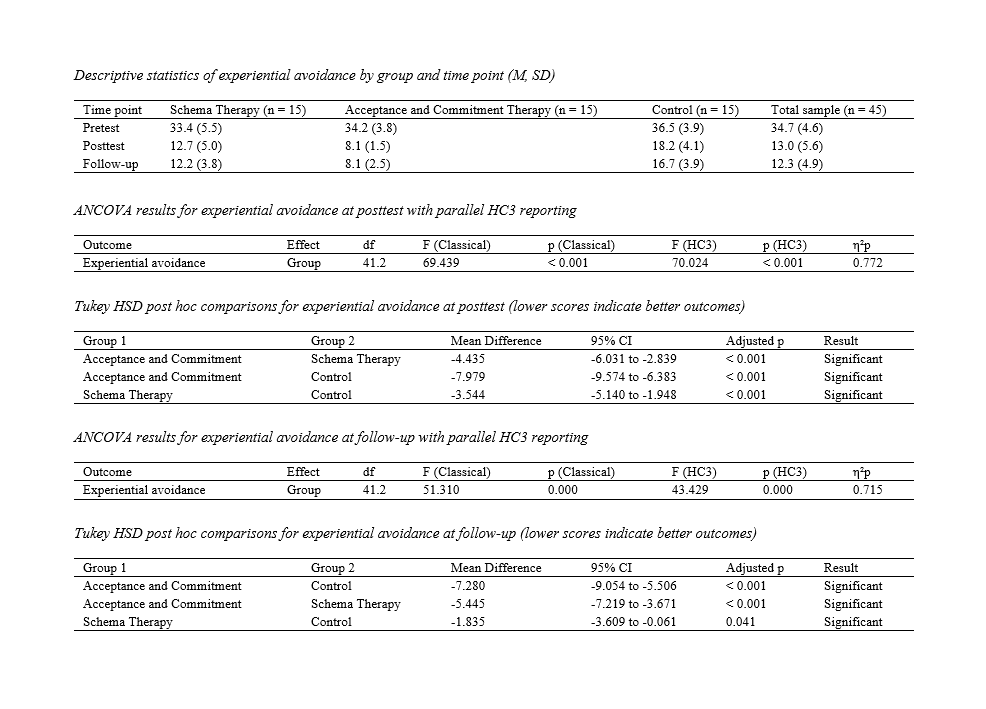
Findings: Inferential analyses demonstrated a statistically significant effect of group on experiential avoidance at posttest after controlling for pretest scores, as indicated by ANCOVA results (F = 69.44, p < 0.001, η²p = 0.77), confirming a large effect of the interventions. Post hoc Tukey HSD comparisons showed that the acceptance and commitment therapy group had significantly lower experiential avoidance scores than the schema therapy group (mean difference = −4.44, p < 0.001) and the control group (mean difference = −7.98, p < 0.001), and the schema therapy group also differed significantly from the control group (mean difference = −3.54, p < 0.001). At follow-up, the group effect remained statistically significant (F = 51.31, p < 0.001, η²p = 0.72), indicating sustained treatment effects over time. Pairwise comparisons at follow-up revealed that acceptance and commitment therapy continued to show significantly lower experiential avoidance compared with the control group (mean difference = −7.28, p < 0.001) and schema therapy (mean difference = −5.45, p < 0.001), while schema therapy also maintained a significant advantage over the control group (mean difference = −1.84, p = 0.041). These results indicate that both interventions produced significant and lasting reductions in experiential avoidance, with acceptance and commitment therapy demonstrating the strongest and most durable effects.
Conclusion: Both schema therapy and acceptance and commitment therapy are effective interventions for reducing experiential avoidance in women with multiple sclerosis; however, acceptance and commitment therapy appears to yield superior and more durable outcomes. These findings support the use of acceptance-based and schema-focused psychological interventions as part of comprehensive psychosocial care for women with multiple sclerosis.
Downloads
References
Alfoone, A., Imani, M., & Sarafraz, M. (2020). A Comparison of the Effectiveness of Group Therapy Based on Acceptance and Commitment Therapy and Cognitive Behavioral Therapy on Experiential Avoidance and Cognitive Fusion in Patients with Migraine Headache [Research]. Armaghane Danesh, 25(1), 69-83. https://doi.org/10.52547/armaghanj.25.1.69
Bowins, B. (2021). Chapter 11 - Acceptance and commitment therapy. In B. Bowins (Ed.), States and Processes for Mental Health (pp. 107-114). Academic Press. https://doi.org/https://doi.org/10.1016/B978-0-323-85049-0.00011-8
Broujeni, M. M., Sajjadian, I., & Golparvar, M. (2024). The Effectiveness of the Narrative-Based Acceptance and Commitment Counseling Package on Experiential Avoidance, Affective Capital and Desire to Divorce in Women on the Verge of Divorce. PWJ, 5(1), 23-35. https://doi.org/10.61838/kman.pwj.5.1.3
Changi Ashtiani, M., Fattahi, N., Balali, D., Alavi, S. H., & Mahmoudzadeh, M. (2024). Effectiveness of Mindfulness-Based Schema Therapy on Mental Pain and Experiential Avoidance in Patients with Cardiovascular Diseases. Journal of Assessment and Research in Applied Counseling (JARAC), 6(1), 90-96. https://doi.org/10.61838/kman.jarac.6.1.10
Dosa, E. A. (2021). The Journey Forward: An Acceptance and Commitment Therapy (ACT) Workshop for Breast Cancer Survivors in Primary Care: The Impact of Psychological Flexibility and Experiential Avoidance on Psychological Distress, Post-Traumatic Growth and Pervasive Fears of Cancer Recurrence. https://search.proquest.com/openview/654f23fd639a04279c46b6007cf811e2/1?pq-origsite=gscholar&cbl=18750&diss=y
Falletta-Cowden, N., & Hayes, S. C. (2022). 6.03 - Acceptance and Commitment Therapy: Applying Contextual Behavioral Science to the Therapeutic Process. In G. J. G. Asmundson (Ed.), Comprehensive Clinical Psychology (Second Edition) (pp. 34-57). Elsevier. https://doi.org/https://doi.org/10.1016/B978-0-12-818697-8.00173-4
Fernández-Rodríguez, C., Coto-Lesmes, R., Martínez-Loredo, V., González-Fernández, S., & Cuesta, M. (2023). Is Activation the Active Ingredient of Transdiagnostic Therapies? A Randomized Clinical Trial of Behavioral Activation, Acceptance and Commitment Therapy, and Transdiagnostic Cognitive-Behavioral Therapy for Emotional Disorders. Behavior Modification, 47(1), 3-45. https://doi.org/10.1177/01454455221083309
Finger, I. d. R., de Freitas, B. I., & Oliveira, M. d. S. (2020). Psychological inflexibility in overweight and obese people from the perspective of acceptance and commitment therapy (ACT). Eating and Weight Disorders - Studies on Anorexia, Bulimia and Obesity, 25(1), 169-175. https://doi.org/10.1007/s40519-018-0541-y
Ghatreh Samani, M., & Najafi, M. (2024). The Comparison Effectiveness of acceptance and commitment therapy with exposure and response prevention and schema therapy with exposure and response prevention on experiential Avoidance & perfectionism in patients with obsession and compulsion disorder. Journal of Psychology, 111(3), 323. https://doi.org/10.18502/qjcr.v23i91.16932
Ghayour, K. F., Shahhabizadeh, F., Safara, M., & Shahidsales, S. (2022). The Effectiveness of Transdiagnostic Intervention and Schema Therapy Based on Mindfulness on Emotional Distress and Experiential Avoidance in Patients With Breast Cancer With Follow-Up. https://jdisabilstud.org/browse.php?a_id=2792&slc_lang=fa&sid=1&printcase=1&hbnr=1&hmb=1
Jeng, B., J, C. K. L., E, S. J., & Motl, R. W. (2025). Sedentary behavior, physical activity, and health-related quality of life in adults with multiple sclerosis. Disability and Rehabilitation, 1-7. https://doi.org/10.1080/09638288.2025.2481981
Kamran, A., Rostamifar, R., & Moghtadaei, K. (2022). The effectiveness of acceptance and commitment therapy on experiential avoidance and emotional processing in patients with irritable bowel syndrome. Health Psychology, 11(41), 155-170.
Moeinzadeh, N., Souri, A., & Seadatee Shamir, A. (2025). Comparison of the Effectiveness of Compassion-Based and Mindfulness-Based Therapies on Dysfunctional Communication Beliefs in Women with Multiple Sclerosis. Iranian Journal of Neurodevelopmental Disorders, 4(2), 1-10.
Na, E., Lee, K., Jeon, B. H., Jo, C., Kwak, U. H., Jeon, Y., Yang, K., Lee, E. J., & Jeong, J. (2022). Acceptance and commitment therapy for destructive experiential avoidance (ACT-DEA): A feasibility study. International journal of environmental research and public health, 19(24), 16434. https://doi.org/10.3390/ijerph192416434
Nazari, F., Gharaei, B., & Zahedi Tajrishi, K. (2022). Investigating the Mediating Role of Emotional Dysregulation, Experiential Avoidance, and Rumination in the Relationship Between Emotional Schemas and Obsessive-Compulsive Symptoms. Iranian Journal of Psychiatry and Clinical Psychology (Andisheh and Raftar), 28(4), 466-479. https://doi.org/10.32598/ijpcp.28.4.4377.1
Nazari, F., Gharraee, B., & Tajrishi, K. Z. (2023). Mediating Role of Emotion Dysregulation, Experiential Avoidance, and Rumination in the Relationship of Emotional Schemas With Obsessive-Compulsive Disorder Symptoms. Iranian Journal of Psychiatry and Clinical Psychology, 28(4), 466-479. https://doi.org/10.32598/ijpcp.28.4.4377.1
Penney, E. S., & Norton, A. R. (2022). A Novel Application of the Schema Therapy Mode Model for Social Anxiety Disorder: A Naturalistic Case Study. Clinical Case Studies, 21(1), 34-47. https://doi.org/10.1177/15346501211027866
Rahmani, M., Jalali, M., Pourahmadi, E., & Abdolsamad, N. (2024). The effectiveness of schema therapy on emotional symptoms, lifestyle and experiential avoidance in Meniere's patients. Nurse and Physician in War, 12(44), 20-27. https://doi.org/10.32598/nurseandphysicianinwar.12.44.20
Rouyintan, S., Azadi, S., Khoramin, S., Babouei, A., & Sandoughchi, E. (2020). Effectiveness of Acceptance and Commitment Therapy on Mental Health and Experiential Avoidance in PTSD Patients. 23. https://zanko.muk.ac.ir/article-1-504-fa.html
Sedighi Arfaee, F., Rashidi, A., & Tabesh, R. (2021). The Distress Tolerance in the Elderly: The Role of Experiential Avoidance, Rumination and Mindfulness. Aging Psychology, 7(1), 12-11. https://doi.org/10.22126/jap.2021.6108.1498
Sierra, M. A., & Ortiz, E. (2023). Feasibility and effect of a self-help online acceptance and commitment therapy program focused on repetitive negative thinking for Colombian young women. Journal of Contextual Behavioral Science, 28, 127-138. https://doi.org/10.1016/j.jcbs.2023.03.010
Spencer, S. D., Meyer, Monet S, Masuda, Akihiko. (2023). A Case-Series Study Examining Acceptance and Commitment Therapy for Experiential Avoidance-Related Mixed Anxiety and Depression in a Telehealth Platform. Clinical Case Studies, 22(1), 78-96. https://doi.org/10.1177/15346501221115113
Tajzadghehi, A., moradi, h., & Bigdeli, H. (2023). Comparison of the effectiveness of group training based on early maladaptive schemas and mindfulness on experiential avoidance and distress tolerance (case study: teenage girls with high body mass index). Military Psychology, 14(2), 25-53. https://jmp.ihu.ac.ir/article_208254_d18dd4b41c53cf3c390c80df68c412b4.pdf
Wharton, E., Edwards, K. S., Juhasz, K., & Walser, R. D. (2019). Acceptance-based interventions in the treatment of PTSD: Group and individual pilot data using Acceptance and Commitment Therapy. Journal of Contextual Behavioral Science, 14, 55-64. https://doi.org/10.1016/j.jcbs.2019.09.006
Xiong, A., Lai, X., Wu, S., Yuan, X., Tang, J., Chen, J., Liu, Y., & Hu, M. (2021). Relationship Between Cognitive Fusion, Experiential Avoidance, and Obsessive–Compulsive Symptoms in Patients With Obsessive–Compulsive Disorder [Original Research]. Frontiers in psychology, 12. https://doi.org/10.3389/fpsyg.2021.655154
Zakiei, A., Khazaie, H., Rostampour, M., Lemola, S., Esmaeili, M., Dürsteler, K., Brühl, A., Sadeghi-Bahmani, D., & Brand, S. (2021). Acceptance and Commitment Therapy (ACT) Improves Sleep Quality, Experiential Avoidance, and Emotion Regulation in Individuals with Insomnia-Results from a Randomized Interventional Study. Life, 11(2), 133. https://doi.org/10.3390/life11020133
Downloads
Additional Files
Publication Timeline
- Submitted
- Revised
- Accepted