Comparison of the Effectiveness of Time Perspective and Emotional Efficacy-Based Interventions on Social-Emotional Loneliness and Self-Concealment in Single Women in the Climacteric Period
DOI:
https://doi.org/10.61838/Keywords:
Time perspective, emotional efficacy, loneliness, self-concealment, single women, climactericAbstract
Objective: This study aimed to compare the effectiveness of Time Perspective Therapy (TPT) and Emotional Efficacy Therapy (EET) on social-emotional loneliness and self-concealment among single women in the climacteric period.
Methods and Materials: This study employed a quasi-experimental, pre-test, post-test, and follow-up design with a control group. The statistical population consisted of single women navigating the climacteric phase. Participants were selected through purposive sampling and randomly assigned to one of three groups: Time Perspective Therapy, Emotional Efficacy Therapy, or a waitlist Control group. Data were collected using standardized self-report inventories measuring social-emotional loneliness (including romantic, family, and social subscales) and self-concealment. Data analysis was conducted using repeated measures ANOVA and Bonferroni post-hoc tests to evaluate the main effects and interactions across the three assessment phases.
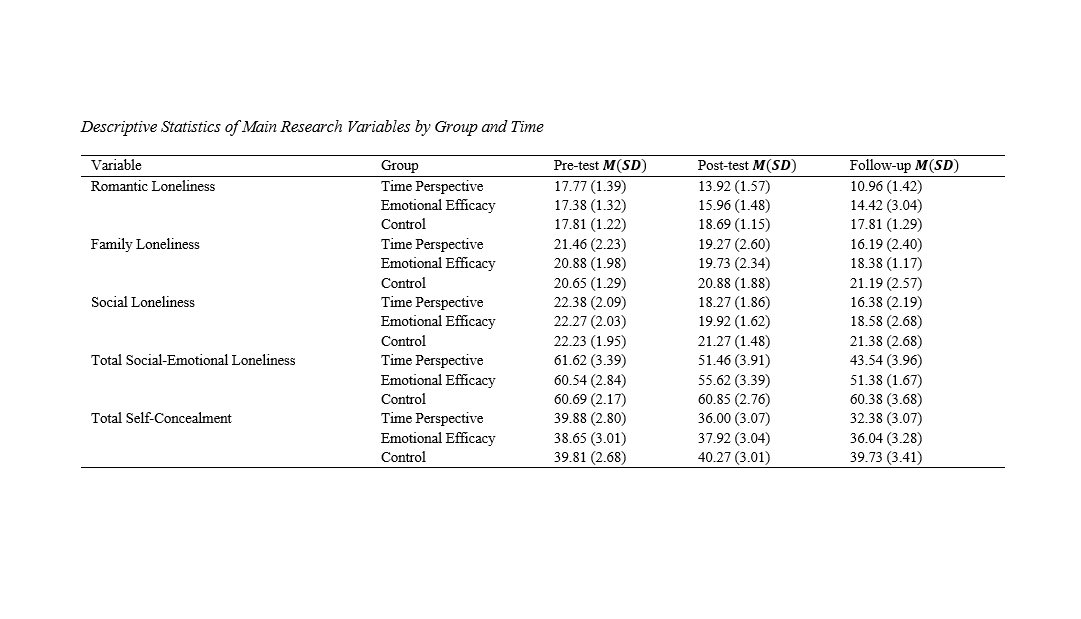
Findings: The repeated measures ANOVA demonstrated significant main effects of time and time group interactions for total social-emotional loneliness, romantic loneliness, family loneliness, social loneliness, and total self-concealment (all ). Bonferroni post-hoc analyses revealed that both TPT and EET significantly improved all measured outcomes across the post-test and follow-up phases compared to the control group. Crucially, the comparative analysis showed that TPT was significantly more effective than EET in reducing total social-emotional loneliness, romantic loneliness, social loneliness, and total self-concealment (all ). The only exception was family loneliness, where no statistically significant difference was observed between the TPT and EET groups ( ).
Conclusion: While both therapeutic modalities successfully alleviate psychological distress, Time Perspective Therapy is generally superior to Emotional Efficacy Therapy in reducing loneliness and self-concealment among single women in the climacteric period.
Downloads
References
Abdollahi, P. S., Kamkar, A., & Khosravi, S. (2023). Effectiveness of Dialectical Behavioral Therapy on Loneliness and Internet Addiction in students. Rooyesh, 12(10), 191-200.
Akbari Balootbangan, A., Mahvelaty, A., Zamani, Z., Abdpoor, F., & Hassanvandi, S. (2023). Prediction of victimization based on emotional intelligence with mediating role of loneliness and empathy: A structural equation modeling approach. Iranian journal of psychiatry and behavioral sciences, 17(2), e123998. https://doi.org/10.5812/ijpbs.123998
Akbari, H., Ghaffarian Mahbout, A., & Teimouri, M. (2021). A qualitative study of the role of family in delayed marriage of girls on the verge of definitive celibacy. The first national conference on social and cultural issues and challenges of the Iranian Muslim family,
Akpinar, E., Çelik, E., & Takunyacı, M. (2024). Exploring the relationship between self-concealment and attitudes towards social media, social appearance anxiety and sensation seeking. EKEV Academy Journal(98), 75-90. https://doi.org/10.17753/sosekev.1458772
Amorim, L. A. G., Da Fonseca, P. N., Machado, G. M. A., Guimaraes, C. L. C., & Da Silva, P. G. N. (2019). Social and emotional loneliness scale for European Congress of Psychiatry. European Psychiatry, 56(Suppl. 1), Abstract 114-289. https://doi.org/10.22235/cp.v13i2.1885
Aracı İyiaydın, A., & Ergun, A. (2025). Womanhood bound to motherhood: Choosing childlessness in Türkiye. BMC psychology, 13(1), 374. https://doi.org/10.1186/s40359-025-02661-9
Bagi, M. (2023). Reasons for delayed marriage and its determinants in Iran. Journal of Applied Sociology, 34(1), 31-50. https://dorl.net/dor/20.1001.1.20085745.1402.34.1.2.2
Dąbrowska, A., Marek-Banach, J., Łopatkiewicz, A., Zimbardo, P. H., & Wysocka, E. (2022). Time perspective and experience of depression, stress, and loneliness among adolescents in youth educational centres. Educational Research Review, 36(1), 91-119. https://doi.org/10.12775/PBE.2022.005
De Santiago Nogueira, C. M. C., Silva, B. D. D. S., Costa, H. M. G. S., de Alcantara, J. R., Morais, F. R. R., Ferreira Barros, R. J. M. L., Feitosa de Melo Rabelo, S. M., Vieira Pereira, E., Lopes de Paiva Cavalcanti, J. R., Teixeira Fernandes, N., & de Melo Fialho, A. V. (2022). Clinical profile and quality of life in climacteric women. BMC Nursing, 21(1), 233. https://doi.org/10.1186/s12912-022-00954-7
Duffner, L. A., Janssen, N., Deckers, K., Schroyen, S., de Vugt, M. E., Köhler, S., Adam, S., Verhey, F. R. J., & Veenstra, M. Y. (2024). Facing the next “geriatric giant”—A systematic literature review and meta-analysis of interventions tackling loneliness and social isolation among older adults. Journal of the American Medical Directors Association, 25(7), 1334-1350. https://doi.org/10.1016/j.jamda.2024.105110
Eisma, M. C., & Buyukcan-Tetik, A. (2025). Prolonged grief symptoms predict social and emotional loneliness and depression symptoms. Behavior therapy, 56, 121-132. https://doi.org/10.1016/j.beth.2024.04.014
Hulteen, R. M., Marlatt, K. L., Allerton, T. D., & Lovre, D. (2023). Detrimental changes in health during menopause: The role of physical activity. International journal of sports medicine, 44(6), 389-396. https://doi.org/10.1055/a-2003-9406
Jin, W., Zhan, T., Geng, Y., Shi, Y., Hu, W., & Ye, B. (2024). Social appearance anxiety among the dark tetrad and self-concealment. Scientific reports, 14, Article 4667. https://doi.org/10.1038/s41598-024-55422-w
Kaak, S., Ziade, F., & Mansour, C. (2025). Psychological impact of menopause on childless women in Lebanon: A comparative study of self-esteem, anxiety, and body image. Rihan Journal for Science Publishing(55).
Kalate Sadati, A., Sadeghieh, S., Jafari Naeimi, F., & Sadeghian Moghadam, Z. (2023). The intersection of culture and celibacy: Exploring individual and socio-cultural aspects of prolonged single life among unmarried women in Yazd, Iran. Journal of Population Association of Iran, 18(36), 51-91. https://doi.org/10.22034/jpai.2024.2023561.1333
Karimpour Natanzi, S., Radfar, S., Taher, M., & Davoudi Monfared, E. (2024). The Effectiveness of Acceptance and Commitment therapy on Self-Concealment of Adolescents with a History of Self-Injury admitted to the Psychiatric ward of the Hospital. Rooyesh, 13(8), 61-70.
Larson, D. G., Chastain, R. L., Hoyt, W. T., & Ayzenberg, R. (2015). Self-concealment: Integrative review and working model. Journal of Social and Clinical Psychology, 34(8), 705-774. https://doi.org/10.1521/jscp.2015.34.8.705
Li, G., Huang, W., Yang, Y., Fan, Z., & Guo, F. (2023). Relationship between reinforcement sensitivity personality and loneliness in the context of bullying experiences: The mediation effect of self-concealment. Studies of Psychology and Behavior, 21(5), 629-636. https://doi.org/10.12139/j.1672-0628.2023.05.008
Lin, S. L., Jo, D., Spencer, S. D., & Masuda, A. (2024). The role of engaged living in the association between self-concealment and psychological distress among racially diverse college students in Hawai‘i. Journal of Contextual Behavioral Science, 33, Article 100811. https://doi.org/10.1016/j.jcbs.2024.100811
MaKay, M., & West, A. (2016). Emotion efficacy therapy: A brief, exposure-based treatment for emotion regulation integrating ACT and DBT. New Harbinger Publications.
Mansoory Nezhad, R., Abdollahi, N., Mahmoodi, T., Abdolrasooli, L., & Zargar, Y. (2021). Investigate the relationship between social and emotional loneliness, fear of negative evaluation, thought suppression, and mindfulness with mediating self-concealment. Shenakht Journal of Psychology and Psychiatry, 8(3), 39-51. https://doi.org/10.32598/shenakht.8.3.39
Marlatt, K. L., Pitynski-Miller, D. R., Gavin, K. M., Moreau, K. L., Melanson, E. L., Santoro, N., & Kohrt, W. M. (2022). Body composition and cardiometabolic health across the menopause transition. Obesity (Silver Spring, Md.), 30(1), 14-27. https://doi.org/10.1002/oby.23289
Mazloom, M., Mohammadkhani, S., Akbari, M., Hasani, J., & Esfandbod, M. (2023). Comparing the mechanism of change of cognitive-behavioral therapy and emotion efficacy therapy in improving psychological adjustment of women with breast cancer: The role of cognitive and emotional flexibility, illness perception, and valued action. Int J Cogn Ther.
Mirhosseini, Z., & Hosseinzadeh, H. (2023). The backgrounds and platforms of absolute celibacy among employees (case study: Employees of Social Security Organization). Social Security Journal, 19(3), 45-70. https://doi.org/10.22034/qjo.2024.436558.1349
Mostowik, J., & Cyranka, K. (2018). New trends in psychotherapy: The role of time perspective in mental health and practiced therapeutic interventions. Psychoterapia, 184(1).
Najafi, M., Sajjadian, I., & Manshaee, G. (2024). Comparison the Effectiveness of Emotion Efficacy Therapy and Mindfulness-Based Cognitive Therapy on Affective Capital and Meta Emotion in Women with Generalized Anxiety Disorder. Res Clin Psychol Counsel, 14(1), 199-222.
Nowakowska, I. (2020). Lonely and thinking about the past: The role of time perspectives, Big Five traits and perceived social support in loneliness of young adults during COVID-19 social distancing. Current Issues in Personality Psychology, 8(3), 175-184. https://doi.org/10.5114/cipp.2020.97289
Park. (2025). The effect of social comparison orientation on self-concealment. Korean Psychological Journal of Culture and Social Issues, 31(1), 167-187. https://doi.org/10.20406/KJCS.2025.2.31.1.167
Petrenko, O., Balika, L., & Koval, K. (2024). The problem of loneliness and coping with stress in the context of life situations experienced by war refugees (based on the research conducted in Rivne, Ukraine). Zeszyty Naukowe Collegium Witelona, 50(1). https://doi.org/10.5604/01.3001.0054.7526
Rezaei, S., Moghadam Amir Aslani, M., Moazzi Vesal, M., Najafi, Z., & Heydari Sharaf, P. (2025). The Effectiveness of Cognitive-Behavioral Therapy on Loneliness and Self-Compassion in the Elderly. J Gerontol, 10(2), 64-73.
Sepidnameh, B., & Parvizi, F. (2024). Investigating the definite singleness of rural girls in Darreh Shahr City (A grounded theory). Journal of Social Problems of Iran, 14(2), 53-79. https://doi.org/10.22059/ijsp.2024.331908.670943
Shahrokh Afshari, I., Savabi Niri, V., Fadaei Goke, F., Bagheri Sheykhangafshe, F., & Esrafilian, F. (2025). The Effectiveness of Dialectical Behavior Therapy in Reducing Fear of Compassion and Self-Concealment while Enhancing Emotion Efficacy in Female Adolescents with Suicidal Ideation. Health Dev J.
Sword, R. M., Sword, R. K. M., Brunskill, S. R., & Zimbardo, P. G. (2014). Time Perspective Therapy: A new time-based metaphor therapy for PTSD. Journal of Loss and Trauma, 19(3), 197-201. https://doi.org/10.1080/15325024.2013.763632
Wolters, N. E., Mobach, L., Wuthrich, V. M., Vonk, P., Van der Heijde, C. M., & Wiers, R. W. (2023). Emotional and social loneliness and their unique links with social isolation, depression and anxiety. J Affect Disord, 329, 207-217.
Zimbardo, P. G., & Boyd, J. N. (2015). The time cure: Overcoming PTSD, anxiety, and anger with time perspective therapy. Jossey-Bass.
Zimbardo, P. G., Sword, R. M., & Sword, R. K. (2012). The time cure: Overcoming PTSD with the new psychology of time perspective therapy. Jossey-Bass.
Ziyaasghari, N., Khademian, T., & Nouroozi, F. (2024). A sociological study permanent of singlehood among women in Tehran (A case study of women aged 40-50 in Districts 3, 10, and 19 of Tehran). Sociology of Education, 10(2), 264-273. https://doi.org/10.22034/ijes.2024.2045101.1647
Downloads
Additional Files
Publication Timeline
- Submitted
- Revised
- Accepted