Using Machine Learning to Identify Latent Profiles of Somatosensory Amplification and Catastrophic Misinterpretation of Bodily Cues in Psychosomatic Patients
DOI:
https://doi.org/10.61838/kman.pwj.5168Keywords:
Advocacy Behavior, Machine Learning, Collective Identity, Perceived Efficacy, Social Network Centrality, Women’s EmpowermentAbstract
Objective: To utilize a machine learning framework to evaluate and interpret the predictive power and complex interactions of perceived efficacy, social network centrality, and collective identity strength on the advocacy behavior of women.
Methods and Materials: This cross-sectional quantitative study analyzed data from a stratified random sample of exactly women in South Africa. Validated self-report scales measured advocacy behavior, internal and external perceived efficacy, social network centrality (derived via an egocentric generator), and collective identity strength. Predictive modeling compared four machine learning algorithms (Gradient Boosting Machine, Random Forest, Support Vector Machine, and Logistic Regression) using an training and testing data partition. Model performance was evaluated using and -score metrics, with SHAP values extracted from the optimal model for feature interpretability.
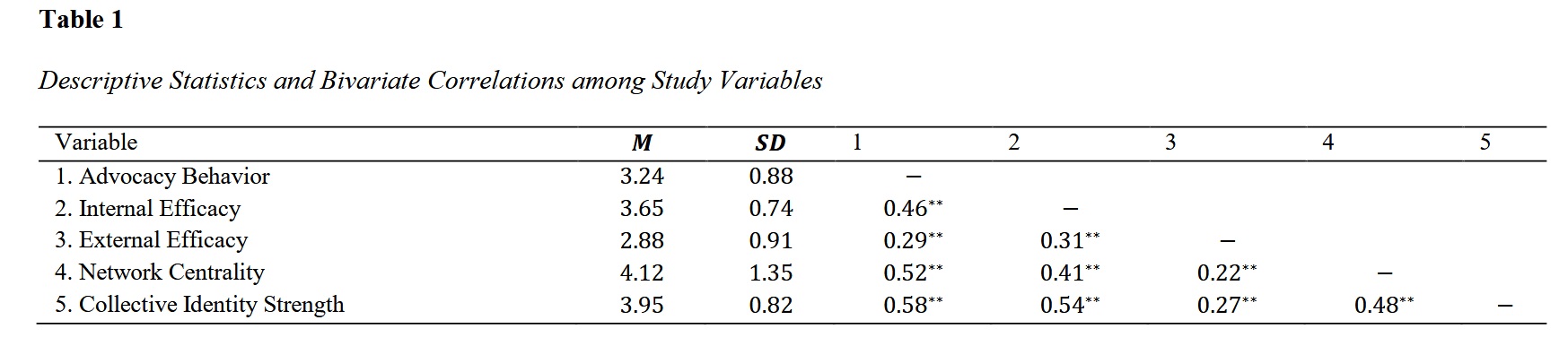
Findings: Tree-based ensemble methods significantly outperformed linear baselines, with the Gradient Boosting Machine achieving the highest of on the test set. SHAP analysis demonstrated that Collective Identity Strength (Mean Absolute SHAP Value of ) was the paramount predictor, followed by Social Network Centrality ( ). Furthermore, Internal Perceived Efficacy ( ) was a substantially stronger predictor than External Perceived Efficacy ( ). Bivariate analyses corroborated these algorithmic outputs, showing advocacy behavior correlated most strongly with Collective Identity Strength ( , ).
Conclusion: Advocacy behavior in women is optimally predicted by a non-linear integration dominated by collective identity strength, structural network position, and internal self-efficacy.
Downloads
References
Antone, N., Kizub, D., Gralow, J., Zujewski, J. A., & Dvaladze, A. (2021). Advancing breast cancer advocacy in Eastern Europe and Central Asia: Findings from Women's empowerment cancer advocacy network (WE CAN) summits. JCO Global Oncology, 7, 585-592. https://doi.org/10.1200/GO.20.00532
Canto, J. M., & Vallejo-Martín, M. (2021). The Effects of Social Identity and Emotional Connection on Subjective Well-Being in Times of the COVID-19 Pandemic for a Spanish Sample. International journal of environmental research and public health, 18(19).
DiCarlo, S. I., Oliveros, A. D., & Åsberg, K. K. (2023). Parent-child concordance and treatment outcome of trauma-focused cognitive behavioral therapy in a child advocacy center. Journal of Family Trauma, Child Custody & Child Development, 1-14. https://doi.org/10.1080/26904586.2023.2244942
Gregorash, A., Tadros, E., & Jhuremalani, A. (2023). Even Wonder Woman Couldn’t Do It All: The Impacts of Superwoman Syndrome on Women with Incarcerated Partners. Applied Family Therapy Journal (AFTJ), 4(2), 143-155. https://doi.org/10.61838/kman.aftj.4.2.9
Hanachi, N., Khademian, T., & Adhami, A. (2023). Sociological Investigation of Cultural-Social Influence of Afghanistan Immigrant Families from Iran (Case study of Tehran city) [Research Article]. Iranian Journal of Educational Sociology, 6(2), 122-130. https://doi.org/10.61186/ijes.6.2.122
Hezarjaribi, J., & Lohrasbi, S. (2011). The control of relationship between social capital and the rate of collective identity. https://www.sid.ir/paper/154804/en
Hosseini, M. (2023). The Impact of Social Environment on the Architecture of Qajar Houses: A View on Collective Identity. Journal of Sociology and Architecture, 8(2), 92-102.
Kann, C., Hashash, S., Steinert-Threlkeld, Z., & Alvarez, R. M. (2023). Collective identity in collective action: evidence from the 2020 summer BLM protests [Original Research]. Frontiers in Political Science, 5. https://doi.org/10.3389/fpos.2023.1185633
Karna, W., & Batthyany, K. (2025). Identifying the Cognitive and Emotional Components of Self-Advocacy in Exceptional Learners. Psychological Research in Individuals with Exceptional Needs, 3(1), 19-26. https://doi.org/10.61838/kman.prien.3.1.3
Karstensen, V. (2025). Predicting Adaptive Behavior by Self-Advocacy and Resilience in Adults with ADHD. Psychological Research in Individuals with Exceptional Needs, 3(1), 36-42. https://doi.org/10.61838/kman.prien.3.1.5
Mackay, C. M. L., Schmitt, M. T., Lutz, A. E., & Mendel, J. (2021). Recent developments in the social identity approach to the psychology of climate change. Current opinion in psychology, 42, 95-101. https://doi.org/10.1016/j.copsyc.2021.04.009
Milan, S. (2015). From Social Movement to Cloud Protesting: The Evolution of Collective Identity. Information, Communication and Society. https://doi.org/10.1080/1369118X.2015.1043135
Moturu, B. P., & Lent, R. W. (2022). Self-Assertive Efficacy and Workplace Advocacy Behavior: A Social Cognitive Analysis. Journal of counseling psychology. https://doi.org/10.1037/cou0000645
Neufeld, A., Harrison, M. J., Stewart, M., & Hughes, K. (2008). Advocacy of Women Family Caregivers: Response to Nonsupportive Interactions With Professionals. Qualitative Health Research, 18(3), 301-310. https://doi.org/10.1177/1049732307313768
Patel, H., & Volgman, A. S. (2021). Women in Cardiology: Role of Social Media in Advocacy. Current Cardiology Reviews. https://doi.org/10.2174/1573403x16666200203104851
Rabani, R., Karimizadeh Ardakani, S., Nazari, J., & Rezaei Aminlouei, H. (2009). Explaining Social Vitality among Ethnic Groups and Its Relationship with Collective Identity (Case Study of Azeri, Kurdish, and Lur Ethnicities). Sociological studies, 2(4), 95-115. https://journals.iau.ir/article_520943.html
Sauder, M. H. (2024). Worth a Shot? The Impact of Athletes' Vaccine Advocacy on Fan Attitudes and Behaviors. Sport Marketing Quarterly, 33(2), 181-196. https://doi.org/10.32731/smq.2024.a929613
Schneider, S. K., & Northcraft, G. B. (1999). Three Social Dilemmas of Workforce Diversity in Organizations: A Social Identity Perspective. Human Relations, 52(11), 1445-1467. https://doi.org/10.1177/001872679905201105
Downloads
Additional Files
Publication Timeline
- Submitted
- Revised
- Accepted