Comparison of the Effectiveness of Relational Imagery Therapy and Acceptance and Commitment Therapy on Communication Patterns in Women Experiencing Marital Infidelity
DOI:
https://doi.org/10.61838/Keywords:
Relational imagery therapy, acceptance and commitment therapy, communication patterns, marital infidelityAbstract
Objective: The present study aimed to examine and compare the effectiveness of relational imagery therapy and acceptance and commitment therapy (ACT) on communication patterns in women confronted with marital infidelity.
Methods and Materials: This research employed a quasi-experimental design with three stages (pretest, posttest, and a three-month follow-up) alongside a control group. The statistical population consisted of women aged 25 to 45 who referred to the Sina Counseling Center in Nowshahr after experiencing marital infidelity. From this population, 45 women were selected purposively and randomly assigned to three equal groups of 15: a relational imagery therapy group, an ACT group, and a control group. The Communication Patterns Questionnaire (Christensen & Sullaway, 1984) was used for data collection. Participants in the experimental groups received eight 90-minute intervention sessions twice a week. The collected data were analyzed using a mixed multivariate analysis of variance.
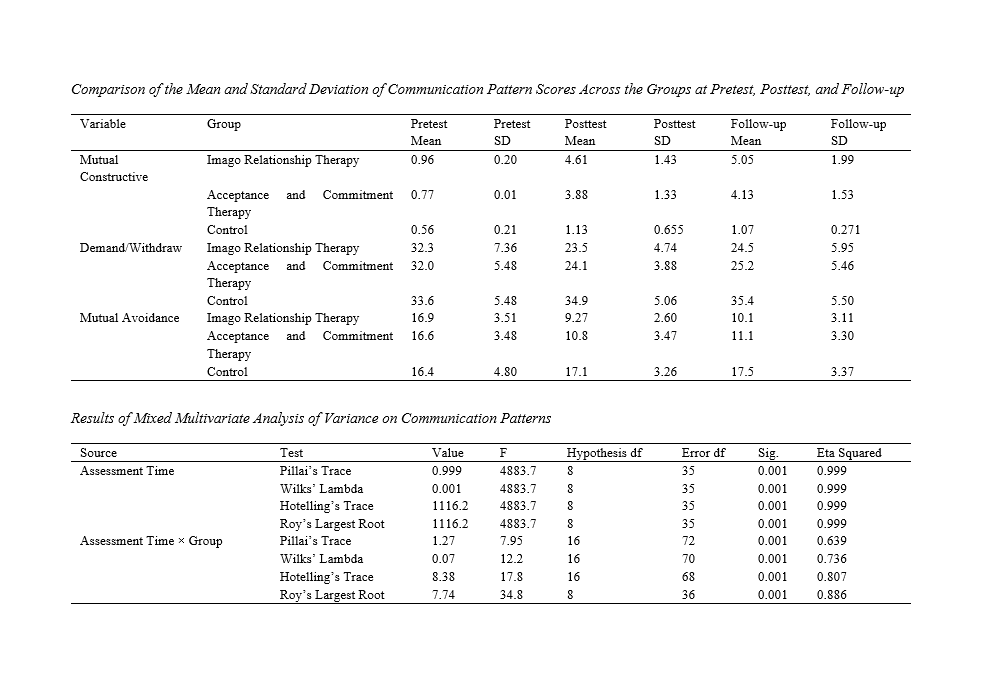
Findings: The results demonstrated that both relational imagery therapy and acceptance and commitment therapy were effective in improving communication patterns among women facing marital infidelity. However, no significant difference was found between the two treatment groups regarding their degree of improvement.
Conclusion: These findings elucidate the importance of relational imagery-based interventions in enhancing the emotional and functional indicators of women affected by marital infidelity, underscoring the necessity of employing this approach in couple counseling services.
Downloads
References
Barimani, P. (2024). Effectiveness of transdiagnostic child therapy combined with maternal acceptance and commitment intervention on anxiety and depression in anxious children and obsessive thoughts related to covid-19 in mothers with corona anxiety. Jarac, 6(2), 44-55.
Beheshtinejad, S., Khayatan, F., & Manshaei, G. R. (2022). A Comparison between the Effectiveness of Mindfulness and Imagotherapy on Intimacy and Commitment among Couples Having Spouses with Attention Deficit Hyperactivity Disorder.
Ben-Ari, K. (2022). Healing Through the Screen: Using Imago Relationship Therapy Online. In Advances in Online Therapy (pp. 240-248). Routledge.
Burns, J. W., Lumley, M. A., Vowles, K. E., Jensen, M. P., Day, M. A., Schubiner, H., & You, D. S. (2025). Comparative main effects, mediators, and moderators of cognitive behavioral therapy, acceptance and commitment therapy, and emotional awareness and expression therapy for chronic spinal pain: Randomized controlled trial rationale and protocol. Contemporary Clinical Trials Communications, 44, 101428.
Carvalho, S. A., Gillanders, D., Forte, T., Trindade, I. A., Pinto-Gouveia, J., Lapa, T., & Castilho, P. (2024). Self-compassion in Acceptance and Commitment Therapy for chronic pain: a pilot study. Scandinavian journal of pain, 22(3), 631-638.
Cheraey, L., Goudarzi, M., & Akbary, M. (2019). Comparing the effectiveness of couple therapy with imago-therapy and Feldman's integrated approach on intimacy commitment of conflicting spouses. Quarterly Journal of Woman and Society, 10(39), 239-254.
Dehnavi, T. G., Yousefi, Z., & Farhadi, H. (2023). The effectiveness of imago therapy on marital satisfaction and emotional experience towards the spouse among the men with marital conflicts. Journal of education and health promotion, 12(1), 418.
Fang, S., & Ding, D. (2024). A meta-analysis of the efficacy of acceptance and commitment therapy for children. Journal of Contextual Behavioral Science, 15, 225-234.
Farahani, F., & Delavar, A. (2018). Comparison of the effectiveness of coupled communication imaging therapy (imago therapy) with acceptance and commitment therapy (ACT) on the mental health of couples. Iranian Journal of Educational Sociology, 1(9), 91-103.
Fatehi, M., Golparvar, M., & Mehdad, A. (2024). Comparison of the Effectiveness of Imago Therapy Package for Affective Breakdown and Trauma Specific Cognitive-Behavioral Therapy on Anxiety and Negative Affects among Adolescent Girl.
Faulkner, J. W., Chua, J., Voice-Powell, A., Snell, D. L., Roche, M., Moffat, J., & Theadom, A. (2025). Experience of Acceptance and Commitment Therapy for those with mild traumatic brain injury (ACTion mTBI): A qualitative descriptive study. PLoS One, 20(1), e0312940.
Fauth, E. B., Novak, J. R., & Levin, M. E. (2024). Outcomes from a pilot online Acceptance and Commitment Therapy program for dementia family caregivers. Aging & mental health, 26(8), 1620-1629.
Ferreira, M. G., Mariano, L. I., de Rezende, J. V., Caramelli, P., & Kishita, N. (2022). Effects of group Acceptance and Commitment Therapy (ACT) on anxiety and depressive symptoms in adults: A meta-analysis. Journal of affective disorders, 309, 297-308.
Gehlert, N., Schmidt, C., Giegerich, V., & Luquet, W. (2017). Randomized controlled trial of imago relationship therapy: exploring statistical and clinical significance. Journal of Couple & Relationship Therapy, 16(3), 188-209.
Ghaffari, A., Zomorodi, S., & Ghodrati, S. (2025). The Effectiveness of Imago Therapy on Love Styles and Communication Problems in Married Women. Preventive Counseling, 6(1).
Güven, N., & İskender, M. (2023). An Application of The Imago Relationship Approach and Group Counselling for Developing the Marriage Relationship. Bayburt Eğitim Fakültesi Dergisi, 18(39), 1047-1069.
Han, A., & Kim, T. H. (2022). Efficacy of internet-based acceptance and commitment therapy for depressive symptoms, anxiety, stress, psychological distress, and quality of life: Systematic review and meta-analysis. Journal of medical Internet research, 24(12), e39727.
Hashemizadeh, F. S., Atashpour, S. H., & Farhadi, H. (2024). Comparison of the Effectiveness of Acceptance and Commitment Therapy Matrix (ACTM) and Emotion-Focused Therapy (EFT) on Family Adaptability and Emotional Self-Regulation in Women with Marital Conflict. Psychology of Woman Journal, 5(2), 76-88.
Hassanzadeh, A., Afshar, E. K., & Dehghani, F. (2024). Comparing the effectiveness of emotion-focused therapy and imago therapy on couple relationship in Zarand city. Quarterly Journal of Psychological Methods and Models Winter, 14(54).
Hendrix, H., & Hunt, H. L. (2021). Doing imago relationship therapy in the space-between: A clinician's guide. WW Norton & Company.
Ivanova, I. (2023). The history of the development of imago therapy in russia. Transactional Analysis in Russia, 3(3), 60-68.
Jalili, M., Saadi, Z. E., Pasha, R., Asgari, P., & Hafezi, F. (2022). Comparing the Effectiveness of Imago-Therapy and Transactional Analysis in Improving Communication Skills, Conflict Resolution and Rejection Sensitivity of Couples Referred to Masjed Soleiman Counseling Centers. Journal of counseling research.
Karimi, Z. (2023). Effectiveness of acceptance and commitment therapy on alexithymia in women experiencing infidelity. PWJ, 4(4), 48-54.
Khatibi, J. (2024). Examining the effectiveness of the imago therapy approach on marital adjustment and love styles in married students with early marriages. Jarac, 6(4), 198-206.
Khodabakhsh, S. (2024). The effectiveness of imago therapy on resilience and difficulty in emotion regulation in women victims of domestic violence. PWJ, 5(4), 77-88.
Krok, D., Telka, E., & Moroń, M. (2025). Marital satisfaction, partner communication, and illness acceptance among couples coping with breast cancer: a dyadic approach. Psycho-Oncology, 32(8), 1240-1247.
Lappalainen, P., Pakkala, I., Lappalainen, R., & Nikander, R. (2024). Supported web-based Acceptance and Commitment Therapy for older family caregivers (CareACT) compared to usual care. Clinical Gerontologist, 45(4), 939-955.
Levin, M. E., Krafft, J., & Twohig, M. P. (2024). An overview of research on Acceptance and Commitment Therapy. Psychiatric Clinics.
Luquet, W., & Muro, L. (2018). Imago relationship therapy alignment with marriage and family common factors. The Family Journal, 26(4), 405-410.
Malestroit, M., Brand-Arpon, V., Courtet, P., & Ducasse, D. (2025). Acceptance and commitment therapy reduces perceived ostracism in suicidal patients. Annals of General Psychiatry, 24, 8.
Montaner, X., Tárrega, S., Pulgarin, M., & Moix, J. (2023). Effectiveness of acceptance and commitment therapy (ACT) in professional dementia caregivers burnout. Clinical Gerontologist, 45(4), 915-926.
Murphy, S., & Samuel, V. (2025). Implementing a brief universal Acceptance and Commitment Therapy (ACT) intervention (InTER-ACT) for secondary school students: a qualitative evaluation of the experiences of teachers and school counsellors. Pastoral Care in Education, 1-29.
Najibzadegan, A. (2024). Efficacy of acceptance and commitment therapy on intimacy, marital forgiveness, and marital burnout in women affected by extramarital relationships. Aftj, 5(3), 102-112.
Nemati, N. (2024). Effectiveness of imago therapy on cognitive flexibility and post-traumatic growth in women affected by extramarital affairs. Aftj, 5(4), 148-155.
Poloee, M., Yaghubi, H., & Toosi, M. S. (2024). Comparing the effectiveness of Cognitive Behavioral Therapy (CBT) and Acceptance and Commitment Therapy (ACT) on the characteristics of Sternberg's love model in couples. Journal of Fundamentals of Mental Health, 26(1).
Prudenzi, A., Graham, C. D., Clancy, F., Hill, D., O'Driscoll, R., Day, F., & O'Connor, D. B. (2025). Group-based acceptance and commitment therapy interventions for improving general distress and work-related distress in healthcare professionals: A systematic review and meta-analysis. Journal of affective disorders, 295, 192-202.
Rauwenhoff, J. C., Bol, Y., van Heugten, C. M., Batink, T., Geusgens, C. A., van den Hout, A. J., & Peeters, F. (2023). Acceptance and commitment therapy for people with acquired brain injury: rationale and description of the BrainACT treatment. Clinical Rehabilitation, 37(8), 1011-1025.
Reyes, A. T. (2023). The process of learning mindfulness and acceptance through the use of a mobile app based on acceptance and commitment therapy: a grounded theory analysis. Issues in Mental Health Nursing, 43(1), 3-12.
Richards, R., Jones, R. A., Whittle, F., Hughes, C. A., Hill, A. J., Lawlor, E. R., & Ahern, A. L. (2024). Development of a Web-Based, Guided Self-help, Acceptance and Commitment Therapy–Based Intervention for Weight Loss Maintenance: Evidence-, Theory-, and Person-Based Approach. Jmir Formative Research, 6(1), e31801.
Roberts, M. Z., Tifft, E. D., Forsyth, J. P., & Boswell, J. F. (2025). Acceptance and Commitment Teletherapy for Mixed Anxiety and Depressive Symptoms During the COVID-19 Pandemic: A Case Study. Clinical Case Studies, 15346501241283059.
Selby, M., & Salavati, E. A. (2025). Acceptance and Commitment Model of Borderline Personality Disorder. In Theories of Borderline Personality Disorder: Concepts and Empirical Base (pp. 247-266). Springer Nature Switzerland.
Solgi, M., Habibzadeh, A., & Soltanifar, M. (2026). Improving Organizational Communication Patterns with a Geopolitical Approach to Information and Communication Technology. Geography (Regional Planning), 15(58).
Trindade, I. A., Guiomar, R., Carvalho, S. A., Duarte, J., Lapa, T., Menezes, P., & Castilho, P. (2023). Efficacy of online-based acceptance and commitment therapy for chronic pain: A systematic review and meta-analysis. The Journal of Pain, 22(11), 1328-1342.
Wang, D., Lin, B., Du, J., Liu, W., Sun, T., Li, Q., & Xiao, L. (2025). Acceptance and commitment therapy for nurses’ sleep, rumination, psychological flexibility, and it's neural mechanism: A randomized controlled fNIRS study. International Journal of Clinical and Health Psychology, 25(1), 100543.
Wilson, A. N. (2025). Introduction to the Special Section: Spotlight on Acceptance and Commitment Training. Behavior Analysis in Practice, 1-3.
Downloads
Additional Files
Publication Timeline
- Submitted
- Revised
- Accepted