Latent Class Analysis of Cognitive Load Profiles in Women Experiencing Impostor Phenomenon: Implications for Academic Persistence
DOI:
https://doi.org/10.61838/kman.pwj.5177Keywords:
Impostor Phenomenon, Cognitive Load Theory, Latent Class Analysis, Academic Persistence, Female University Students, Higher EducationAbstract
Objective: The objective of this study was to identify latent cognitive load profiles among female university students experiencing the Impostor Phenomenon and to evaluate the subsequent implications of these distinct profiles for their academic persistence.
Methods and Materials: Employing a quantitative, cross-sectional survey design, data were collected from a sample of female university students in Chile who reported experiencing the Impostor Phenomenon. Participants completed online self-report measures, including the Clance Impostor Phenomenon Scale, a multidimensional cognitive load inventory (assessing intrinsic, extraneous, and germane load), and an Academic Persistence Scale. Latent Class Analysis (LCA) was utilized to identify unobserved cognitive load profiles, and a robust three-step approach was applied to assess significant differences in the distal outcome of academic persistence across the emergent latent classes.
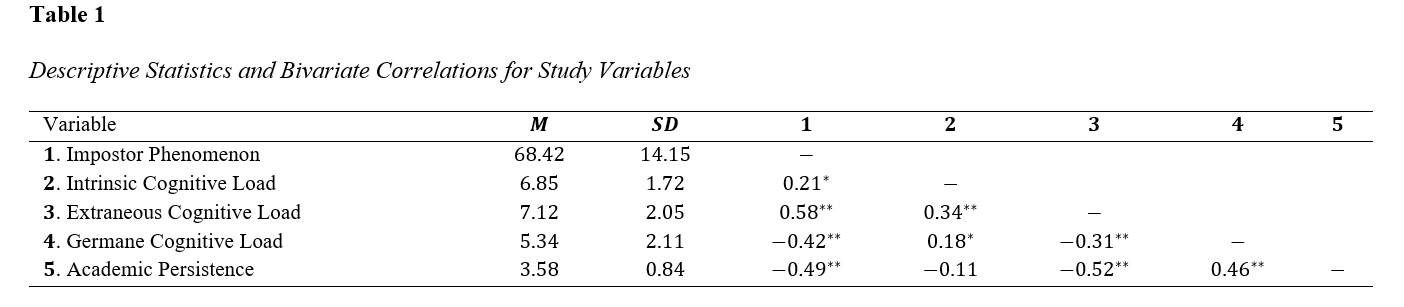
Findings: Correlational analyses initially revealed that the Impostor Phenomenon was positively associated with extraneous cognitive load and negatively associated with both germane cognitive load and academic persistence. Based on model fit indices, LCA supported a three-class model: (1) an Adaptive Cognitive Load profile ( , ), characterized by moderate intrinsic, the lowest extraneous, and the highest germane load; (2) an Extraneously Overloaded profile ( , ), characterized by high intrinsic, the highest extraneous, and the lowest germane load; and (3) a Compensatory Cognitive Load profile ( , ), characterized by the highest intrinsic, moderately high extraneous, and relatively high germane load. Academic persistence varied significantly among these profiles; the Adaptive class reported the highest persistence ( , ), the Compensatory class reported moderate persistence ( , ), and the Extraneously Overloaded class demonstrated the significantly lowest persistence ( , ).
Conclusion: The Impostor Phenomenon functions as a critical cognitive bottleneck that generates a paralyzing extraneous cognitive load, severely hindering germane learning processes and significantly reducing long-term academic persistence among female university students.
Downloads
References
Andira, D. P., & Daulay, A. A. (2025). Understanding the Impostor Phenomenon Among Active Student Organization Members in Indonesian Universities. Journal of Mathematics Instruction Social Research and Opinion, 4(3), 739-750. https://doi.org/10.58421/misro.v4i3.668
Choi, J., & Lee, Y. E. (2025). Exploring the Impostor Phenomenon Among Korean Daycare Directors: A Grounded Theory Approach. Behavioral Sciences, 15(5), 565. https://doi.org/10.3390/bs15050565
Fimiani, R., Mannocchi, C., Gorman, B. S., & Gazzillo, F. (2024). Guilt Over Success, Impostor Phenomenon, and Self-Sabotaging Behaviors. Current Psychology, 43(21), 19081-19090. https://doi.org/10.1007/s12144-024-05697-z
Fleischhauer, M., Wossidlo, J., Michael, L., & Enge, S. (2021). The Impostor Phenomenon: Toward a Better Understanding of the Nomological Network and Gender Differences. Frontiers in psychology, 12. https://doi.org/10.3389/fpsyg.2021.764030
Jafari, Z., & Abdi Zarrin, S. (2021). The relationship between academic engagement, academic identity, academic persistence, and academic adjustment in students. Journal of Educational Psychology Studies, 18(44), 103-122.
Khodashahi, F. (2024). The Relationship between Basic Psychological Needs and Goal Orientation with Academic Persistence among Students. Journal of Recent Innovations in Psychology, 5, 65-74. https://ensani.ir/fa/article/601945/
Khoshesteh-Abbasi, F., Tarvordi Zadeh, H., & Younesi, S. J. (2023). Comparison of the Effectiveness of Cognitive and Metacognitive Strategies on Academic Persistence. Psychological Studies of Adolescents and Youth, 4(7), 43-32. https://doi.org/10.61838/kman.jayps.4.7.3
Lent, R. W., Miller, M. J., Smith, P., Watford, B., Lim, R. H., & Hui, K. (2016). Social Cognitive Predictors of Academic Persistence and Performance in Engineering: Applicability Across Gender and Race/Ethnicity. Journal of Vocational Behavior, 94, 79-88. https://doi.org/10.1016/j.jvb.2016.02.012
Li, Y., Qiu, F., Luo, B., Hu, Y., Li, J., Li, Y., He, P., & Fang, J. (2025). The Relationship Between Impostor Phenomenon and Emotional Exhaustion Among Chinese Nurses: The Mediating Role of Bi-Directional Work-Family Conflict. Frontiers in Public Health, 12. https://doi.org/10.3389/fpubh.2024.1410452
Shayesteh, A., Boman, J., & Nylander, E. (2024). Impostor Phenomenon Is a Common Feature Among Individuals With Primary Hyperhidrosis. Sage Open Medicine, 12. https://doi.org/10.1177/20503121231220828
Sheveleva, M. S., Permyakova, T. M., & Kornienko, D. S. (2023). Perfectionism, the Impostor Phenomenon, Self-Esteem, and Personality Traits Among Russian College Students. Psychology in Russia State of Art, 16(3), 132-148. https://doi.org/10.11621/pir.2023.0310
Soleimani, M., Ghadampour, E., & Abbasi, M. (2023). A Feasibility Study of Education Based on Successful Academic Identity on Academic Persistence and Academic Well-being. Rooyesh-e Ravanshenasi Journal (Growth of Psychology), 12(12), 33-42.
Swaidan, E. (2025). Impostor Phenomenon Unveiled: Exploring Its Impact on Well-Being, Performance, and Satisfaction Among Employees. Administrative Sciences, 15(2), 67. https://doi.org/10.3390/admsci15020067
Tasya, M. A., Nurihsan, J., Yudha, E. S., Dakes, P. S. P., & Farmadi, R. F. (2024). The Urgency of Impostor Phenomenon in Educational Institutions. G-Couns Jurnal Bimbingan Dan Konseling, 9(1), 552-560. https://doi.org/10.31316/gcouns.v9i1.4902
Wei, M., Liu, S., Ko, S. Y., Wang, C., & Du, Y. (2020). Impostor Feelings and Psychological Distress Among Asian Americans: Interpersonal Shame and Self-Compassion. The counseling psychologist, 48(3), 432-458. https://doi.org/10.1177/0011000019891992
Westover, J. (2025). Overcoming Impostor Phenomenon: My Journey to Confront Self-Doubt in the Workplace. HCLReview, 18(1). https://doi.org/10.70175/hclreview.2020.18.1.3
Yaffe, Y. (2021). Students' recollections of parenting styles and impostor phenomenon: The mediating role of social anxiety. Personality and individual differences, 172, 110598. https://doi.org/10.1016/j.paid.2020.110598
Yang, X., Yeo, K. J., Lee, S.-H., & Handayani, L. (2024). A Systematic Review of Impostor Syndrome in Higher Education. International Journal of Evaluation and Research in Education (Ijere), 13(6), 3884. https://doi.org/10.11591/ijere.v13i6.30726
Downloads
Additional Files
Publication Timeline
- Submitted
- Revised
- Accepted