Predicting Anxiety Sensitivity Based on Fatigue and Occupational Stress Among Female Law Enforcement Employees
DOI:
https://doi.org/10.61838/Keywords:
Anxiety sensitivity, fatigue, occupational stress, female employees, law enforcement, TabrizAbstract
Objective: The present study aimed to predict anxiety sensitivity based on fatigue and occupational stress among female law enforcement employees in Tabriz.
Methods and Materials: This study employed a descriptive-correlational design with a predictive approach. The statistical population consisted of all female law enforcement employees working in Tabriz in 2025. Using convenience sampling, 230 participants were initially recruited, of whom 212 were included in the final analysis after excluding incomplete questionnaires. Data were collected using the Anxiety Sensitivity Index-3, the Multidimensional Fatigue Inventory, and the Health and Safety Executive Occupational Stress Indicator Tool. Data analysis was performed using SPSS version 27 through descriptive statistics, Pearson correlation coefficients, and simultaneous multiple regression analysis.
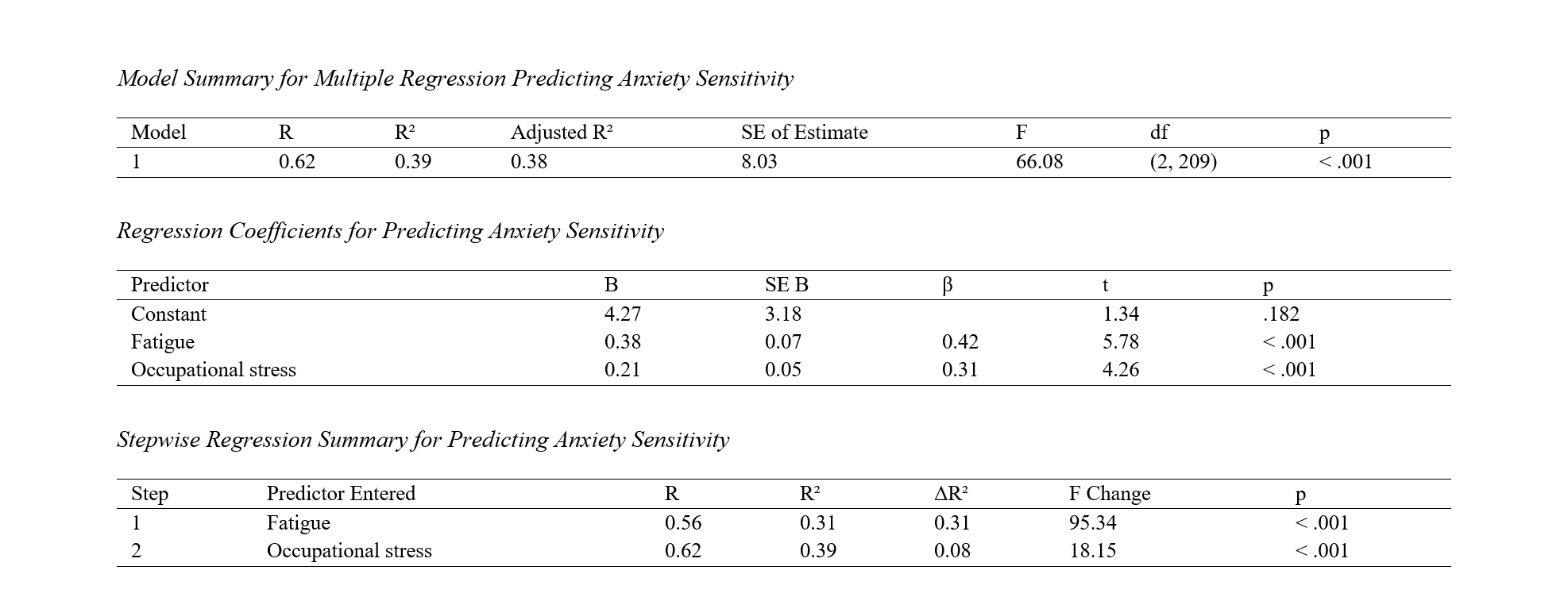
Findings: The results showed that fatigue was positively and significantly correlated with anxiety sensitivity (r = .56, p < .01), and occupational stress was also positively and significantly correlated with anxiety sensitivity (r = .49, p < .01). The findings of multiple regression analysis indicated that fatigue and occupational stress jointly predicted anxiety sensitivity significantly (R = .62, R² = .39, F(2, 209) = 66.08, p < .001). Both fatigue (β = .42, p < .001) and occupational stress (β = .31, p < .001) were significant predictors of anxiety sensitivity, with fatigue showing the stronger predictive contribution.
Conclusion: The findings suggest that fatigue and occupational stress are significant predictors of anxiety sensitivity among female law enforcement employees in Tabriz. Higher levels of fatigue and job stress were associated with greater fear of anxiety-related sensations, and fatigue emerged as the stronger predictor. These results highlight the importance of developing organizational and psychological interventions aimed at reducing fatigue, managing occupational stress, and promoting mental health among female law enforcement personnel.
Downloads
References
Alaee, E. Q., Taklavi Varaniyab, S., Ahmadi, V., Mirzaian, B., Hassanvand Amouzadeh, M., & Shairi, M. R. (2022). The efficacy of transdiagnostic cognitive behavioural therapy on reducing negative affect, anxiety sensitivity, and improving perceived control in children with emotional disorders: A randomized controlled trial. Child Psychiatry & Human Development, 53(6), 1386-1401. https://doi.org/10.1007/s10578-021-01205-2
Anjum, A., & K., J. (2025). Influence of Hardiness and Emotional Intelligence on Occupational Stress Among the Personnel in Muscat. International Journal for Multidisciplinary Research, 7(1). https://doi.org/10.36948/ijfmr.2025.v07i01.35641
Bourassa Rabichuk, S., Williamson, T., & Ricciardelli, R. (2025). Stress experiences of women in policing: A scoping review. International Journal of Police Science & Management. https://doi.org/10.1177/14613557241269477
Cheung, Y. K., Chien, W. T., Lo, H. H. M., & Yip, P. S. F. (2023). Predictors, mediators and moderators of police work-related stress: A systematic review. International journal of environmental research and public health, 20(5), 3982. https://doi.org/10.3390/ijerph20053982
Diannita, C. G., Permatasari, H., & Mulyono, S. (2024). Occupational Stress and Professional Quality of Life Among Community Health Nurses During the COVID-19 Pandemic. J Holist Nurs, 42(2_suppl), S110-S117. https://doi.org/10.1177/08980101231204774
Edwards, J. A., Webster, S., Van Laar, D., & Easton, S. (2008). Psychometric analysis of the UK Health and Safety Executive’s Management Standards work-related stress Indicator Tool. Work & Stress, 22(2), 96-107. https://doi.org/10.1080/02678370802166599
Elliot, D., Garg, B., Kuehl, K. S., DeFrancesco, C., & Sleigh, A. (2015). Why are women law enforcement officers more burned-out and what might help them? Occupational Medicine & Health Affairs, 3(3), 216. https://doi.org/10.4172/2329-6879.1000216
Hovenkamp-Hermelink, J. H. M., van der Veen, D. C., Oude Voshaar, R. C., Batelaan, N. M., Penninx, B. W. J. H., Jeronimus, B. F., Schoevers, R. A., & Riese, H. (2019). Anxiety sensitivity, its stability and longitudinal association with severity of anxiety symptoms. Scientific reports, 9, 4314. https://doi.org/10.1038/s41598-019-39931-7
Illias, M., Riach, K., & Demou, E. (2024). Understanding the interplay between organisational injustice and the health and wellbeing of female police officers: A meta-ethnography. BMC public health, 24, 2659. https://doi.org/10.1186/s12889-024-20152-1
Jardin, C., Sharp, C., Garey, L., Vanwoerden, S., Crist, N., Elhai, J. D., & Zvolensky, M. J. (2018). The construct validity of the Anxiety Sensitivity Index-3. Psychiatry research, 270, 578-584. https://doi.org/10.1016/j.psychres.2018.07.045
Ma, C. C., Hartley, T. A., Sarkisian, K., Fekedulegn, D., Mnatsakanova, A., Owens, S., Gu, J. K., Tinney-Zara, C. A., Zhang, X., Charles, L. E., Violanti, J. M., & Burchfiel, C. M. (2015). Influence of work characteristics on the association between police stress and sleep quality. Safety and Health at Work, 6(4), 303-309. https://doi.org/10.1016/j.shaw.2015.08.004
Mantar, A., Yemez, B., & Alkin, T. (2011). Anxiety sensitivity and its importance in psychiatric disorders. Turk Psikiyatri Dergisi, 22(3), 187-193.
McNally, R. J. (2002). Anxiety sensitivity and panic disorder. Biological Psychiatry, 52(10), 938-946. https://doi.org/10.1016/S0006-3223(02)01475-0
Nasr Esfahani, E., Esmaeili, R., Pourabdian, S., & Shakarian, M. (2025). Investigating the Relationship Between Stress Coping Styles and Job Fatigue Among Female School Bus Drivers in Isfahan. Health System Research, 21(2), 249-256. https://hsr.mui.ac.ir/article-1-1813-en.html
Rozmann, N. (2025). Occupational Stress and Sleep Quality Among Hungarian Nurses in the Post-Covid Era: A Cross-Sectional Study. Healthcare, 13(16), 2029. https://doi.org/10.3390/healthcare13162029
Taylor, S. (1995). Anxiety sensitivity: Theoretical perspectives and recent findings. Behaviour Research and Therapy, 33(3), 243-258. https://doi.org/10.1016/0005-7967(94)00063-P
Taylor, S., Zvolensky, M. J., Cox, B. J., Deacon, B., Heimberg, R. G., Ledley, D. R., Abramowitz, J. S., Holaway, R. M., Sandin, B., Stewart, S. H., Coles, M., Eng, W., Daly, E. S., Arrindell, W. A., Bouvard, M., & Cardenas, S. J. (2007). Robust dimensions of anxiety sensitivity: Development and initial validation of the Anxiety Sensitivity Index-3. Psychological assessment, 19(2), 176-188. https://doi.org/10.1037/1040-3590.19.2.176
Teles, D. O., de Oliveira, R. A., de Oliveira Parnaíba, A. L., Rios, M. A., Machado, M. B., Aquino, P. d. S., de Menezes, P. R., Ribeiro, S. G., Soares, P. R. A. L., Biazus Dalcin, C., & Pinheiro, A. K. B. (2024). Assessment of the mental health of police officers: A systematic review of specific instruments. International journal of environmental research and public health, 21(10), 1300. https://doi.org/10.3390/ijerph21101300
Veldman, J., Meeussen, L., Van Laar, C., & Phalet, K. (2017). Women (do not) belong here: Gender-work identity conflict among female police officers. Frontiers in psychology, 8, 130. https://doi.org/10.3389/fpsyg.2017.00130
Violanti, J. M., Charles, L. E., McCanlies, E., Hartley, T. A., Baughman, P., Andrew, M. E., Fekedulegn, D., Ma, C. C., Mnatsakanova, A., & Burchfiel, C. M. (2017). Police stressors and health: A state-of-the-art review. Policing: An International Journal, 40(4), 642-656. https://doi.org/10.1108/PIJPSM-06-2016-0097
Violanti, J. M., Fekedulegn, D., Hartley, T. A., Charles, L. E., Andrew, M. E., Ma, C. C., & Burchfiel, C. M. (2016). Highly rated and most frequent stressors among police officers: Gender differences. American Journal of Criminal Justice, 41(4), 645-662. https://doi.org/10.1007/s12103-016-9342-x
Violanti, J. M., Owens, S. L., Fekedulegn, D., Ma, C. C., Charles, L. E., Hartley, T. A., Andrew, M. E., & Burchfiel, C. M. (2018). An exploration of shift work, fatigue, and gender among police officers: The BCOPS study. Workplace Health & Safety, 66(11), 530-537. https://doi.org/10.1177/2165079918754586
Zvolensky, M. J., Garey, L., Fergus, T. A., Gallagher, M. W., Viana, A. G., Shepard, B. C., Mayorga, N. A., Kelley, L. P., Griggs, J. O., & Schmidt, N. B. (2018). The Short Scale Anxiety Sensitivity Index (SSASI): Psychometric properties and relation to anxiety and depressive symptoms in a young adult community sample. Psychiatry research, 269, 686-693. https://doi.org/10.1016/j.psychres.2018.08.117
Downloads
Additional Files
Publication Timeline
- Submitted
- Revised
- Accepted