The Relationship Between Childhood Trauma and Personality Traits with Attitudes Toward Childbearing in Married Women Aged 25–45
DOI:
https://doi.org/10.61838/Keywords:
Childhood trauma, personality traits, attitudes toward childbearing, extraversion, openness to experience, married womenAbstract
Objective: The present study aimed to examine the relationship between childhood trauma and personality traits with attitudes toward childbearing in married women aged 25–45.
Methods and Materials: This study employed a fundamental, descriptive–correlational design. The statistical population consisted of married women aged 25–45 who referred to psychological clinics and mental health centers in districts 1 to 5 of Tehran. A sample of 222 participants was selected using a convenience sampling method, based on recommended sample sizes for correlational research and considering potential attrition. Data were collected using the Attitudes Toward Fertility and Childbearing Scale (AFCS), the Childhood Trauma Questionnaire (CTQ), and the short form of the Five-Factor Personality Inventory (NEO-FFI). Data analysis was conducted using SPSS version 27 at both descriptive and inferential levels, including Pearson correlation coefficients and simultaneous multiple regression analysis to examine relationships and predictive power among variables.
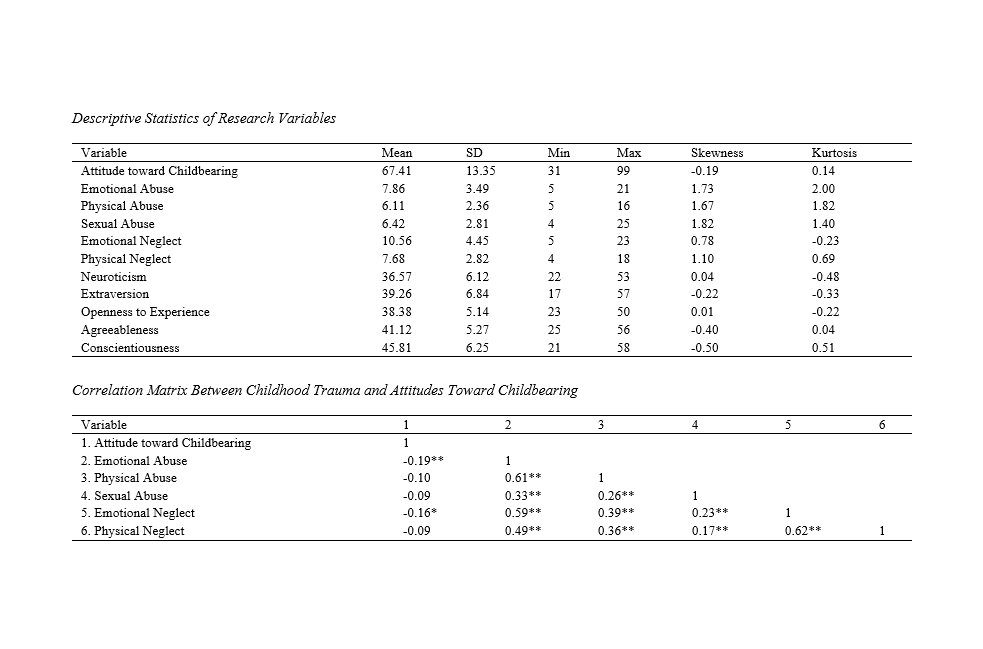
Findings: The results indicated that emotional abuse (r = -0.19, p < 0.01) and emotional neglect (r = -0.16, p < 0.05) were significantly and negatively correlated with attitudes toward childbearing, whereas other trauma dimensions showed non-significant relationships. Among personality traits, extraversion (r = 0.26, p < 0.01), openness to experience (r = 0.17, p < 0.01), and agreeableness (r = 0.22, p < 0.01) demonstrated significant positive correlations with attitudes toward childbearing. The results of multiple regression analysis revealed that extraversion (β = 0.15, p = 0.046) and openness to experience (β = 0.13, p = 0.040) significantly predicted attitudes toward childbearing, while childhood trauma variables did not show significant predictive effects in the presence of personality traits. The overall regression model was statistically significant (F = 5.49, p < 0.01) and explained 11% of the variance in attitudes toward childbearing.
Downloads
References
Bakhani, G. (2022). A qualitative study of attitudes toward population policies and childbearing (Case study: Youth of Ardabil province). Strategic studies of women, 24(96), 39-67.
Bateman, A., Rüfenacht, E., Perroud, N., Debbané, M., Nolte, T., Shaverin, L., & Fonagy, P. (2024). Childhood maltreatment, dissociation and borderline personality disorder: Preliminary data on the mediational role of mentalizing in complex post-traumatic stress disorder. Psychology and Psychotherapy: Theory, Research and Practice, 97(Suppl. 1), 58-74. https://doi.org/10.1111/papt.12514
Bektaş, N. (2025). Investigating Sociodemographic Features, Childhood Trauma, Personality and Psychological Symptoms as Predictors of Emotional Eating. Ayna Klinik Psikoloji Dergisi, 12(1), 1-25. https://doi.org/10.31682/ayna.1407214
Cheng, Y.-h. A., & Yang, C.-l. W. (2021). Continuity and changes in attitudes toward marriage in contemporary Taiwan. Journal of Population Research, 38(2), 139-167. https://doi.org/10.1007/s12546-021-09259-z
Fiskin, G., & Sari, E. (2021). Evaluation of the relationship between youth attitudes towards marriage and motivation for childbearing. Children and Youth Services Review, 121, 105856. https://doi.org/10.1016/j.childyouth.2020.105856
Karimi, A. (2021). Analysis of Youth Attitudes Towards Marriage and Childbearing. Strategic Studies in Sports and Youth, 20(52), 275-292. https://faslname.msy.gov.ir/article_452.html?lang=en
Karimi, E., Hashemi Nosrat-Abad, T., & Khanjani, Z. (2024). Structural relationships of childhood traumatic experiences with narcissistic personality disorder symptoms: The mediating role of early maladaptive schemas. Royesh-e-Ravan Shenasi, 13(3), 21-32. http://frooyesh.ir/article-1-4999-en.html
Karimi, E., Hashemi Nosratabad, T., & Khanjani, Z. (2024). Structural Relationships Between Childhood Traumatic Experiences and Symptoms of Narcissistic Personality Disorder: The Mediating Role of Early Maladaptive Schemas. Rooyesh Psychology, 13(3), 21-32. https://frooyesh.ir/article-1-4999-en.html
Kaveh Firouz, Z., Zare, B., & Janbakhsh Ganjeh, S. (2017). The Impact of Social and Cultural Capital Components on Attitudes Towards Childbearing (Case Study: Couples About to Marry in Tehran). Social Studies and Research in Iran, 6(1), 119-143. https://jisr.ut.ac.ir/article_61834.html
Kaveh Firouz, Z., Zarei, B., & Shamseddini, H. (2016). The Impact of Lifestyle Components on Attitudes Towards Childbearing (Case Study: Women About to Marry in Tehran). Women in Development and Politics, 14(2), 217-234. https://jwdp.ut.ac.ir/article_59201_en.html
Knapen, S. R. Y., Mensink, W., Hoogendoorn, A. W., Swildens, W. E., Duits, P., Hutsebaut, J., & Beekman, A. T. F. (2025). Associations between Childhood Trauma and Epistemic Trust, Attachment, Mentalizing, and Symptoms of Borderline Personality Disorder. Psychopathology, 58(3), 187-198. https://doi.org/10.1159/000542919
Kühner, C., de Waal, M., Steenkamp, L., van Zwol, I., Goudriaan, A., & Thomaes, K. (2025). The impact of types of childhood maltreatment on the severity of PTSD and comorbid personality disorder symptoms. European Journal of Psychotraumatology, 16(1), 2491172. https://doi.org/10.1080/20008066.2025.2491172
Riemann, G., Chrispijn, M., Kupka, R. W., Penninx, B. W. J., & Giltay, H. E. J. (2024). Borderline personality features in relationship to childhood trauma in unipolar depressive and bipolar disorders. Journal of affective disorders, 363, 358-364. https://doi.org/10.1016/j.jad.2024.07.101
Sepahvand, R., tahour, M. A., Salimi, S. H., Rahnejat, A. M., & Sepandi, M. (2025). Structural Modeling of Self-Harming Behaviors Based on Personality Organization With the Mediating Role of Childhood Traumas and Reflective Function in Militaries With Borderline Personality Disorder and Healthy People. Journal of education and health promotion, 14(1). https://doi.org/10.4103/jehp.jehp_560_24
Wang, Y. (2024). The Relationship Between Childhood Trauma and Borderline Personality Disorder: The Mediator Effect of Insecure Attachment. TMBLS, 7, 186-189. https://doi.org/10.62051/2tk48319
Zarei Norouzi, M., Nouri Lasik, S., Vaziri Talesh, M. A., & Moradi, M. (2024). Predicting adolescents' self-harming behaviors based on childhood trauma and dark personality traits. The 5th National Conference on Psychopathology Studies and Modern Treatment Methods, Tehran,
Zhong, Y., Hu, Q., Chen, J., Li, Y., Chen, R., Li, Y., Cong, E., & Xu, Y. (2024). The Impact of Childhood Trauma on Adolescent Depressive Symptoms: The Chain Mediating Role of Borderline Personality Traits and Self-Control. BMC psychiatry, 24(1). https://doi.org/10.1186/s12888-024-05829-6
Downloads
Additional Files
Publication Timeline
- Submitted
- Revised
- Accepted