Comparison of the Effectiveness of Emotion-Focused Therapy and the Existential–Spiritual Reconstruction Protocol in Enhancing Quality of Life Among Women Attending Healthcare Centers in Bushehr City
DOI:
https://doi.org/10.61838/Keywords:
Miscarriage, Existential–Spiritual Reconstruction Therapy, Emotion-Focused Therapy, Quality of LifeAbstract
Objective: The present study aimed to compare the effectiveness of Emotion-Focused Therapy (EFT) and the Existential–Spiritual Reconstruction Protocol in improving the quality of life among women attending healthcare centers in Bushehr City.
Methods and Materials: This study employed a quasi-experimental design with a pretest–posttest and a control group. The statistical population consisted of women with a history of miscarriage who attended healthcare centers in Bushehr City. From the eligible participants, 45 individuals were selected and randomly assigned to three groups of 15 participants each (two experimental groups and one control group). Initially, a pretest was administered to all three groups. Subsequently, the two experimental groups received therapeutic interventions over eight 90-minute sessions, and finally, a posttest was conducted for all groups. Data were collected using the Quality of Life Questionnaire (SF-36). The data were analyzed using SPSS software, version 25.
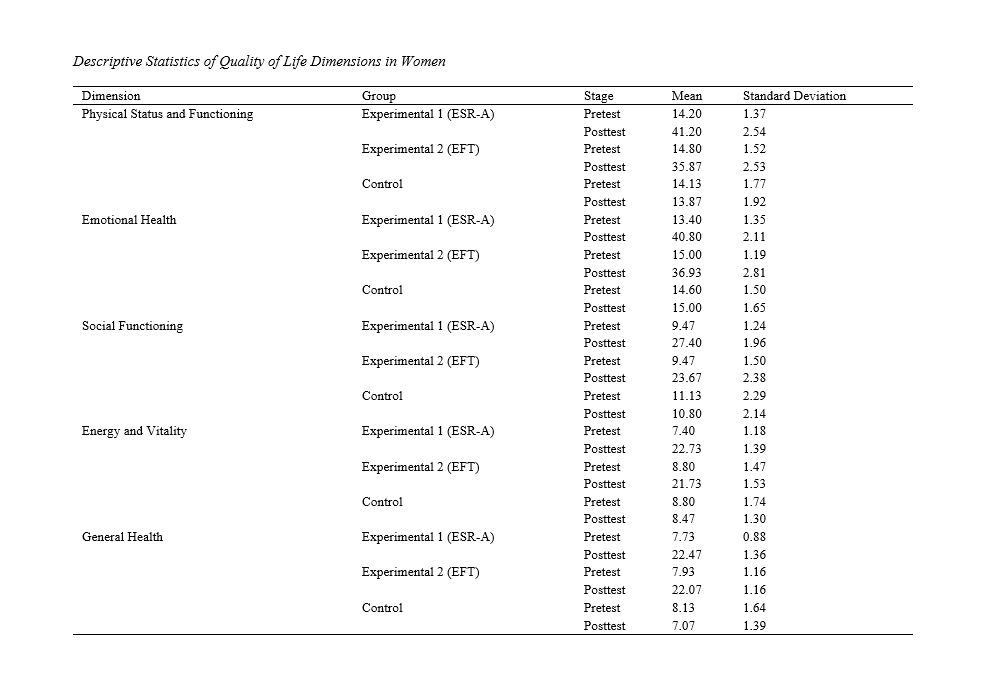
Findings: The results indicated a significant difference between the effectiveness of the miscarriage-related Existential–Spiritual Reconstruction Protocol and Emotion-Focused Therapy in improving the quality of life of women with a history of miscarriage. In most dimensions of quality of life, both experimental groups (ESR-A and EFT) showed significant differences compared to the control group (p < .05). Therefore, both interventions led to improvements in quality of life dimensions compared to no intervention. Furthermore, direct comparison between the two experimental groups revealed that in some dimensions, the level of improvement in the first experimental group (ESR-A) was greater than that in the second experimental group (EFT).
Conclusion: The findings of this study demonstrated that both interventions are effective in improving the quality of life of women with a history of miscarriage; however, the Existential–Spiritual Reconstruction Protocol, which is developed based on qualitative findings and tailored to the cultural context of the community, showed greater effectiveness.
Downloads
References
Afzood, A., Bakhshipour, A., & Sadeghi, M. (2024). Predicting the Quality of Marital Life: The Role of Mindfulness and Spiritual Experiences. Health Spirituality and Medical Ethics, 11(2), 63-72. https://doi.org/10.32598/hsmej.11.2.506.1
Alavi, A. M. (2024). Investigating the effectiveness of emotion-focused therapy on psychological well-being and improving the quality of life of divorced women in Gonbad-Kavoos city. Scientific Journal of Modern Research Approaches in Management and Accounting, 8(28), 575-592. https://majournal.ir/index.php/ma/article/view/2499
Asghari, M., & Hosseini Mehrabadi, H. S. (2024). The Mediating Effect of the Quality of Aesthetic Experience on the Relationship between Spiritual Intelligence and Life Satisfaction in Teachers of Qom Province (Structural Equation Modeling). Sociology of Education, 10(1), 343-354. https://doi.org/10.22034/ijes.2023.1995938.1393
Azarbaijani, M., Roshan, H., & Hosseini, F. H. (2025). Examining the Role of Satisfying Spouses' Spiritual Needs in Enhancing Quality of Life: A Quran-Based Spiritual Health Approach. Pizhuhish dar din va salamat, 11(2), 93-11. https://www.sid.ir/fileserver/jf/1312-382868-fa-1651192.pdf
Cole, L., Ridings, L., & Phillips, S. M. (2024). Stress and Coping Factors Affecting Health-Related Quality of Life in Parents of Children with Congenital Heart Disease: An Integrative Review. Pediatric Cardiology, 45(3), 457-470. https://doi.org/10.1007/s00246-023-03227-5
Geravand, A., Jalilzadeghan, H., Khezri, H., Ahmadishool, P., & Mehraban, S. H. (2025). Effectiveness of Spiritual-religious Interventions in Mental Health and Quality of Life of Cancer Patients: A Meta-analysis of Studies Conducted in IranSummary. Pizhuhish dar din va salamat, 10(4), 128-142. https://journals.sbmu.ac.ir/jrrh/article/download/43780/34142/247943
Irfaniyan Razai, M., Kashavazi Arshadi, F., Golshani, F., Hasani, F., & Rolchahi, B. (2023). The effectiveness of emotion-focused therapy on frustration tolerance and marital quality of life in women with recurrent miscarriages. Quarterly Journal of Health and Medical Management, 14, 24-31. https://www.noormags.ir/view/en/articlepage/2100943/
Javidan, L. (2022). The effectiveness of couple therapy with EIS model on positive and negative emotions and marital adjustment of couples. Journal of Psychological Dynamics in Mood Disorders (PDMD), 1(3), 20-30. https://ijpdmd.com/article_180410.html
Karimi Dastaki, A., & Mahmudi, M. (2024). The Effectiveness of Life Meaning Workshops on Resilience, Negative Affect, and Perceived Social Support in Students. Journal of Psychological Dynamics in Mood Disorders (PDMD), 3(1), 187-197. https://doi.org/10.22034/pdmd.2024.448984.1063
Kashtmand, Z., & Parandin, S. (2023). Effectiveness of Group Training in Emotion-Focused Couples Therapy on Marital Adjustment and Quality of Life in Women with Marital Disputes in Islamabad Gharb. First International Conference on Psychology, Social Sciences, Educational Sciences, and Philosophy,
Khajeh, A. H., Farhadi, H., & Aghaei, A. (2022). Investigating the Effectiveness of a Combined Emotion-Focused Therapy and Compassion-Based Therapy Package on Marital Quality of Life and Attachment Dimensions of Couples. Applied Family Therapy, 10. https://www.aftj.ir/article_142271.html
Montazeri, S., Saberi, F., Dogolsar, F. K., Mahmoudi, F., & Shaali, A. (2025). The Effectiveness of Emotion-Focused Therapy on Marital Disenchantment and Quality of Life in Couples With Marital Conflicts. Ijbmc, 12(2), 227-234. https://doi.org/10.61838/ijbmc.v12i2.976
Moysés, R., Marques, I., Santos, B. D., Benzaken, A., & Pereira, M. G. (2023). Quality of Life in Amazonian Women during Cervical Cancer Treatment: The Moderating Role of Spirituality. International Journal of Environment Research Public Health, 20(3), 24-87. https://doi.org/10.3390/ijerph20032487
Musa, A. S., Elbqowm, O., AlBashtawy, M., Al Qadire, M. I., Suliman, M., Tawalbeh, L. I., Alkhawaldeh, A., & Batiha, A. M. M. (2023). Spiritual wellbeing and quality of life among hemodialysis patients in Jordan: a cross-sectional correlational study. Journal of Holistic Nursing, 41(3), 220-232. https://doi.org/10.1177/08980101221083422
Razaqi, S., Mansoubi Far, M., Havasie Sumar, N., & Tahmorsi, N. (2023). The effectiveness of Emotion-Focused Therapy on emotional regulation and quality of life in music students exhibiting social anxiety disorder traits. Journal of Psychological Sciences, 22(27), 1335-1352. http://psychologicalscience.ir
Salehi Mobarakeh, A., Golparvar, M., & Yousefi, Z. (2024). Comparison of the effectiveness of integrated spiritual self-care training and mindfulness-based cognitive therapy on quality of life and health self-efficacy in patients undergoing hemodialysis. Iranian Journal of Neurodevelopmental Disorders, 3(4), 79-89. https://doi.org/10.61838/kman.jndd.3.4.8
Sheivandi Cholicheh, K., Abdolmaleki, S., Ghalami, Z., & Nafar, Z. (2023). Explaining the Resilience Model Based on Purposeful Life and Quality of Relationships Mediated by Spiritual Health in the Face of Stress Conditions Caused by COVID-19. Counseling Culture and Psycotherapy, 14(54), 1-34. https://doi.org/10.22054/qccpc.2022.65402.2858
Sheyvandi Chelicheh, K., Abdolmaleki, S., Ghalami, Z., & Nafar, Z. (2023). Explaining the Resilience Model Based on Life Purpose and Relationship Quality with the Mediating Role of Spiritual Health in Facing Psychological Pressure Due to COVID-19. Quarterly Journal of Counseling Culture and Psychotherapy, 14(54), 1-34. https://qccpc.atu.ac.ir/article_14612.html
Tsoho, M. A., & Soylar, P. (2024). Investigation of the relationship between spiritual well-being and quality of life in breast cancer patients. Journal of Public Health, 32(9), 1683-1690. https://doi.org/10.1007/s10389-023-01930-4
Zandi, M., Mohammadi Khani, S., & Hatami, M. (2024). Comparing the Effectiveness of Acceptance and Commitment Therapy and Emotion-Focused Therapy on the Quality of Life of Patients with Type 2 Diabetes. Journal of Psychological Achievements, 1, 1-10. https://psychac.scu.ac.ir/article_19434.html
Downloads
Publication Timeline
- Submitted
- Revised
- Accepted