Prediction of Attitudes Toward Marital Infidelity Based on Thinking Styles and Mindfulness with the Mediating Role of Emotional Attachment in Women
DOI:
https://doi.org/10.61838/Keywords:
Attitudes toward marital infidelity, thinking styles, mindfulness, emotional attachmentAbstract
Objective: The present study aimed to examine the structural model predicting attitudes toward marital infidelity based on thinking styles and mindfulness with the mediating role of emotional attachment in women.
Methods and Materials: This applied study employed a descriptive–correlational design using structural equation modeling. The statistical population consisted of women attending counseling and psychological service centers in Zanjan in 2025. Based on Klein’s recommendation, a sample size of 260 participants was initially selected using convenience sampling, of which 252 valid questionnaires were analyzed after data screening. Data collection instruments included the Attitudes Toward Infidelity Questionnaire (Whatley, 2008), the Thinking Styles Questionnaire–Short Form (Sternberg & Wagner, 1997), the Freiburg Mindfulness Inventory–Short Form (2006), and the Interpersonal Dependency Inventory (Hirschfeld et al., 1997). Data were analyzed using LISREL (version 8) with structural equation modeling techniques.
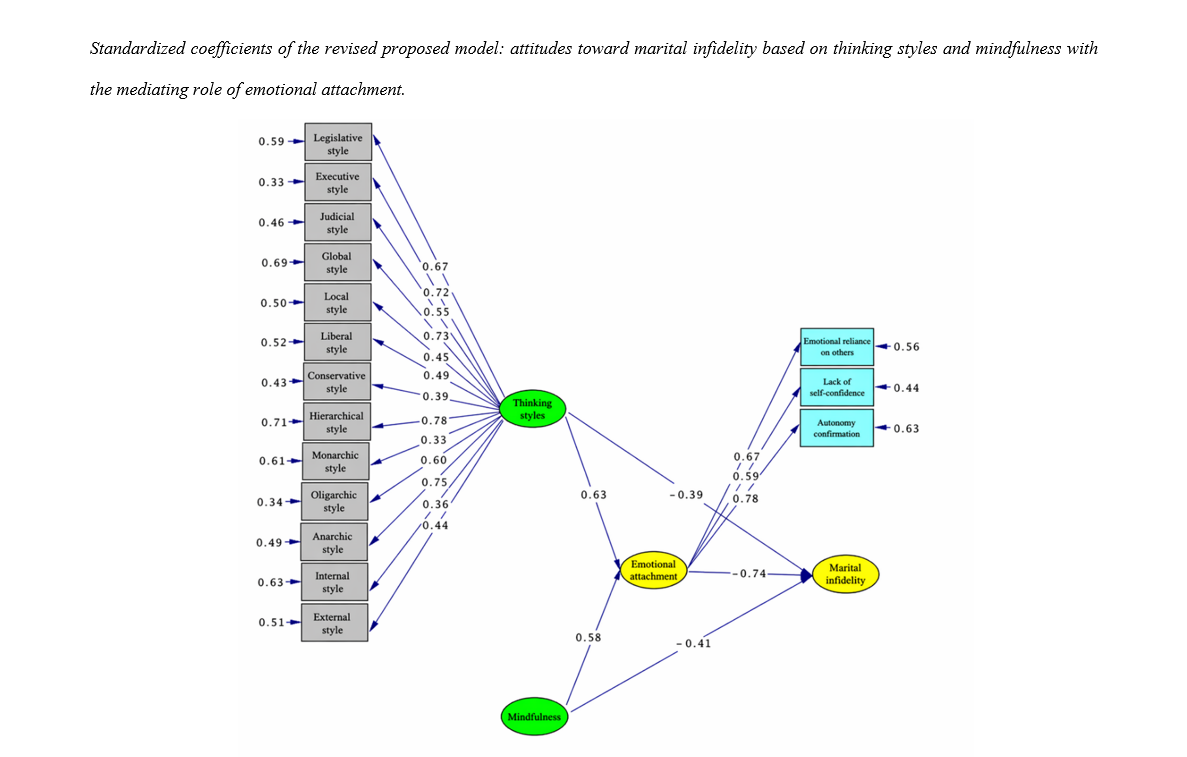
Findings: The proposed model demonstrated an acceptable fit (χ² = 178.40, df = 88, RMSEA = 0.043, CFI = 0.921). Thinking styles had a significant negative direct effect on attitudes toward marital infidelity (β = -0.391, p < .01), and mindfulness also showed a significant negative direct effect (β = -0.412, p < .01). Emotional attachment significantly predicted attitudes toward marital infidelity (β = -0.745, p < .01). Furthermore, thinking styles (β = 0.637, p < .01) and mindfulness (β = 0.586, p < .01) had significant positive effects on emotional attachment. The indirect effects of thinking styles (β = -0.656) and mindfulness (β = -0.745) on attitudes toward marital infidelity through emotional attachment were significant, confirming the mediating role of emotional attachment.
Conclusion: The findings indicate that attitudes toward marital infidelity can be effectively predicted through an integrated model involving thinking styles, mindfulness, and emotional attachment, highlighting the importance of cognitive and emotional mechanisms in shaping relational attitudes.
Downloads
References
Abdollahzadeh, H. (2010). Introduction to Mark Whatley's Attitudes Toward Infidelity Scale. Azmoonyar Pouya Institute.
Ahmadi Dahmand, R., & Zarei Tupkhaneh, M. (2022). Predicting marital infidelity based on marital boundaries and marital satisfaction. Islamic Psychology Research, 5(2), 31-52.
Alaybek, B., Wang, Y., Dalal, R. S., Dubrow, S., & Boemerman, L. S. (2021). Meta-analytic relations between thinking styles and intelligence. Personality and individual differences, 168, 110322. https://doi.org/10.1016/j.paid.2020.110322
Barkhordari, M., & Shahbazi, A. (2023). Predicting marital satisfaction based on attachment styles with the mediating role of mindfulness and positive thinking. Royesh-e Ravanshenasi, 12(3), 199-208.
Channawar, S. N. (2023). Mindfulness practices for stress reduction and mental clarity. International Journal of Futuristic Innovation in Arts, Humanities and Management, 2(3), 49-59.
Cohen, L., & Lansing, A. H. (2022). The tend and befriend theory of stress: Understanding the biological, evolutionary, and psychosocial aspects of the female stress response. In Biopsychosocial Factors of Stress, and Mindfulness for Stress Reduction (pp. 67-81). Springer International Publishing. https://doi.org/10.1007/978-3-030-81245-4_3
Dennin, A., Furman, K., Pretz, J. E., & Roy, M. M. (2022). The relationship of types of intuition to thinking styles, beliefs, and cognitions. Journal of Behavioral Decision Making, 35(5), e2283. https://doi.org/10.1002/bdm.2283
Feng, B., & Lee, K. J. (2010). The influence of thinking styles on responses to supportive messages. Communication Studies, 61(2), 224-238. https://doi.org/10.1080/10510971003604000
Fonagy, P., Campbell, C., & Luyten, P. (2023). Attachment, mentalizing and trauma: Then (1992) and now (2022). Brain Sciences, 13(3), 459. https://doi.org/10.3390/brainsci13030459
Ghasemzadeh, M., Shahian, H., & Bakhshipour Roodsari, A. (2026). The mediating role of mindfulness in the relationship between attachment styles and nomophobia in students. Royesh-e Ravanshenasi, 14(5), 53-62.
Gholami Gharahsheran, Z., Sanaei Zaker, B., Kiamanesh, A., & Zahrakar, K. (2022). The role of attitudes toward marriage and emotional maturity in predicting marital instability in women and men. Journal of Psychological Science, 21(116), 1581-1598.
Gross, J. J. (2015). Emotion regulation: Current status and future prospects. Psychological Inquiry, 26(1), 1-26. https://doi.org/10.1080/1047840X.2014.940781
Hedayati Zafarghandi, S., Emamipour, S., & Rafieipour, A. (2021). Investigating the effectiveness of mindfulness-based therapy on emotion regulation skills. Journal of Faculty of Medicine, Mashhad University of Medical Sciences, 64(1), 2230-2236.
Hosseini Ardakani, A. (2020). The effectiveness of emotion-focused therapy on social anxiety and interpersonal dependency in women referring to health houses. Quarterly Journal of New Ideas in Psychology, 4(8), 1-11.
Kaba, K., & Gungor, A. (2024). Dominant ego states in relation to attachment styles and infidelity tendencies. The Family Journal, 10664807241231247. https://doi.org/10.1177/10664807241231247
Khadka, C. (2022). The evolution of attachment theory: From Bowlby to modern perspectives. TUTA Journal, 125-140. https://doi.org/10.3126/tutaj.v10i1.74328
Khani, S. (2023). Increase in divorce or stagnation in marriage? A reflection on the trend of marriage and divorce indicators in Iran over the past 15 years. Social Continuity and Change, 2(1), 25-43.
Khazraloo, E., Aghayousefi, A., & Ebrahimi Moghadam, H. (2026). A structural model for predicting attitudes toward marital infidelity based on attachment with the mediating role of coping strategies in married women and men in Tehran. Health Promotion Management, 14(1), 14-25.
Lashkari, H., & Ghaderi, K. (2026). Family transformations in modern society and their consequences for social relationships Bushehr.
Mandal, E., & Lip, M. (2022). Mindfulness, relationship quality, and conflict resolution strategies used by partners in close relationships. Current Issues in Personality Psychology, 10(2), 135-146. https://doi.org/10.5114/cipp.2021.111981
Mosharrafi, M., Khakpour, R., & Niknam, M. (2025). A structural model explaining the tendency toward marital infidelity based on self-compassion with the mediating role of emotional maturity. Journal of Psychological Science, 23(133), 95-112.
Rahnama, F., Ahmadi, S., & Zahrakar, K. (2023). Predicting attitudes toward extramarital relationships based on dark personality dimensions and attachment quality in married women. Woman and Society, 14(2), 17-34.
Richardson, E., Beath, A., & Boag, S. (2023). Default defenses: The character defenses of attachment-anxiety and attachment-avoidance. Current Psychology, 42(32), 28755-28770. https://doi.org/10.1007/s12144-022-03919-w
Safir, S., & Ahmadi, S. (2026). Predicting attitudes toward infidelity based on childhood trauma and attachment style in married people in Karaj. Health Promotion Management, 14(3), 1-11.
Simione, L., & Saldarini, F. (2023). A critical review of the monitor and acceptance theory of mindfulness. Mindfulness, 14(6), 1317-1328. https://doi.org/10.1007/s12671-023-02129-0
Soumya, R. R., & Sathiyaseelan, A. (2021). Mindfulness: An emotional aid to the glass ceiling experiences. Cogent Psychology, 8(1), 1907911. https://doi.org/10.1080/23311908.2021.1907911
Thornes, B., & Collard, J. (2023). Who Divorces? Routledge. https://doi.org/10.4324/9781003384168
Ytterstad, S., & Olaisen, J. (2023). How can the use of Sternberg's learning style add understanding to leadership development? In Learning Transformational Leadership: A Pedagogical and Practical Perspective (pp. 169-183). Springer International Publishing. https://doi.org/10.1007/978-3-031-21824-8_10
Zaker, E. A., Arefi, M., Kakabaraee, K., & Chehri, A. (2023). Associations between thinking styles and differentiation with emotional divorce in divorcing couples: The mediating role of dysfunctional beliefs. Journal of Divorce & Remarriage, 64(3), 235-254.
Zarifi, M., & Eghbal, Z. (2024). The relationship between thinking styles and problem solving with marital satisfaction in women with experiences of emotional and cultural abuse by spouse. Women's Cultural Psychology, 15(59), 59-73.
Downloads
Additional Files
Publication Timeline
- Submitted
- Revised
- Accepted