The Effectiveness of Short-Term Object Relations Therapy on the Dimensions of Shame in Women with Multiple Sclerosis (MS): A Randomized Clinical Trial
DOI:
https://doi.org/10.61838/Keywords:
Multiple sclerosis, object relations therapy, shame, short-term psychotherapy, randomized clinical trialAbstract
Objective: The present study aimed to determine the effectiveness of short-term object relations therapy on the dimensions of shame in women with multiple sclerosis.
Methods and Materials: This study was an applied quantitative research conducted using a quasi-experimental design with pretest, posttest, and three-month follow-up, including an experimental group and a control group. The statistical population consisted of women diagnosed with multiple sclerosis referred to medical centers in Isfahan during 2025–2026. A total of 36 participants were selected through convenience sampling and randomly assigned to an experimental group (n = 18) and a control group (n = 18). The experimental group received short-term object relations therapy based on Masterson’s protocol in 14 sessions (45 minutes each, twice weekly), while the control group received no intervention. Data were collected using the Experience of Shame Scale (ESS), which assesses characterological, behavioral, and bodily shame. Data analysis was performed using SPSS-29 at both descriptive and inferential levels, including repeated-measures analysis of variance and Bonferroni post hoc tests.
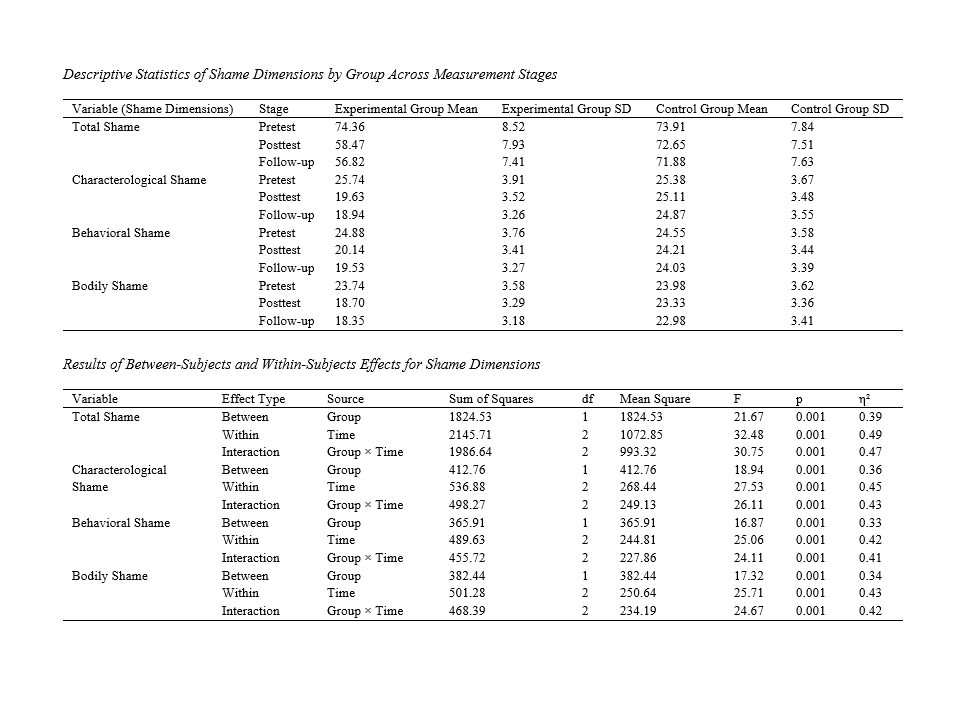
Findings: The results of repeated-measures ANOVA indicated significant effects of time, group, and the interaction between time and group on total shame and all its dimensions (p < 0.001), with large effect sizes. Bonferroni post hoc tests showed that shame scores in the experimental group significantly decreased from pretest to posttest and from pretest to follow-up (p < 0.001), while no significant differences were observed between posttest and follow-up stages, indicating stability of treatment effects. No significant changes were observed in the control group.
Conclusion: Short-term object relations therapy is an effective intervention for reducing the dimensions of shame in women with multiple sclerosis, and its effects are stable over time, suggesting its potential as a valuable psychotherapeutic approach for improving emotional functioning in this population.
Downloads
References
Akbari, Z., & Talebi, G. (2025). Effectiveness of Object Relations Therapy on Self-Concept and Physical Appearance Perfectionism in People with Body dysmorphic disorder. Journal of Applied Psychological Research. https://doi.org/10.22059/japr.2025.386121.645078
Andami, A., Hashemi, N., & Nasrollahi, B. (2023). The mediating role of cognitive emotion regulation strategies in the relationship between self-objectification and body shame with body dysmorphic disorder in women referring to beauty clinics. Journal of Applied Family Therapy, 4(1), 172-192. https://doi.org/10.61838/kman.aftj.4.1.10
Bahmani Nia, M., & Sohrabi Shegefti, N. (2024). Comparison of Ego Strength, Defense Mechanisms, and Object Relations in Individuals with Depression and Healthy Individuals. Clinical Psychology and Personality, 22(1), 126-145. https://cpap.shahed.ac.ir/article_4316.html?lang=en
Boroumand, N., & Hosseini Ravari Zadeh, N. (2023). Comparing the Effectiveness of Short-Term Dynamic Psychotherapy and Object Relations Therapy on Interpersonal Sensitivity and Aggressive Behaviors in Individuals with Borderline Personality Disorder. Royesh-e-Ravanshenasi, 12(1), 207-216. https://frooyesh.ir/article-1-3652-en.html
Caligor, E., Preti, E., Stern, B. L., Sowislo, J. F., & Clarkin, J. F. (2023). Object relations theory model of personality disorders. American Journal of Psychotherapy, 76(1), 26-30.
Clarkin, J. F., Caligor, E., & Sowislo, J. F. (2020). An Object Relations Model Perspective on the Alternative Model for Personality Disorders (DSM-5). Psychopathology, 53(3), 141-148. https://doi.org/10.1159/000508353
Hosseini, F., Vakili, P., & Abolmaali, K. (2021). Comparing the Effectiveness of Object Relations Couple Therapy and Solution-Focused Couple Therapy on Emotional Expression in Couples with Marital Conflict. Applied Family Therapy Journal, 2(1), 108-125. https://journals.kmanpub.com/index.php/aftj/article/view/411
Joseph, M., & Witter, M. (2024). Internalized Object Relationship as an Advanced Level of Psychodiagnosis. Journal of Contemporary ISTDP, 1(1). https://doi.org/10.70839/2pjrxv44
Kahraman, S., & Aktan, E. A. (2024). The Relationship Between Object Relations and Relationship Satisfaction, Marital Adjustment, and Sexual Satisfaction: The Mediating Role of Narcissistic and Borderline Personality Traits. Opus Toplum Araştırmaları Dergisi, 21(3), 189-203. https://doi.org/10.26466/opusjsr.1472521
Maleki, S., Leilabadi, L., & Kooshki, S. (2025). Efficacy of mentalization based group therapy on object relations and difficulties in emotion regulation: Outcome for individuals with dependent personality syndrome. Journal of Applied Psychological Research. https://doi.org/10.22059/japr.2023.352891.644491
Nikosafat, Z., & Qarebaghi, F. (2020). The Mediating and Moderating Role of Ego Strength in the Relationship Between Object Relations and Identity States Among Students. Clinical Psychology and Personality (Daneshvar Raftar), 18(2), 109-118. https://www.sid.ir/paper/1044139/en
Omidi Cheshmeh Kabood, A., Sepahvandi, M., & Mirderikvand, F. (2025). Examining the effect of object relations on fibromyalgia symptoms: the mediating role of alexithymia and self-compassion. J Psychol Sci, 24(151), 33-54. https://psychologicalscience.ir/article-1-2755-en.html
Ovisi, H., Monirpour, N., & Zargham Hajbi, M. (2023). Ego strength model based on object relations and the mediating role of personality organization in individuals seeking cosmetic facial surgery. Psychology of Growth, 12(1), 145-154. https://frooyesh.ir/browse.php?a_id=3920&slc_lang=en&sid=1&printcase=1&hbnr=1&hmb=1
Poulton, J. L. (2023). Object relations and relationality in couple therapy: Exploring the middle ground. Jason Aronson, Incorporated. https://www.amazon.com/Object-Relations-Relationality-Couple-Therapy/dp/0765708949
Rostaa, P., Bahrinian, S. A., Ahi, Q., & Ghanifar, M. H. (2024). The Effectiveness of Mentalization-Based Therapy on Object Relations and Feelings of Shame and Guilt in Mother-Child Conflicted Relationships. Journal of Arak University of Medical Sciences, 5(27), 279-286. http://amuj.arakmu.ac.ir/~amuj/article-1-7724-fa.html
Rousta, P., Bahrinain, S. A., Ahai, G., & Ghani Far, M. (2024). The impact of mentalization therapy on object relations and emotional expression in conflicted mother-child relationships. Journal of Nursing and Midwifery, 22(5), 351-341. https://doi.org/10.61186/unmf.22.5.341
Safavi, S., Mokund Hosseini, S., Sabahi, P., & Mohammadi Khani, P. (2022). The Effectiveness of Object Relations-Based Couples Therapy on Marital Satisfaction in Couples Seeking Divorce with Mild Borderline Personality Organization: An Experimental Study Considering the Moderating Role of Executive Functioning. Clinical Psychology, 14(3), 13-24. http://noo.rs/GNQFZ
Sarlak, A., Farrokhzad, M., Khanzadeh, F., Younesi Sinaki, M., Razavi Mahdian, S. Z., & Tayyar Parvin, M. (2023). The Effectiveness of Intensive Short-Term Dynamic Psychotherapy on Object Relations, Anger, and Guilt in Women with Major Depressive Disorder. Psychological Achievements. https://psychac.scu.ac.ir/article_18967.html?lang=en
Sarlak, N. (2024). Structural relationships of social anxiety and object relations mediated by alexithymia in patients with asthma. 6(82), 71-80. https://en.civilica.com/doc/2124189/
Sarlak, N., & Talebi, G. (2024). The effectiveness of short-term object relations group therapy on panic, obsessive-compulsive personality disorder, and narcissistic personality disorder in patients with asthma. 10(3), 315-326.
Sarlak, N., & Talebi, G. (2025). Effectiveness of Short-Term Object Relations Group Intervention on Self-Awareness, Social Anxiety and Alexithymia in Patients with Asthma. Research in Clinical Psychology and Counseling, 15(1), 135-158. https://doi.org/10.22067/tpccp.2025.88949.1671
Sarlaki, A., Farokhzad, M., Khanzadeh, F., Younesi Sinaki, M., Razavi Mahdian, S. Z., & Tayyar Parvin, M. (2024). Effectiveness of Intensive Short-Term Dynamic Psychotherapy on Object Relations, Anger, and Guilt in Women with Major Depressive Disorder. Psychological Achievements, 30(1), 89-102. https://psychac.scu.ac.ir/article_18967.html
Shafigh, S., & Talebi, G. (2024). The effectiveness of group psychotherapy with a dynamic-interpersonal approach on thought suppression in individuals with obsessive-compulsive disorder. 67(3), 1204-1218.
Spero, M. H. (1984). Shame: An object-relational formulation. The Psychoanalytic Study of the Child, 39(1), 259-282. https://doi.org/10.1080/00797308.1984.11823429
Summers, F. (2024). Object relations theories and psychopathology: A comprehensive text. Routledge. https://doi.org/10.4324/9781003265795
Downloads
Additional Files
Publication Timeline
- Submitted
- Revised
- Accepted