Hierarchical Linear Modeling of Body Surveillance Frequency: Linking Media Consumption Intensity and Internalized Thin-Ideal in Adolescent Females
DOI:
https://doi.org/10.61838/kman.pwj.5314Keywords:
Body Surveillance, Hierarchical Linear Modeling, Media Consumption, Thin-Ideal Internalization, Adolescent FemalesAbstract
Objective: The objective of this study was to utilize a multilevel statistical framework to examine how individual-level media consumption intensity and internalized thin-ideal uniquely predict body surveillance frequency, and to determine whether the magnitude of these relationships varies significantly across distinct high school contexts among adolescent females.
Methods and Materials: A cross-sectional design was employed, utilizing a sample of N=1348 Hungarian adolescent females nested within multiple high schools. Participants completed a battery of validated self-report psychometric instruments, including a media exposure inventory, the Sociocultural Attitudes Towards Appearance Questionnaire-4 to assess thin-ideal internalization, and the surveillance subscale of the Objectified Body Consciousness Scale. Data were analyzed using Hierarchical Linear Modeling to appropriately partition the variance between individual psychological traits (Level 1) and the overarching sociocultural school contexts (Level 2), while controlling for baseline Body Mass Index.
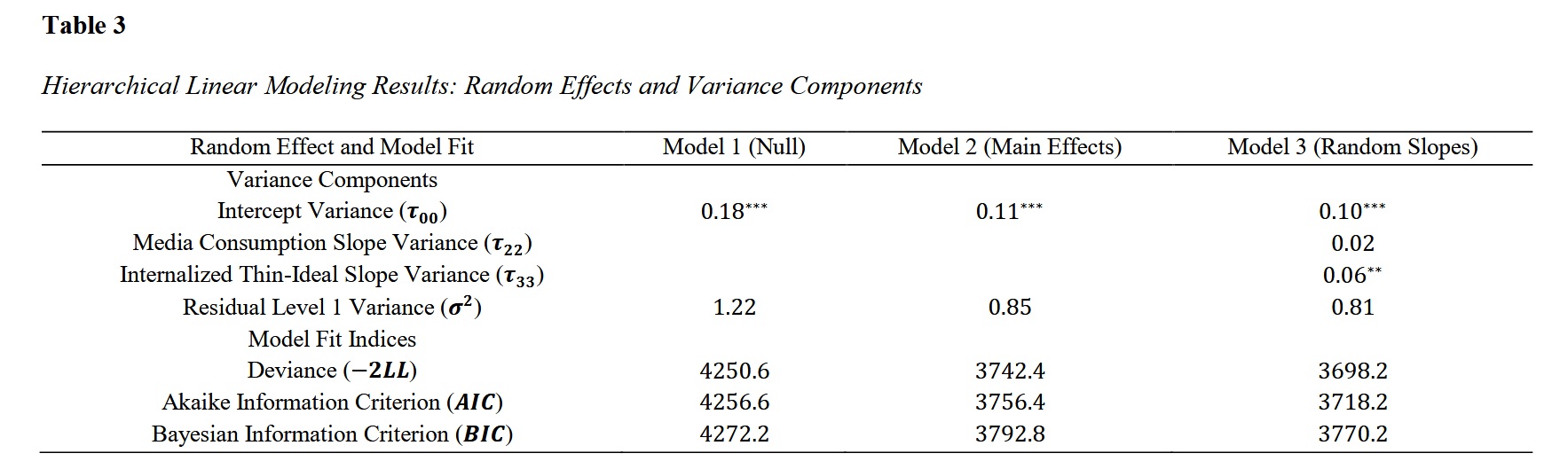
Findings: The calculation of the unconditional null model yielded an Intraclass Correlation Coefficient of 12.8%, confirming that a significant proportion of the variance in body surveillance frequency is attributable to between-school differences. Main effects modeling demonstrated that both intense media consumption and the internalized thin-ideal were robust, significant positive predictors of body surveillance at Level 1. Random slopes analyses revealed that the predictive relationship between the internalized thin-ideal and body surveillance varied significantly across different educational environments; conversely, the random slope for media consumption intensity was not statistically significant, indicating a uniformly detrimental effect across all schools. Additionally, Body Mass Index exhibited a significant positive association with heightened self-surveillance behaviors.
Conclusion: Body surveillance among adolescent females is a deeply context-dependent phenomenon where the psychological harm of internalizing societal beauty standards is significantly magnified or buffered by the specific sociocultural climate of the school environment, underscoring the critical need for systemic, whole-school interventions.
Downloads
References
Abrevaya, S., Bravo, I. M. F., Morgenstern, C., Cuello, C., López, P., & Torrente, F. (2025). Psychosocial Interventions to Improve Body Image in Social Media Users: A Systematic Review. https://doi.org/10.31234/osf.io/4qguz_v1
Batool, I., Ishaq, G., & Batool, H. (2025). Exploring the Mediating Role of Body Image in the Relationship Between Social Interaction Anxiety and Sleep Disturbance Among Overweight Individuals. Jssa, 3(1), 78-88. https://doi.org/10.59075/jssa.v3i1.97
Çınaroğlu, M., & Yılmazer, E. (2025). Problematic Social Media Use, Self-Objectification, and Body Image Disturbance: The Moderating Roles of Physical Activity and Diet Intensity. Psychology research and behavior management, Volume 18, 931-952. https://doi.org/10.2147/prbm.s517193
Ebrahimi, K., & Akbarnejad, K. (2025). Investigating the Mediating Role of Body Image Concern in the Relationship between Excessive Use of Social Media and Mental Health among Adolescents. https://jhc.mazums.ac.ir/article-1-358-fa.html
Engel, M. P., & Schmidt, M. (2025). All Extern? Exploring the Impact of Social Media and Physical Activity on Adolescents’ Body Image and Interoception. Current Issues in Sport Science (Ciss), 10(2), 061. https://doi.org/10.36950/2025.2ciss061
Goh, A. Y., Hartanto, A., Kasturiratna, K. T. A. S., & Majeed, N. M. (2025). No Consistent Evidence for Between- And Within-Person Associations Between Objective Social Media Screen Time and Body Image Dissatisfaction: Insights From a Daily Diary Study. Social Media + Society, 11(1). https://doi.org/10.1177/20563051251313855
KavehFarsani, Z., & Worthington Jr, E. L. (2024). Direct effects of marital empathy, body image, and perceived social support on quality of life of married women with breast cancer and the mediating role of perceived marital quality. Iranian Journal of Psychiatry, 19(1), 70. https://doi.org/10.18502/ijps.v19i1.14340
Lyu, Z., Jiao, Y., Zheng, P., & Zhong, J. (2021). Why Do Selfies Increase Young Women’s Willingness to Consider Cosmetic Surgery in China? The Mediating Roles of Body Surveillance and Body Shame. Journal of Health Psychology. https://doi.org/10.1177/1359105321990802
Maes, C., Vanherle, R., Fardouly, J., & Vandenbosch, L. (2025). #BoPo, #Ideal, or #Mixed? Exploring Adolescents’ Daily Exposure to Appearance Content on Social Media and Its Relations with Body Image Components. Communication Research. https://doi.org/10.1177/00936502251338901
Malloy, J., Kazenbroot-Phillips, H., & Roy, R. (2024). Associations Between Body Image, Eating Behaviors, and Diet Quality Among Young Women in New Zealand: The Role of Social Media. Nutrients, 16(20), 3517. https://doi.org/10.3390/nu16203517
Mazzeo, S. E., Weinstock, M., Vashro, T. N., Henning, T., & Derrigo, K. (2024). Mitigating harms of social media for adolescent body image and eating disorders: a review. Psychology research and behavior management, 2587-2601. https://doi.org/10.2147/PRBM.S410600
McKenney, S. J., & Bigler, R. S. (2014). Internalized Sexualization and Its Relation to Sexualized Appearance, Body Surveillance, and Body Shame Among Early Adolescent Girls. The Journal of Early Adolescence, 36(2), 171-197. https://doi.org/10.1177/0272431614556889
Mercurio, A., & Rima, B. (2011). Watching My Weight: Self-Weighing, Body Surveillance, and Body Dissatisfaction. Sex Roles, 65(1-2), 47-55. https://doi.org/10.1007/s11199-011-9980-x
Merino, M., Tornero-Aguilera, J. F., Rubio-Zarapuz, A., Villanueva-Tobaldo, C. V., Martín-Rodríguez, A., & Clemente-Suárez, V. J. (2024). Body Perceptions and Psychological Well-Being: A Review of the Impact of Social Media and Physical Measurements on Self-Esteem and Mental Health with a Focus on Body Image Satisfaction and Its Relationship with Cultural and Gender Factors. Healthcare (Basel, Switzerland), 12(14), 1396. https://doi.org/10.3390/healthcare12141396
Mironica, A., Popescu, C. A., George, D., Tegzeșiu, A. M., & Gherman, C. D. (2024). Social Media Influence on Body Image and Cosmetic Surgery Considerations: A Systematic. https://doi.org/10.7759/cureus.65626
Mosanya, M., Uram, P., & Kocur, D. (2024). Social Media: Does It Always Hurt? Self-Compassion and Narcissism as Mediators of Social Media’s Predicting Effect on Self-Esteem and Body Image and Gender Effect: A Study on a Polish Community Sample. Polish Psychological Bulletin, 11-25. https://doi.org/10.24425/ppb.2024.150352
Navadiya, K., Rafi, S., Harvansh, B., Shamatmika, R., & Sharma, V. K. (2024). How Social Media Impacts Promotion of Body Image Dissatisfaction Among Youth. International Journal of Innovative Science and Research Technology, 3257-3281. https://doi.org/10.38124/ijisrt/ijisrt24jul1874
Norozi, A., Maleki, A., Parsamehr, M., & Ghasemi, H. (2018). Investigating the effect of body image and body management on women's sports participation in Ilam province. Journal of Applied Sociology, 29(4), 99-122. https://doi.org/10.22108/jas.2018.104379.1117
Price, M., Pink, A. E., Anagnostopoulou, V., Branford, L., Fleming, C. J. E., Jenkins, G., Jones, L., Lovesey, C., Mehta, A., & Gatzemeier, J. (2024). Self-Esteem, but Not Age, Moderates the Influence of Viewing Social Media on Body Image in Adult Females. Psychology of Popular Media, 13(3), 439-446. https://doi.org/10.1037/ppm0000493
Riyami, Y. S. A., Senani, I. H. A., Brashdi, A. S. A., Balushi, N. I. A., Almarabheh, A., & Ahmed, J. (2024). Young Females Experience Higher Body Image Dissatisfaction Associated With a High Social Media Use: A Cross-Sectional Study in Omani University Students. Middle East Current Psychiatry, 31(1). https://doi.org/10.1186/s43045-024-00477-8
Rodgers, R. F., & Nowicki, G. P. (2024). #mybestmidlife: Profiles of photo-based social media use and body image among midlife women. Body Image, 48, 101646. https://doi.org/https://doi.org/10.1016/j.bodyim.2023.101646
Sabol, M. A., & Duell, N. (2024). Effects of Social Media Use on Body Image and Disordered Eating in Adolescents. https://doi.org/10.31234/osf.io/fxh6m
Sattarpanahi, E., kiani, L., Hesami, S., Salehi, N., & Kavousighafi, M. (2024). Body Image and Social Media: A Qualitative Investigation of the Influence of Instagram on Young Women's Self-Perception and Body Satisfaction. PWJ, 5(2), 25-32. https://doi.org/10.61838/kman.pwj.5.2.5
Sharma, N., & Mehta, R. (2024). Predicting Body Image Dissatisfaction from Social Media Use and Peer Comparison. Journal of Adolescent and Youth Psychological Studies (JAYPS), 5(7), 154-162. https://doi.org/10.61838/kman.jayps.5.7.17
Suhag, K., & Rauniyar, S. (2024). Social Media Effects Regarding Eating Disorders and Body Image in Young Adolescents. Cureus, 16(4). https://doi.org/10.7759/cureus.58674
Wollast, R., Riemer, A. R., Bernard, P., Leys, C., Kotsou, I., & Klein, O. (2019). How Self‐compassion Moderates the Effect of Body Surveillance on Subjective Happiness and Depression Among Women. Scandinavian journal of psychology, 60(5), 464-472. https://doi.org/10.1111/sjop.12553
Zaharia, A., & Gonța, I. (2024). The healthy eating movement on social media and its psychological effects on body image. Frontiers in Nutrition, 11, 1474729. https://doi.org/10.3389/fnut.2024.1474729
Downloads
Additional Files
Publication Timeline
- Submitted
- Revised
- Accepted