The Effectiveness of Mindfulness-Based Cognitive Therapy on Distress Tolerance and Perceived Stress in Women with Social Anxiety Disorder
DOI:
https://doi.org/10.61838/Keywords:
Mindfulness-based cognitive therapy, distress tolerance, perceived stress, women with social anxiety disorderAbstract
Objective: The present study aimed to determine the effectiveness of mindfulness-based cognitive therapy on distress tolerance and perceived stress in women with social anxiety disorder.
Methods and Materials: The present study employed a quasi-experimental design with a pretest-posttest control group. The statistical population consisted of women diagnosed with social anxiety disorder based on DSM-5 criteria in Tehran in 2024. A total of 30 participants were selected through convenience sampling and randomly assigned into an experimental group (n = 15) and a control group (n = 15). Data collection instruments included the Distress Tolerance Scale developed by Simmons and Gaher, the Perceived Stress Scale developed by Cohen et al., and the Social Anxiety Questionnaire developed by Connor. The experimental group participated in mindfulness-based cognitive therapy sessions for 8 consecutive weeks, with one 90-minute session per week, while the control group did not receive any intervention. Data were analyzed using descriptive statistics and multivariate analysis of covariance (MANCOVA) in SPSS software after examining assumptions of normality and homogeneity of variances.
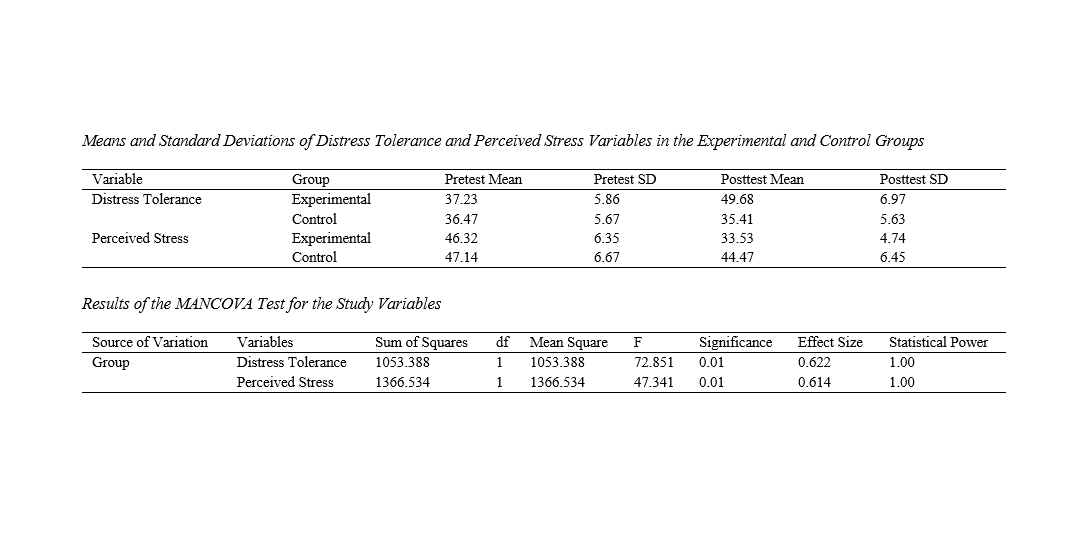
Findings: The results of multivariate analysis of covariance indicated a significant difference between the experimental and control groups in distress tolerance and perceived stress at the posttest stage (p < 0.01). Mindfulness-based cognitive therapy significantly increased distress tolerance and reduced perceived stress among women with social anxiety disorder. The findings demonstrated significant effects for distress tolerance (F = 72.851, p < 0.01, η² = 0.622) and perceived stress (F = 47.341, p < 0.01, η² = 0.614). Statistical power for both variables was reported as 1.00, indicating high explanatory strength of the intervention.
Conclusion: The findings suggest that mindfulness-based cognitive therapy is an effective psychological intervention for improving distress tolerance and reducing perceived stress in women with social anxiety disorder.
Downloads
References
Alanzi, T. M., Alharthi, A., Alrumman, S. N., Abanmi, S. N., Jumah, A., Alansari, H., Alharthi, T. S., Alibrahim, A., Algethami, A. A., Aburass, M. K., Alshahrani, A. M., Alzahrani, S., Al-Otaibi, B., Magadmi, T., & Almasodi, M. S. (2024). ChatGPT as a Psychotherapist for Anxiety Disorders: An Empirical Study With Anxiety Patients. Nutrition and Health, 31(3), 1111-1123. https://doi.org/10.1177/02601060241281906
Arrastía-Chisholm, M., Adams, K. S., Cakmakci, H., & Cunningham, T. J. (2024). Mindfulness and Yoga. Int. J. PWB, 2(1), 46-57. https://doi.org/10.61518/ijpw-34
Baghbani, F., Alidousti, K., Parvizi, M. M., Ahmadi, A., Alamdarloo, S. M., Jaladat, A. M., & Atarzadeh, F. (2023). Efficacy of Dry Cupping Versus Counselling With Mindfulness-Based Cognitive Therapy Approach (MBCT) on Fertility Quality of Life and Conception Success in Infertile Women Due to Polycystic Ovarian Syndrome: A Pilot Randomized Clinical Trial. https://doi.org/10.21203/rs.3.rs-2763633/v1
Bramanti, A., Pessolano, C., Garofano, M., Maglio, A., Ciccarelli, M., Budaci, L., Calabrese, M., Marıno, A., Loria, F., Corallo, F., Bramanti, P., Vecchione, C., & Vatrella, A. (2025). Mindfulness-Based Interventions for Chronic Pulmonary Diseases: A Systematic Review of Effects on Anxiety, Depression, Stress, Dyspnea, and Quality of Life. Bioengineering, 12(9), 931. https://doi.org/10.3390/bioengineering12090931
Carney, L., Park, C. L., & Hingorany, P. (2023). The Mechanisms of Mindfulness-Based Stress Reduction and Mindfulness-Based Cognitive Therapy for Cancer Patients and Survivors: A Systematic Review. Psychology of Consciousness Theory Research and Practice. https://doi.org/10.1037/cns0000362
Diamond, D. M. (2025). The Evolution of Cognitive-Behavioral Therapy for Anxiety: From Traditional Methods to Mindfulness and Acceptance-Based Approaches. Psychiatric Annals, 55(8). https://doi.org/10.3928/00485713-20250702-01
Farzanegan, M., Azizi, A., Fard, S. S., Sadeghi, A., Arefi, M., Badi, H. S., Adibi, P., Daghaghzadeh, H., & Afshar, H. (2025). Effectiveness of a Bioenergy Economy Program Versus Mindfulness-Based Cognitive Therapy on the Severity and Psychological Symptoms of Irritable Bowel Syndrome. Journal of education and health promotion, 14(1). https://doi.org/10.4103/jehp.jehp_1924_23
He, I. R., Gaillard, A., & Rossell, S. L. (2025). Addressing Body Dysmorphic Disorder Through Mindfulness: A New Therapeutic Frontier. Australian & New Zealand Journal of Psychiatry, 59(5), 405-412. https://doi.org/10.1177/00048674251328557
Holas, P., & Wardęszkiewicz, J. (2025). Self-Compassion and Resilience as Mediators of a 30-Day Internet-Delivered Mindfulness-Based Cognitive Therapy: A Pragmatic Open Trial. https://doi.org/10.21203/rs.3.rs-7555045/v1
Khataei, R., Khoshnoud, Z., Ahmadi, A., Moadeb, S., & Bagherian, B. (2023). The Effect of Mindfulness-Based Cognitive Therapy (MBCT) Online Training on Perceived Stress of Nursing Students: An Interventional Study. https://doi.org/10.21203/rs.3.rs-2821468/v1
Khavari, M., Alizadeh, K. H., Zarei, E., & Dortāj, F. (2024). Effectiveness of Mindfulness-Based Cognitive Therapy on Psychological Distress Syndromes, Rumination, and Self-Compassion in Students With Psychological Distress. Jayps, 5(2), 123-131. https://doi.org/10.61838/kman.jayps.5.2.14
Kim, J.-H., Oh, H., & Yoon, A. S. (2024). Mindfulness-Based Cognitive Therapy–Game: An Ironic Way to Treat Internet Gaming Disorder (Preprint). https://doi.org/10.2196/preprints.65786
Kraemer, K. M., Jain, F. A., Mehta, D. H., & Fricchione, G. L. (2022). Meditative and Mindfulness-Focused Interventions in Neurology: Principles, Science, and Patient Selection. Seminars in Neurology, 42(02), 123-135. https://doi.org/10.1055/s-0042-1742287
Marinovic, D. A., & Hunter, R. (2022). Examining the Interrelationships Between Mindfulness‐based Interventions, Depression, Inflammation, and Cancer Survival. Ca a Cancer Journal for Clinicians, 72(5), 490-502. https://doi.org/10.3322/caac.21733
May, A. C., Davis, C., Kirlić, N., & Stewart, J. L. (2022). Mindfulness-Based Interventions for the Treatment of Aberrant Interoceptive Processing in Substance Use Disorders. Brain Sciences, 12(2), 279. https://doi.org/10.3390/brainsci12020279
Nicholson, W. C., Sapp, M., Karas, E. M., Duva, I., & Grabbe, L. (2025). The Body Can Balance the Score: Using a Somatic Self-Care Intervention to Support Well-Being and Promote Healing. Healthcare, 13(11), 1258. https://doi.org/10.3390/healthcare13111258
Roodmajani, M. B., Nayyeri, M., & Ramezani, J. (2024). Comparison of Mindfulness-Based Cognitive Therapy and Integrated Transdiagnostic Psychotherapy for Emotion Regulation and Distress Tolerance. Elderly Health Journal. https://doi.org/10.18502/ehj.v10i1.15966
Shamblaw, A. L., & Segal, Z. V. (2022). Mindfulness Meditation in the Long-Term Management of Mood Disorders: Contributions by Canadian Researchers. Canadian Journal of Behavioural Science/Revue canadienne des sciences du comportement, 54(2), 142-151. https://doi.org/10.1037/cbs0000286
Shapiro, S. L., Carlson, L. E., & Sawyer, B. A. (2024). Mindfulness-Based Interventions in Mental Health Populations. 77-90. https://doi.org/10.1037/0000418-006
Shchaslyvyi, A. Y., Antonenko, S., & Telegeev, G. D. (2024). Comprehensive Review of Chronic Stress Pathways and the Efficacy of Behavioral Stress Reduction Programs (BSRPs) in Managing Diseases. International journal of environmental research and public health, 21(8), 1077. https://doi.org/10.3390/ijerph21081077
Slocum, K., & Bilican, F. I. (2025). Dialectical Behaviour Therapy Skills Training and Group Cognitive Behavioural Therapy for Hashimoto's Disease: Data on Quality of Life, Stress and Related Variables From a Randomised Controlled Trial. Counselling and Psychotherapy Research, 25(2). https://doi.org/10.1002/capr.70020
Szczepanowski, R., Wójta-Kempa, M., Pawlak, A., Kolasa, J., Uchmanowicz, I., Czapla, M., & Cyrkot, T. (2022). Depressive and Anxiety Disorders in the Cardiological Conditions: Psychological Interventions. Medical Research Journal, 7(4), 333-339. https://doi.org/10.5603/mrj.a2022.0051
Vázquez-Lara, M. D., Rúger-Navarrete, A., Mohamed-Abdel-Lah, S., Gómez‐Urquiza, J. L., Fernández-Carrasco, F. J., Díaz, L. R., Caparrós-González, R. A., Palomo-Gómez, R., Riesco-González, F. J., & Vázquez-Lara, J. M. (2025). The Impact of Mindfulness Programmes on Anxiety, Depression and Stress During Pregnancy: A Systematic Review and Meta-Analysis. Healthcare, 13(12), 1378. https://doi.org/10.3390/healthcare13121378
Wardęszkiewicz, J., & Holas, P. (2023). Internet-Delivered Modified Mindfulness-Based Cognitive Therapy (iMBCT) Intervention for Perceived Stress and Emotional Distress: A Pilot RCT Study. https://doi.org/10.21203/rs.3.rs-3622035/v1
Zarei, S., Lakhanpal, G., & Sadavoy, J. (2022). Tele-Mindfulness for Dementia's Family Caregivers: A Randomized Trial With a Usual Care Control Group. Current Alzheimer Research, 19(5), 364-372. https://doi.org/10.2174/1567205019666220514131015
Zeng, Y., Zhang, J., & Yang, J. (2025). Attention to Cancer-Related Physical and Mental Fatigue: Breaking the Vicious Cycle. World journal of psychiatry, 15(3). https://doi.org/10.5498/wjp.v15.i3.99037
Zhang, Z. J., Dong, Y., & Sun, Y. (2025). Effect of Mindfulness-Based Cognitive Therapy on Rumination and Post-Traumatic Growth in Patients With Acute Cerebral Infarction: A Randomized Controlled Trial. Medicine, 104(22), e42570. https://doi.org/10.1097/md.0000000000042570
Downloads
Additional Files
Publication Timeline
- Submitted
- Revised
- Accepted