Predicting Women's Life Satisfaction Through Self-Esteem, Meaning in Life, Social Connectedness, and Cognitive Emotion Regulation: A Serial Mediation Model
DOI:
https://doi.org/10.61838/kman.pwj.5422Keywords:
Life Satisfaction, Self-Esteem, Meaning in Life, Social Connectedness, Cognitive Emotion Regulation, Women, Subjective Well-BeingAbstract
Objective: The present study aimed to examine the direct and indirect relationships between self-esteem and life satisfaction among women and to investigate whether meaning in life, social connectedness, and cognitive emotion regulation function as serial mediators in this relationship.
Methods and Materials: This cross-sectional correlational study was conducted among 701 adult women residing in Canada. Participants were recruited through online platforms, community organizations, and university-affiliated networks. Data were collected using the Rosenberg Self-Esteem Scale, Meaning in Life Questionnaire, Social Connectedness Scale–Revised, Cognitive Emotion Regulation Questionnaire, and Satisfaction with Life Scale. Descriptive statistics and Pearson correlation analyses were performed using SPSS version 29. Structural equation modeling (SEM) was conducted using AMOS version 29 to test the hypothesized serial mediation model. Model fit was evaluated using χ²/df, Comparative Fit Index (CFI), Tucker-Lewis Index (TLI), Incremental Fit Index (IFI), Goodness-of-Fit Index (GFI), Root Mean Square Error of Approximation (RMSEA), and Standardized Root Mean Square Residual (SRMR). Indirect effects were assessed using bias-corrected bootstrapping procedures with 5,000 resamples and 95% confidence intervals.
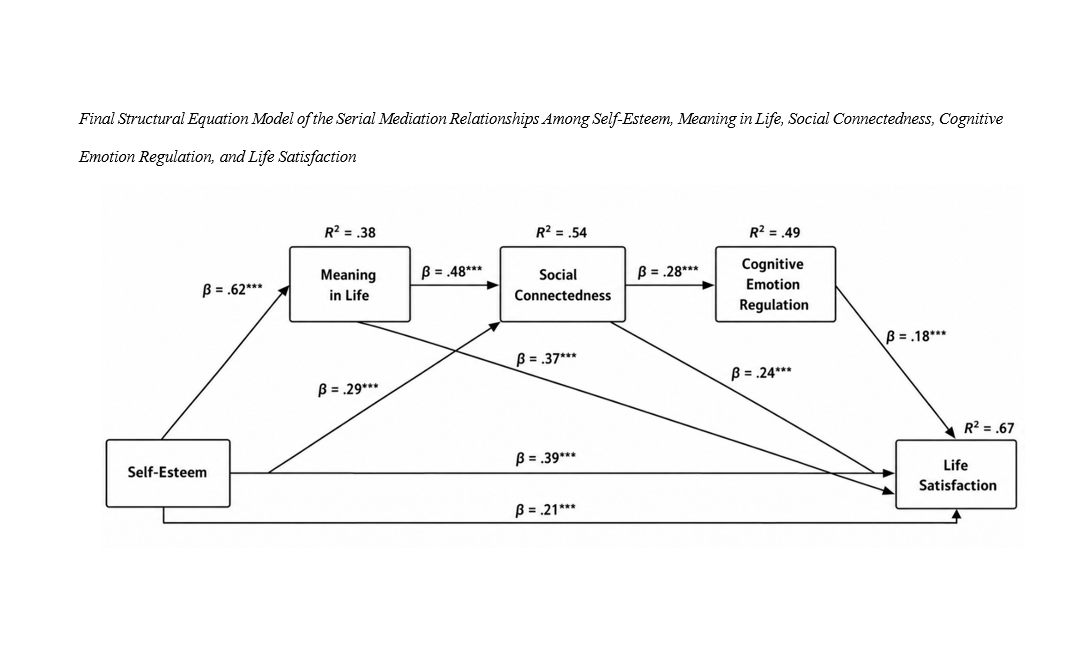
Findings: The structural model demonstrated excellent fit to the data (χ²/df = 2.24, CFI = .962, TLI = .956, IFI = .963, GFI = .941, RMSEA = .042, SRMR = .038). Self-esteem significantly predicted meaning in life (β = .62, p < .001), social connectedness (β = .29, p < .001), and life satisfaction (β = .21, p < .001). Meaning in life significantly predicted social connectedness (β = .48, p < .001), cognitive emotion regulation (β = .37, p < .001), and life satisfaction (β = .39, p < .001). Social connectedness significantly predicted cognitive emotion regulation (β = .28, p < .001) and life satisfaction (β = .24, p < .001), while cognitive emotion regulation positively predicted life satisfaction (β = .18, p < .001). Bootstrap analyses revealed significant indirect effects through all mediation pathways. The serial mediation pathway from self-esteem to life satisfaction through meaning in life, social connectedness, and cognitive emotion regulation was statistically significant (β = .03, 95% CI [.01, .06]). The model explained 67% of the variance in life satisfaction.
Conclusion: The findings indicate that self-esteem contributes to women’s life satisfaction both directly and indirectly through a sequence of existential, interpersonal, and emotional mechanisms. Meaning in life emerged as the strongest mediator, while social connectedness and cognitive emotion regulation further enhanced the pathway from self-esteem to life satisfaction. These results highlight the importance of integrated interventions targeting self-worth, life meaning, social relationships, and adaptive emotional regulation to promote women’s psychological well-being and overall life satisfaction.
Downloads
References
Abrinková, L., Orosová, O., & Čurová, V. (2024). Selected Internal Assets, Perceived External Resources of Resilience and Life Satisfaction. https://doi.org/10.36315/2024padix10
Bottaro, R., & Faraci, P. (2022). The Use of Social Networking Sites and Its Impact on Adolescents’ Emotional Well-Being: A Scoping Review. Current Addiction Reports, 9(4), 518-539. https://doi.org/10.1007/s40429-022-00445-4
Branquinho, C., Moraes, B., Noronha, C., Ferreira, T., Rodrigues, N. N., & Matos, M. G. d. (2023). Perceived Quality of Life and Life Satisfaction: Does the Role of Gender, Age, Skills, and Psychological Factors Remain Relevant After the COVID-19 Pandemic? Children, 10(9), 1460. https://doi.org/10.3390/children10091460
Cojocaru, L., Soponaru, C., Muntele‐Hendreș, D., & Ceobanu, C. (2025). Meaning in Life Among Aged People: A Qualitative Study of an Institutionalized Elderly Sample. European Journal of Investigation in Health Psychology and Education, 15(6), 91. https://doi.org/10.3390/ejihpe15060091
Dodd, E., Ismail, S. U., Christopher, G., Wildschut, T., Sedikides, C., & Cheston, R. (2021). Nostalgic Conversations: The Co-Production of an Intervention Package for People Living With Dementia and Their Spouse. Dementia, 21(2), 489-502. https://doi.org/10.1177/14713012211047350
Eather, N., Wade, L., Pankowiak, A., & Eime, R. (2023). The Impact of Sports Participation on Mental Health and Social Outcomes in Adults: A Systematic Review and the ‘Mental Health Through Sport’ Conceptual Model. Systematic Reviews, 12(1). https://doi.org/10.1186/s13643-023-02264-8
Fernandes, J., Santos, C., & Martins, M. V. (2025). Psychosocial Effects of Romantic Breakups During Emerging Adulthood: A Systematic Review. Clinical Psychology & Psychotherapy, 32(5). https://doi.org/10.1002/cpp.70139
Hepper, E. G., Sedikides, C., Wildschut, T., Cheung, W. Y., Abakoumkin, G., Arıkan, G., Aveyard, M., Baldursson, E. B., Białobrzeska, O., Bouamama, S., Bouzaouech, I., Brambilla, M., Burger, A. M., Chen, S. X., Cisek, S., Demassosso, D., Estevan‐Reina, L., González, R., Guerra, R., . . . Zengel, B. (2024). Pancultural Nostalgia in Action: Prevalence, Triggers, and Psychological Functions of Nostalgia Across Cultures. Journal of Experimental Psychology General, 153(3), 754-778. https://doi.org/10.1037/xge0001521
Hossain, S., O’Neill, S. C., & Strnadová, I. (2022). What Constitutes Student Well-Being: A Scoping Review of Students’ Perspectives. Child Indicators Research, 16(2), 447-483. https://doi.org/10.1007/s12187-022-09990-w
Hung, F. N., & Chan, R. C. H. (2022). Differentiation of Self, Proximal Minority Stress, and Life Satisfaction Among Sexual Minorities: Intrapersonal and Interpersonal Pathways to Life Satisfaction. American Journal of Orthopsychiatry, 92(5), 552-563. https://doi.org/10.1037/ort0000638
Jones, C. (2022). The Relationship Between Connectedness to Nature and WellBeing: A Meta-Analysis. Curr Res Psychol Behav Sc, 3(6), 1-8. https://doi.org/10.54026/crpbs/1064
Joshi, S. C., Woltering, S., & Woodward, J. (2023). Cell Phone Social Media Use and Psychological Well-Being in Young Adults: Implications for Internet-Related Disorders. International journal of environmental research and public health, 20(2), 1197. https://doi.org/10.3390/ijerph20021197
Layous, K., Kurtz, J. L., Wildschut, T., & Sedikides, C. (2022). The Effect of a Multi-Week Nostalgia Intervention on Well-Being: Mechanisms and Moderation. Emotion, 22(8), 1952-1968. https://doi.org/10.1037/emo0000817
Lee, H. W., Kim, S.-H., & Uhm, J.-P. (2021). Social Virtual Reality (VR) Involvement Affects Depression When Social Connectedness and Self-Esteem Are Low: A Moderated Mediation on Well-Being. Frontiers in psychology, 12. https://doi.org/10.3389/fpsyg.2021.753019
Ma, L., Li, X., & Xiang, Y. (2023). How Does Benign/Malicious Envy Impact Young Women's Subjective Well‐being in Daily Life? An Investigation of Intrapersonal and Interpersonal Pathway. Applied Psychology Health and Well-Being, 16(1), 102-118. https://doi.org/10.1111/aphw.12471
Mahasneh, A. M. (2022). The Relationship Between Subjective Well-Being and Social Support Among Jordanian University Students. Psychology in Russia State of Art(2), 53-64. https://doi.org/10.11621/pir.2022.0204
McCullough, K. M., Wong, Y. J., & Deng, K. (2021). Exploring the Connections Between Watching Asian American YouTubers, Racial Identity, and Self-Esteem. Asian American Journal of Psychology, 12(1), 41-51. https://doi.org/10.1037/aap0000218
Mehrpour, A., Hoffman, A., Widmer, É., & Staerklé, C. (2024). Social Ties and Social Identification: Influences on Well-Being in Young Adults. Journal of Social and Personal Relationships, 41(10), 3085-3108. https://doi.org/10.1177/02654075241263239
Milošević, J., Habe, K., & Bajec, B. (2025). Differences in Experiencing Well-Being in Youth Choir Singers Regarding (In)Formal Participation. Behavioral Sciences, 15(10), 1337. https://doi.org/10.3390/bs15101337
Puțaru, A. I., & Rusu, A. S. (2023). Qualitative Literature Review Concerning Psycho-Social Factors of the Student – Teacher Relationship. 6, 411-419. https://doi.org/10.15405/epes.23056.37
Roper, M., & Tobin, S. J. (2022). Compassionate Goals, Facebook Use, and Subjective Well-Being: Examining the Roles of Relationship Maintenance and Connectedness. Cyberpsychology Behavior and Social Networking, 25(8), 527-533. https://doi.org/10.1089/cyber.2021.0259
Slone, M., & Peer, A. (2021). Children’s Reactions to War, Armed Conflict and Displacement: Resilience in a Social Climate of Support. Current psychiatry reports, 23(11). https://doi.org/10.1007/s11920-021-01283-3
Szczęśniak, M., Bajkowska, I., Czaprowska, A., & Sileńska, A. (2022). Adolescents’ Self-Esteem and Life Satisfaction: Communication With Peers as a Mediator. International journal of environmental research and public health, 19(7), 3777. https://doi.org/10.3390/ijerph19073777
Tangmunkongvorakul, A., Kelly, M., Thongpibul, K., Musumari, P. M., Srithanaviboonchai, K., & Banwell, C. (2022). The Association Between Connectedness and Grit Among Thai in-School Adolescents in Urban Chiang Mai, Thailand. Frontiers in psychology, 13. https://doi.org/10.3389/fpsyg.2022.809508
Thi, L.-H., Phan, M.-H. T., Dinh, H. V. T., Nguyen, P.-H. T., Pham, T., Luu, L. D., & Hoang, T. H. (2025). Social Support and Mental Health in School Students: Parallel Mediation Effects of Self‑Esteem and Mastery. https://doi.org/10.21203/rs.3.rs-7247209/v1
Wagner, G., Zeiler, M. D., Karwautz, A., Schneider, A., Rami‐Merhar, B., & Berger, G. (2022). Personality, Coping and Developmental Conditions in Female Adolescents and Young Adults With Type 1 Diabetes: Influence on Metabolic Control and Quality of Life. Frontiers in Psychiatry, 12. https://doi.org/10.3389/fpsyt.2021.809015
Walsh, L. C., Regan, A., Okabe‐Miyamoto, K., & Lyubomirsky, S. (2024). Does Putting Down Your Smartphone Make You Happier? The Effects of Restricting Digital Media on Well-Being. PLoS One, 19(10), e0306910. https://doi.org/10.1371/journal.pone.0306910
Weng, F. (2023). The Impact of Social-Engagement, Social-Support and Self-Esteem on Life Satisfaction in UK Youth: A Sequential Explanatory Mixed Methods Study. Lecture Notes in Education Psychology and Public Media, 24(1), 1-12. https://doi.org/10.54254/2753-7048/24/20230538
Yang, L., Sin, K. F., & Savickas, M. L. (2023). Assessing Factor Structure and Reliability of the Career Adaptability Scale in Students With Special Educational Needs. Frontiers in psychology, 14. https://doi.org/10.3389/fpsyg.2023.1030218
Yang, Y., Sedikides, C., Wang, Y., & Cai, H. (2024). Nature Nurtures Authenticity: Mechanisms and Consequences. Journal of personality and social psychology, 126(1), 79-104. https://doi.org/10.1037/pspi0000432
Zhang, Z. H., & Wang, Y. (2025). Development of National Identity Among Chinese Adolescents: Identification of Subgroups and Influencing Factors. Psychology in the Schools, 62(10), 4053-4064. https://doi.org/10.1002/pits.23594
Zhao, M., & Zhang, Y. (2025). How Does Nature Connectedness Improve Mental Health in College Students? A Study of Chain Mediating Effects. Behavioral Sciences, 15(5), 654. https://doi.org/10.3390/bs15050654
Downloads
Additional Files
Publication Timeline
- Submitted
- Revised
- Accepted