The Relationship Between Childhood Emotional Neglect and Intimacy Avoidance in Women: The Mediating Roles of Rejection Sensitivity, Self-Compassion, and Attachment Anxiety
DOI:
https://doi.org/10.61838/kman.pwj.5433Keywords:
Childhood emotional neglect, intimacy avoidance, rejection sensitivity, self-compassion, attachment anxiety, womenAbstract
Objective: This study aimed to examine the relationship between childhood emotional neglect and intimacy avoidance in women and to investigate the mediating roles of rejection sensitivity, self-compassion, and attachment anxiety within a structural equation modeling framework.
Methods and Materials: The present study employed a cross-sectional correlational design. The study population consisted of adult women residing in Canada during the 2025–2026 research period. A total of 548 women aged 18 to 62 years (M = 34.71, SD = 9.42) were selected through online convenience sampling and participated voluntarily. Data were collected using the Childhood Trauma Questionnaire–Short Form (CTQ-SF), Rejection Sensitivity Questionnaire (RSQ), Self-Compassion Scale (SCS), Experiences in Close Relationships–Revised (ECR-R), and Fear of Intimacy Scale (FIS). Descriptive statistics and Pearson correlation analyses were performed using SPSS version 29. Structural equation modeling and bootstrap analyses with 5,000 resamples were conducted using AMOS version 29 to evaluate direct and indirect relationships among the study variables.
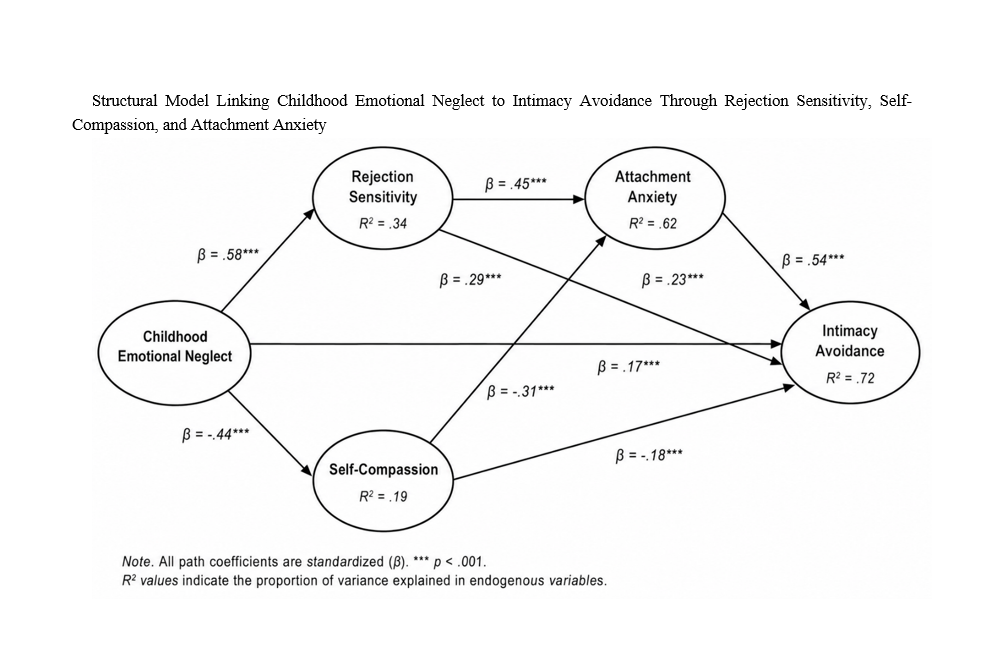
Findings: The proposed structural model demonstrated excellent fit to the data (χ²/df = 2.22, CFI = .957, TLI = .951, GFI = .924, AGFI = .908, RMSEA = .047, SRMR = .041). Childhood emotional neglect was positively associated with rejection sensitivity (β = .58, p < .001), attachment anxiety (β = .29, p < .001), and intimacy avoidance (β = .17, p < .001), while negatively associated with self-compassion (β = −.44, p < .001). Rejection sensitivity positively predicted attachment anxiety (β = .45, p < .001) and intimacy avoidance (β = .23, p < .001). Self-compassion negatively predicted attachment anxiety (β = −.31, p < .001) and intimacy avoidance (β = −.18, p < .001). Attachment anxiety emerged as the strongest predictor of intimacy avoidance (β = .54, p < .001). Bootstrap analyses confirmed significant indirect effects through rejection sensitivity, self-compassion, attachment anxiety, and their serial pathways, indicating partial mediation.
Conclusion: The findings suggest that childhood emotional neglect exerts a substantial influence on women's intimacy avoidance through interconnected cognitive, emotional, and attachment-related mechanisms. Rejection sensitivity and attachment anxiety function as risk factors, whereas self-compassion serves as a protective factor. Interventions designed to enhance self-compassion, reduce rejection sensitivity, and promote attachment security may help mitigate the long-term relational consequences of childhood emotional neglect and improve women's capacity for emotional intimacy and healthy interpersonal relationships.
Downloads
References
Almeida, T. C., & Costa, S. M. (2023). Benevolent and Adverse Childhood Experiences and Attachment in Adulthood: A Comparative Study Between Sex Offenders and the General Population. Crime & Delinquency, 71(5), 1535-1557. https://doi.org/10.1177/00111287231172716
Amari, N., Martin, T., Mahoney, A., Peacock, S., Stewart, J., & Alford, E. A. (2022). Exploring the Relationship Between Compassion and Attachment in Individuals With Mental Health Difficulties: A Systematic Review. Journal of Contemporary Psychotherapy, 53(3), 245-256. https://doi.org/10.1007/s10879-022-09573-4
Ankori, G., Solan, M., Plishty, S., Klomek, A. B., Apter, A., & Yagil, Y. (2025). The Role of Parental Qualities in Supporting Children With ADHD. Children, 12(7), 845. https://doi.org/10.3390/children12070845
Aracı‐İyiaydın, A., Toplu‐Demirtaş, E., Kayabol, N. B. A., & Rohner, R. P. (2023). All You Fear Is Love: The Roles of Rejection by Intimate Others. Personal Relationships, 30(2), 451-470. https://doi.org/10.1111/pere.12473
Bahmani, T., Naseri, N. S., & Fariborzi, E. (2022). Relation of Parenting Child Abuse Based on Attachment Styles, Parenting Styles, and Parental Addictions. Current Psychology, 42(15), 12409-12423. https://doi.org/10.1007/s12144-021-02667-7
Chen, Z. (2023). The Relationship Between Fathers Parenting Behavior and Adult Attachment. Lecture Notes in Education Psychology and Public Media, 3(1), 1068-1075. https://doi.org/10.54254/2753-7048/3/2022602
Deniz, M. E., & KurtuluŞ, H. Y. (2023). Self-Efficacy, Self-Love, and Fear of Compassion Mediate the Effect of Attachment Styles on Life Satisfaction: A Serial Mediation Analysis. Psychological Reports, 128(2), 457-482. https://doi.org/10.1177/00332941231156809
Dinzeo, T. J., Ryan, E., & Pujji, S. D. (2025). The Influence of Adverse Childhood Experiences and Schizotypy on Adult Attachment Styles. Psychological Trauma Theory Research Practice and Policy. https://doi.org/10.1037/tra0002037
Doorn, G. V., Teese, R., & Dye, J. (2024). Adverse Childhood Experiences and Infidelity: The Mediating Roles of Anxious and Avoidant Attachment Styles. Family Process, 64(1). https://doi.org/10.1111/famp.13088
Etxaburu, N., Herrero, M., & Estévez, A. (2024). Self-Compassion as a Moderating Variable Between Attachment, Emotional Dependence, Stress, Anxiety, and Depression in Spanish Adolescents. Behavioral Psychology/Psicología Conductual, 269-288. https://doi.org/10.51668/bp.8324203n
Falgares, G., Costanzo, G., Manna, G., & Lamis, D. A. (2024). Childhood Emotional Maltreatment and Internalizing Problems in a Non-Clinical Sample of Adolescents: A Moderated-Mediation Model of Insecure Anxious Attachment Style and Gender. Research in Psychotherapy Psychopathology Process and Outcome. https://doi.org/10.4081/ripppo.2024.745
Giacomo, E. d., Andreini, E., Santambrogio, J., Arcara, A., & Clerici, M. (2024). The Interplay Between Borderline Personality Disorder and Oxytocin: A Systematic Narrative Review on Possible Contribution and Treatment Options. Frontiers in Psychiatry, 15. https://doi.org/10.3389/fpsyt.2024.1439615
Gibbons, R. (2024). The Psychodynamics of Self-Harm. Bjpsych Advances, 31(3), 164-172. https://doi.org/10.1192/bja.2024.68
Huynh, T., Phillips, E. M., & Brock, R. L. (2021). Self‐compassion Mediates the Link Between Attachment Security and Intimate Relationship Quality for Couples Navigating Pregnancy. Family Process, 61(1), 294-311. https://doi.org/10.1111/famp.12692
K., F. (2024). Effect of Attachment Style on Emotional Regulation and Psychological Wellbeing Among Adults. Aijmr, 2(3). https://doi.org/10.62127/aijmr.2024.v02i03.1046
Kara, E., & Şahin, F. Y. (2022). Çocukluk Dönemi̇ Örselenme Yaşantilari, Evli̇li̇kte Öz Yetki̇nli̇k Ve İli̇şki̇sel Yilmazlik Arasindaki̇ İli̇şki̇ler: Bağlanma Sti̇lleri̇ni̇n Araci Rolü. The Journal of Academic Social Sciences, 124(124), 158-179. https://doi.org/10.29228/asos.51800
Karaköse, S., & Ledermann, T. (2026). Insecure Attachment and Mental Health in Married Couples. Couple and Family Psychology Research and Practice, 15(1), 16-31. https://doi.org/10.1037/cfp0000276
Karveli, S., Karademas, E. C., Poulakaki, N., Antonopoulou, Z., Arkadopoulos, N., & Markopoulos, C. (2025). The Mediating Role of Early Maladaptive Schemas in the Relationship Between Attachment Styles and Adjustment to Early‐Stage Breast Cancer. Psycho-Oncology, 34(6). https://doi.org/10.1002/pon.70196
Kaya, M. D., Kaya, F., & Eroğlu, Y. (2023). Interpersonal Cognitive Distortions: What Is the Role of Childhood Trauma and Attachment? Journal of Education in Science Environment and Health, 292-309. https://doi.org/10.55549/jeseh.1381214
Khan, S., Riaz, R., & Ali, Z. B. (2022). Childhood Attachment With Parents as Predictor of Subjective Wellbeing in Emerging Adults. Clinical and Counselling Psychology Review, 4(2), 57-81. https://doi.org/10.32350/ccpr.42.04
Paivio, S. C., & Pascual‐Leone, A. (2023). Cultivating the Alliance. 79-102. https://doi.org/10.1037/0000336-005
Papalia, N., & Widom, C. S. (2023). Do Insecure Adult Attachment Styles Mediate the Relationship Between Childhood Maltreatment and Violent Behavior? Development and Psychopathology, 36(2), 636-647. https://doi.org/10.1017/s0954579422001468
Pinto‐Cortez, C., Peñaloza-Díaz, G., Martínez, N., Díaz, S. A. C., Valdovino, N., Zavala, M., Muzatto-Negrón, P., & Zapata-Sepúlveda, P. (2023). Adverse Childhood Experiences and Psychopathology in Adolescents From Northern Chile: The Moderating Role of the Attachment Style. Psicologia Reflexão E Crítica, 36(1). https://doi.org/10.1186/s41155-023-00273-z
Prato‐Previde, E., Ricci, E. B., & Colombo, E. S. (2022). The Complexity of the Human–Animal Bond: Empathy, Attachment and Anthropomorphism in Human–Animal Relationships and Animal Hoarding. Animals, 12(20), 2835. https://doi.org/10.3390/ani12202835
Quinlan, H., Hadden, K. L., & Storey, D. P. (2021). The Relationship Between Self-Compassion, Childhood Maltreatment and Attachment Orientation in High-Risk Adolescents. Youth & Society, 54(5), 890-906. https://doi.org/10.1177/0044118x211002857
Scharfe, E. (2026). Attachment Representations and Depression. 423-439. https://doi.org/10.1037/0000437-023
Tavares, L., Vagos, P., & Xavier, A. (2022). The Role of Self‐compassion in the Psychological (Mal)adjustment of Older Adults: A Repeated‐measures Study Protocol. Psychology and Psychotherapy Theory Research and Practice, 95(4), 990-1002. https://doi.org/10.1111/papt.12414
Topino, E., & Gori, A. (2025). Childhood Neglect and Its Effect on Self-Conception and Attachment in Adulthood: A Structural Equation Model. Psychological Trauma Theory Research Practice and Policy. https://doi.org/10.1037/tra0001921
Wang, H. (2023). Impact of Attachment Relationships on Anxiety and Depression. SHS Web of Conferences, 180, 02028. https://doi.org/10.1051/shsconf/202318002028
West, T. N., Don, B. P., & Fredrickson, B. L. (2022). Attachment Insecurity Moderates Emotion Responses to Mindfulness and Loving-Kindness Meditation in Adults Raised in Low Socioeconomic Status Households. Emotion, 22(6), 1101-1118. https://doi.org/10.1037/emo0001049
Wong, I., & Denson, T. F. (2025). Insecure Attachment and Burnout Among Mental Health Professionals: The Mediating Role of Caregiving Representations and Disrupted Cognitive Schema. Traumatology an International Journal. https://doi.org/10.1037/trm0000637
Yu, S., Zhang, C., Wang, Y., Liu, T., Chen, X., Guo, J., Zhang, G., & Xu, W. (2022). Parental Neglect, Anxious Attachment, Perceived Social Support, and Mental Health Among Chinese College Students With Left‐behind Experience: A Longitudinal Study. PsyCh Journal, 12(1), 150-160. https://doi.org/10.1002/pchj.611
Zhou, Z. (2024). The Influence of Personality Shaping on Romantic Relationships in Early Adulthood. Journal of Education Humanities and Social Sciences, 26, 317-322. https://doi.org/10.54097/2s6emv80
Downloads
Additional Files
Publication Timeline
- Submitted
- Revised
- Accepted