Predicting Women's Psychological Flourishing Using XGBoost: The Relative Importance of Self-Compassion, Resilience, Emotional Intelligence, and Social Support
DOI:
https://doi.org/10.61838/kman.pwj.5446Keywords:
Psychological Flourishing, Women, XGBoost, Machine Learning, Resilience, Self-Compassion, Emotional Intelligence, Social SupportAbstract
Objective: The present study aimed to predict psychological flourishing among women using the Extreme Gradient Boosting (XGBoost) machine-learning algorithm and to determine the relative importance of self-compassion, resilience, emotional intelligence, and perceived social support as predictors of flourishing.
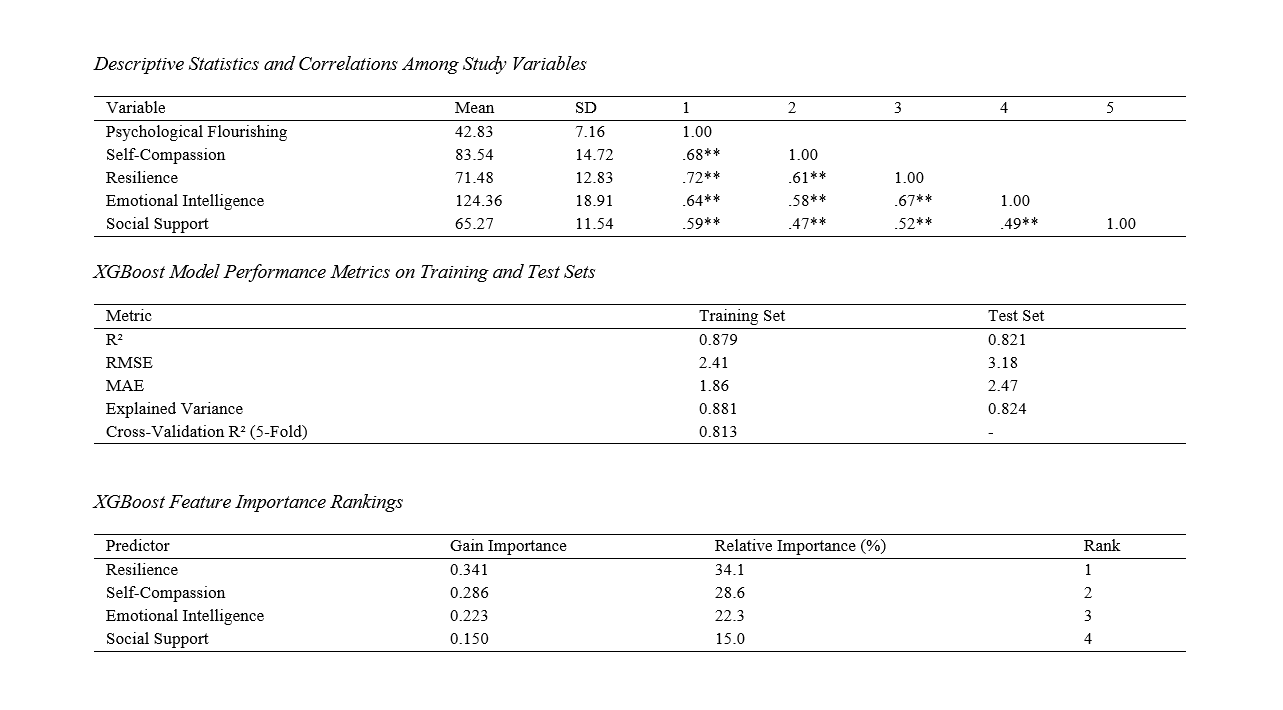
Methods and Materials: This cross-sectional predictive study was conducted among 642 adult women residing in Canada. Participants were recruited through online platforms and community networks and completed a battery of standardized self-report measures assessing psychological flourishing, self-compassion, resilience, emotional intelligence, and perceived social support. After data screening and preprocessing, descriptive statistics and Pearson correlations were calculated. The dataset was randomly divided into training (80%) and testing (20%) subsets. XGBoost was employed as the primary predictive model due to its ability to capture complex nonlinear relationships and interactions among predictors. Hyperparameter tuning was performed using five-fold cross-validation and grid-search optimization procedures. Model performance was evaluated using the coefficient of determination (R²), root mean square error (RMSE), mean absolute error (MAE), and explained variance. Feature importance analysis and SHAP (Shapley Additive Explanations) values were used to determine the relative contribution and interpretability of each predictor.
Findings: All predictor variables demonstrated significant positive correlations with psychological flourishing. The XGBoost model exhibited strong predictive performance, explaining 82.1% of the variance in flourishing scores on the test dataset (R² = .821), with low prediction errors (RMSE = 3.18; MAE = 2.47). Feature importance analysis revealed that resilience was the most influential predictor (34.1%), followed by self-compassion (28.6%), emotional intelligence (22.3%), and social support (15.0%). SHAP analyses confirmed that all predictors exerted positive effects on flourishing, with resilience demonstrating the strongest impact on model predictions. The findings indicated that internal psychological strengths contributed more substantially to flourishing than external support resources.
Conclusion: The findings suggest that women’s psychological flourishing can be accurately predicted using machine-learning approaches and is primarily influenced by resilience, self-compassion, emotional intelligence, and social support. Resilience emerged as the strongest determinant of flourishing, highlighting the importance of adaptive coping capacities in promoting optimal psychological functioning. Interventions aimed at enhancing flourishing among women should prioritize the development of resilience and self-compassion while also strengthening emotional intelligence and supportive interpersonal relationships.
Downloads
References
Amartyavanda, A., Widyasari, D. C., Syakarofath, N. A., & Latipun, L. (2024). Health Workers Need More Than Emotional Intelligence to Regulate Stress During Health Crises. Kne Social Sciences. https://doi.org/10.18502/kss.v9i5.15175
Bhattacharjee, A. (2024). Effectiveness of Emotional Intelligence Training Programs for Healthcare Providers in Kolkata. Eatp, 3784-3757. https://doi.org/10.53555/kuey.v30i5.3529
Bock, L., Riedel, E., & Rana, M. (2025). A Four-Week Online Compassion and Gratitude Training Programme to Enhance Emotion Regulation: Implications for Stress Management and Healthcare Leadership. Healthcare, 14(1), 12. https://doi.org/10.3390/healthcare14010012
Ding, C., Mortillaro, M., & Ramdas, M. (2024). Emotional Intelligence in Applied Settings: Approaches to Its Theoretical Model, Measurement, and Application. https://doi.org/10.3389/978-2-8325-4623-9
Emslie, N. J. (2025). Reimagining Emotional Intelligence as Theological Praxis in Anglican Ministry. Journal of Anglican Studies, 1-21. https://doi.org/10.1017/s1740355325100703
Gannamraju, S. K. (2025). Lived Experiences of Spiritual Emotional Intelligence: A Bhagavad Gitā-Based Indigenous Model of Psychological Wellbeing. Frontiers in psychology, 16. https://doi.org/10.3389/fpsyg.2025.1730103
Goodwin, L., Wallymahmed, A., Triandafilidis, Z., & Barker, D. (2025). Professional Quality of Life Is Related to Emotional Intelligence, Self-Care, and Work Conditions in Healthcare Workers: Findings From a Moderated Mediation Analysis. BMC Health Services Research, 25(1). https://doi.org/10.1186/s12913-025-13437-7
Hovnanyan, A., Vardanyan, N., Moscardino, U., Olff, M., & Scrimin, S. (2024). Traumatic Stress Symptoms in Civilians After the 2020 Nagorno-Karabakh War: The Protective Role of Self-Compassion and Emotional Intelligence. Journal of Health Psychology, 29(14), 1653-1666. https://doi.org/10.1177/13591053241258630
Kolobaric, N., Milone, B., Salman, M., Buh, A., Biyani, N., Wafy, G., Fung, S., Scott, M., Kiska, R., Kang, R., Lee, K., Syed, S., Gibb, M., Dhaliwal, S., Myran, D. T., Maskerine, C., Brown, P. A., Akbari, A., Hundemer, G. L., . . . Sood, M. M. (2025). Effectiveness of Wellness Program Interventions to Improve Physician Wellness: A Systematic Review. BMC Health Services Research, 25(1). https://doi.org/10.1186/s12913-025-12934-z
Kumar, S. A., Vogt, D., Miller, A. N., Mitchell, K. S., Brock, R. L., & DiLillo, D. (2025). Posttraumatic Resilience and Growth: A Network Analysis of Character Strengths Among Sexual Assault Survivors. Psychological Trauma Theory Research Practice and Policy. https://doi.org/10.1037/tra0001857
Kuzmić, A., Filipec, M., & Jakovljević, M. (2025). The Links Between Physical Activity, Metacognition, and Empathy Among Physiotherapy Students. Healthcare, 13(18), 2350. https://doi.org/10.3390/healthcare13182350
Liu, M., Yan, Z., & Wu, C. (2025). Comparative Efficacy and Acceptability of Resilience-Focused Interventions for Nurses: A Systematic Review and Network Meta-Analysis of Randomized Controlled Trials. BMC Nursing, 24(1). https://doi.org/10.1186/s12912-025-03090-0
Liu, R. (2025). Psychological Resources for Academic Buoyancy: The Roles of Growth Mindset and Emotional Intelligence in Chinese University Students. Frontiers in psychology, 16. https://doi.org/10.3389/fpsyg.2025.1580929
Lu, T., Liu, M., Zhang, X., & Li, O. (2024). Assessing the Emotional Intelligence Level of School Heads Towards Crafting an Executive Development Program. Journal of World Englishes and Educational Practices, 6(1), 117-136. https://doi.org/10.32996/jweep.2024.6.1.5
Mosallanezhad, M., Torabizadeh, C., & Zarshenas, L. (2023). A Study of the Relationship Between Ethical Sensitivity and Emotional Intelligence in Nursing, Anesthesia, and Operating Room Students. International Journal of Emotional Education, 15(1), 89-104. https://doi.org/10.56300/jaer8536
Mustabeen, M., & Arshad, N. (2025). Self-Compassion, Psychological Inflexibility, Resilience and Psychological Wellbeing: A Correlational Study With Mental Health Trainees. https://doi.org/10.21203/rs.3.rs-7768779/v1
Nayak, S., & Satpathy, B. (2023). Emotional Intelligence: A Competence Analysis for Public Health Care Providers. https://doi.org/10.52783/jier.v3i2.497
Rofiqah, R. (2023). The Effect of Self-Compassion and Support Systems on Flourishing in Students. 68-76. https://doi.org/10.2991/978-2-38476-032-9_8
S., R., & K., D. P. (2024). Correlation of Emotional and Spiritual Intelligence in Musicians. International Journal for Multidisciplinary Research, 6(2). https://doi.org/10.36948/ijfmr.2024.v06i02.18664
Saoji, S. S., Paul, P., Sontakke, P., Reche, A., & Awghad, S. (2024). Determining the Emotional Intelligence and Compassion Fatigue Among Postgraduate Dental Students Using the Emotional Intelligence Scale and the Quality of Life Scale: An Observational Study. Cureus. https://doi.org/10.7759/cureus.64060
Schimmels, J., Schneider, J., Bücher, K., & Coty, M. B. (2024). Stoicism and Cognitive Strategies for Nursing Professional Development. The Journal of Continuing Education in Nursing, 55(8), 378-386. https://doi.org/10.3928/00220124-20240328-02
Shani, M., & Wübbelt, K. (2025). Coping With Long-Covid Stigma: The Role of Self-Compassion and Self-Coldness. Health Psychology Open, 12. https://doi.org/10.1177/20551029251349409
Tendhar, T., Marcotte, M. A., Mesquita, P. B. d., & Saikia, M. J. (2024). Online Video-Mediated Compassion Training Program for Mental Health and Well-Being of University Students. Healthcare, 12(10), 1033. https://doi.org/10.3390/healthcare12101033
Tsironis, C., Tatsis, F., Konstanti, Z., Mentis, M., Stolakis, K., Kotsia, V., Mantzoukas, S., Dragioti, E., & Gouva, M. (2024). Resilience and Self-Compassion: Shields Against Age-Related Declines in Oral Health and Shame. Cureus. https://doi.org/10.7759/cureus.66565
Z., W., Yin, B., Luo, X., & Ghosh, A. (2023). The Importance of Emotional Intelligence in the Successful Leadership of MBA Programs. International Journal for Multidisciplinary Research, 5(6). https://doi.org/10.36948/ijfmr.2023.v05i06.8382
Downloads
Additional Files
Publication Timeline
- Submitted
- Revised
- Accepted