TabNet Prediction of Depression Risk Among Women Through Rumination, Social Isolation, Self-Criticism, and Intolerance of Uncertainty
DOI:
https://doi.org/10.61838/kman.pwj.5474Keywords:
Depression Risk, Women, TabNet, Machine Learning, Rumination, Self-Criticism, Social Isolation, Intolerance of UncertaintyAbstract
Objective: The present study aimed to predict depression risk among women using rumination, social isolation, self-criticism, and intolerance of uncertainty through an explainable TabNet machine learning model and to determine the relative importance of these predictors in identifying individuals at elevated risk for depressive symptoms.
Methods and Materials: This cross-sectional predictive study was conducted among 1,248 women residing in Kenya. Participants were recruited using a stratified convenience sampling strategy from community health centers, educational institutions, workplaces, and online platforms. Data were collected using standardized self-report measures, including the Patient Health Questionnaire-9 (PHQ-9) for depression risk, the Ruminative Responses Scale (RRS), the Lubben Social Network Scale-Revised (LSNS-6), the Levels of Self-Criticism Scale (LOSC), and the Intolerance of Uncertainty Scale-12 (IUS-12). Following data preprocessing and standardization, the dataset was divided into training (70%), validation (15%), and testing (15%) subsets. A TabNet deep learning model was developed and optimized using cross-validation and hyperparameter tuning procedures. Model performance was evaluated using the coefficient of determination (R²), root mean square error (RMSE), mean absolute error (MAE), and mean squared error (MSE). Feature importance and SHAP analyses were conducted to enhance interpretability.
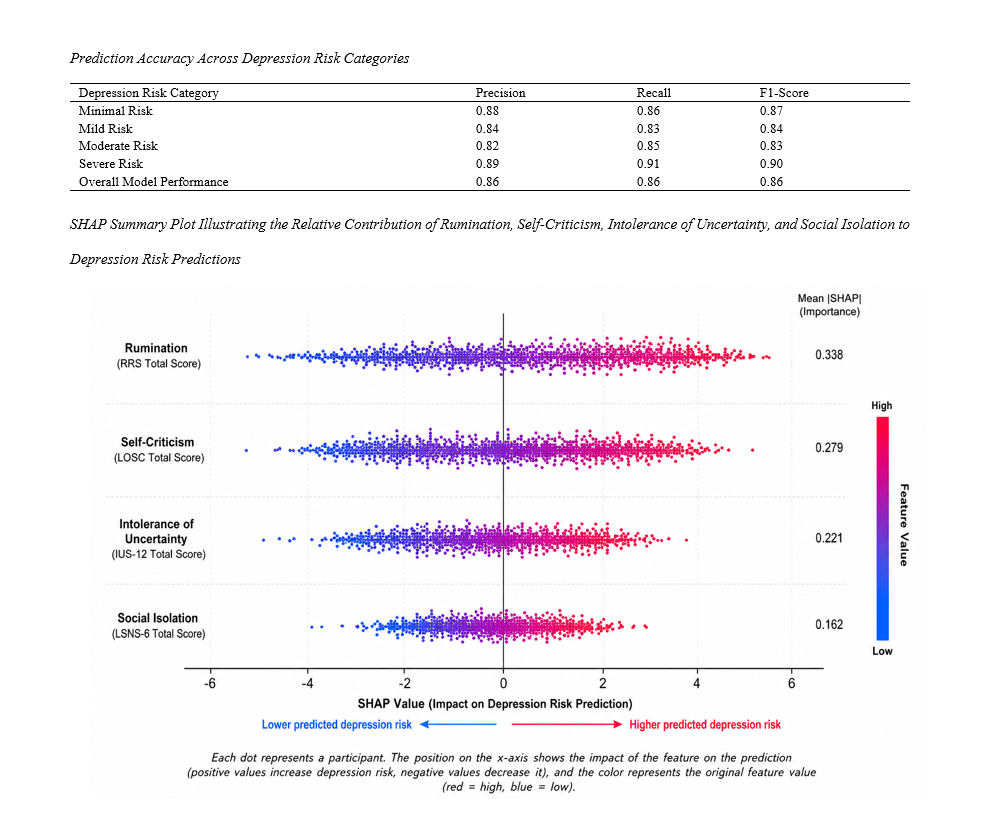
Findings: The TabNet model demonstrated excellent predictive performance, achieving an R² of .874 in the training set, .846 in the validation set, and .832 in the testing set. Correlation analyses indicated significant positive associations between depression risk and rumination (r = .71), self-criticism (r = .68), intolerance of uncertainty (r = .65), and social isolation (r = .63). Feature importance analysis revealed that rumination was the strongest predictor (33.8%), followed by self-criticism (27.9%), intolerance of uncertainty (22.1%), and social isolation (16.2%). SHAP analysis confirmed that higher levels of all four predictors contributed to increased depression risk. Classification analyses further demonstrated strong model accuracy, yielding an overall F1-score of .86 and particularly high performance in identifying severe depression risk cases.
Conclusion: The findings indicate that depression risk among women can be accurately predicted using a combination of cognitive and social vulnerability factors. Rumination emerged as the most influential predictor, highlighting the central role of repetitive negative thinking in depressive symptomatology. The results support transdiagnostic models of emotional disorders and demonstrate the utility of explainable machine learning approaches for mental health screening, early detection, and personalized intervention planning.
Downloads
References
Assaf, M., Malaeb, D., Sakr, F., Dabbous, M., Fekih-Romdhane, F., Hallit, S., & Obeïd, S. (2025). Mediating Effect of Intolerance of Uncertainty Between Feeling of Unsafety and Depression/Well-Being Among a Sample of Lebanese Adults. Archives of Public Health, 83(1). https://doi.org/10.1186/s13690-025-01551-1
Choudhary, K., Mason, G., Correa, A., Fotinos, K., Lokuge, S., Greifenberger, A., Toumeh, E., Clarissa, S., Epstein, I., Sternat, T., & Katzman, M. A. (2023). Intolerance of Uncertainty, Perfectionism, and Coping as Predictors of Depression Diagnosis and Severity. Journal of Mood and Anxiety Disorders, 3, 100019. https://doi.org/10.1016/j.xjmad.2023.100019
Cutajar, K., & Bates, G. (2025). Australian Women in the Perinatal Period During COVID-19: The Influence of Self-Compassion and Emotional Regulation on Anxiety, Depression, and Social Anxiety. Healthcare, 13(2), 120. https://doi.org/10.3390/healthcare13020120
Flynt, S., Cho, G. Y., Koscinski, B., Accorso, C., Knapp, A. A., Gorka, S. M., Suhr, J. A., Austin, M. J., & Allan, N. P. (2025). A One-Arm Pilot Trial of a Telehealth CBT-based Group Intervention Targeting Transdiagnostic Risk for Emotional Distress. PLoS One, 20(6), e0303131. https://doi.org/10.1371/journal.pone.0303131
Gerdan, G., & Şalcıoğlu, E. (2025). Experiential Avoidance as a Transdiagnostic Mediator in the Relationship Between Intolerance of Uncertainty, Maladaptive Perfectionism, and Psychiatric Symptoms: Structural and Causal Mediation Analyses in a Clinical Sample. Clinical Psychology & Psychotherapy, 32(3). https://doi.org/10.1002/cpp.70102
Gosselin, P., Castonguay, C., Goyette, M., Lambert, R., Brisson, M., Landreville, P., & Grenier, S. (2022). Anxiety Among Older Adults During the COVID-19 Pandemic. Journal of anxiety disorders, 92, 102633. https://doi.org/10.1016/j.janxdis.2022.102633
Harrison, V., Moulds, M. L., & Jones, K. (2022). Perceived Social Support and Prenatal Wellbeing; The Mediating Effects of Loneliness and Repetitive Negative Thinking on Anxiety and Depression During the COVID-19 Pandemic. Women and Birth, 35(3), 232-241. https://doi.org/10.1016/j.wombi.2020.12.014
Hernández-Posadas, A., Lommen, M. J., Rosa-Gómez, A. D. l., Bouman, T., Díaz, J. M. M., & Palacio‐González, A. d. (2023). Transdiagnostic Factors in Symptoms of Depression and Post-Traumatic Stress: A Systematic Review. Current Psychology, 43(7), 5933-5948. https://doi.org/10.1007/s12144-023-04792-x
İnözü, M., Gök, B. G., Tüzün, D., & Hacıömeroğlu, A. B. (2022). Does Cognitive Flexibility Change the Nature of the Relationship Between Intolerance of Uncertainty and Psychological Symptoms During the COVID-19 Outbreak in Turkey? Current Psychology, 42(20), 17412-17423. https://doi.org/10.1007/s12144-021-02450-8
Katzman, J., Weiss, E. A., Ojeda, C. J., Katzman, W. G., & Felsman, P. (2023). A Pilot Experience With Improvisational Theater to Reduce Burnout in Psychiatric Residency. Creative Education, 14(05), 1094-1110. https://doi.org/10.4236/ce.2023.145070
Kesner, L., Juríčková, V., Grygarová, D., & Horáček, J. (2025). Impact of Media-Induced Uncertainty on Mental Health: Narrative-Based Perspective. Jmir Mental Health, 12, e68640. https://doi.org/10.2196/68640
Kim, J. G., Yang, H., Seo, D., Lee, G., Park, M.-J., McReynolds, L. S., Amsel, L., Park, S. H., Hur, J., Kim, Y.-H., & Han, S. H. (2025). Intolerance of Uncertainty and COVID-19-related Post-Traumatic Stress Disorder Symptoms in US and Korean College Students: Serial Mediation by COVID-19 Concerns and Loneliness. BMC psychology, 13(1). https://doi.org/10.1186/s40359-025-03027-x
Monferrer, M., García, A. S., Ricarte, J. J., Montes, M. J., Fernández‐Caballero, A., & Fernández-Sotos, P. (2023). Facial Emotion Recognition in Patients With Depression Compared to Healthy Controls When Using Human Avatars. Scientific reports, 13(1). https://doi.org/10.1038/s41598-023-31277-5
Moreno-Mansilla, S., Ricarte, J. J., & Hallford, D. J. (2021). Cannabis Use Among Early Adolescents and Transdiagnostic Mental Health Risk Factors. Clinical Child Psychology and Psychiatry, 26(2), 531-543. https://doi.org/10.1177/1359104521994637
Muls, A., Georgopoulou, S., Hainsworth, E., Hartley, B., O'Gara, G., Stapleton, S., & Cruickshank, S. (2022). The Psychosocial and Emotional Experiences of Cancer Patients During the COVID-19 Pandemic: A Systematic Review. Seminars in Oncology, 49(5), 371-382. https://doi.org/10.1053/j.seminoncol.2022.08.001
Nekić, M. (2023). How Anxious and Stressed Are Emerging Adults? The Role of Mindfulness and Intolerance of Uncertainty. Psych, 5(4), 1019-1029. https://doi.org/10.3390/psych5040068
Phillips, T., Wells, N. M., Brown, A. H., Tralins, J., & Bonter, D. N. (2023). Nature and Well‐being: The Association of Nature Engagement and Well‐being During the SARS‐CoV‐2 Pandemic. People and Nature, 5(2), 607-620. https://doi.org/10.1002/pan3.10433
Quigley, M., Whiteford, S., Cameron, G., Zuj, D. V., & Dymond, S. (2022). Longitudinal Assessment of COVID-19 Fear and Psychological Wellbeing in the United Kingdom. Journal of Health Psychology, 28(8), 726-738. https://doi.org/10.1177/13591053221134848
Songco, A., Minihan, S., Fox, E., Ladouceur, C. D., Mewton, L., Moulds, M. L., Pfeifer, J. H., Harmelen, A. L. v., & Schweizer, S. (2023). Social and Cognitive Vulnerability to COVID-19-Related Stress in Pregnancy: A Case-Matched-Control Study of Antenatal Mental Health. https://doi.org/10.31234/osf.io/t8hdr
Torrente, F., Yoris, A., Dm, L., Lopez, P. L., Bekinschtein, P., Vázquez, G., Manes, F., & Cetkovich, M. (2021). Emotional Symptoms, Mental Fatigue and Behavioral Adherence After 72 Continuous Days of Strict Lockdown During the COVID-19 Pandemic in Argentina. https://doi.org/10.1101/2021.04.21.21255866
Wu, J., Wang, C., Zheng, Y., Han, X., Guo, J., Cui, Y., Hu, J., Lin, M. P., & You, J. (2025). Intolerance of Uncertainty Predicts Suicidal Ideation Among Adolescents Through Maladaptive Cognitive Emotion Regulation Strategies and Psychache. Suicide and Life-Threatening Behavior, 55(2). https://doi.org/10.1111/sltb.70001
Yiğitoğlu, G. T., Keskin, G., & Köktaş, N. Ç. (2023). The Traumatic Impact of the COVID-19 Pandemic: The Possible Role of Rumination and Uncertainty. Current Psychology, 43(13), 12311-12320. https://doi.org/10.1007/s12144-023-04379-6
Zhang, S., Yong, S., Tang, Y., He, F., Chen, L., Zhang, L., Deng, Y., & Chen, J. (2023). Intolerance of Uncertainty Fuels Preservice Teachers’ Smartphone Dependence Through Rumination and Anxiety During the COVID-19 Pandemic: A Cross-Sectional Study. Heliyon, 9(7), e17798. https://doi.org/10.1016/j.heliyon.2023.e17798
Zhuo, L., Wu, Q., Le, H., Li, H., Zheng, L., Ma, G., & Tao, H. (2021). COVID-19-Related Intolerance of Uncertainty and Mental Health Among Back-to-School Students in Wuhan: The Moderation Effect of Social Support. International journal of environmental research and public health, 18(3), 981. https://doi.org/10.3390/ijerph18030981
Zsidó, A. N., Arató, N., Inhóf, O., Matuz-Budai, T., Stecina, D., & Lábadi, B. (2022). Psychological Well-Being, Risk Factors, and Coping Strategies With Social Isolation and New Challenges in Times of Adversity Caused by the COVID-19 Pandemic. Acta Psychologica, 225, 103538. https://doi.org/10.1016/j.actpsy.2022.103538
Downloads
Additional Files
Publication Timeline
- Submitted
- Revised
- Accepted