The Effectiveness of Emotional Schema Therapy on Defense Mechanisms, Emotional Distress Tolerance, and Psychosomatic Symptoms in Married Women with Psychosomatic Disorder Symptoms
DOI:
https://doi.org/10.61838/Keywords:
Emotional schema therapy, Defense mechanisms, Emotional distress tolerance, Psychosomatic symptoms, Married womenAbstract
Objective: This study aimed to examine the effectiveness of emotional schema therapy on defense mechanisms, emotional distress tolerance, and psychosomatic symptoms in married women with symptoms of psychosomatic disorder.
Methods and Materials: This quasi-experimental study used a pretest–posttest design with a control group. The participants were married women with symptoms of psychosomatic disorder in Isfahan. Eligible participants were selected through convenience sampling and randomly assigned to an experimental group and a control group. The experimental group received eight 90-minute sessions of emotional schema therapy, while the control group received no psychological intervention during the study period. Data were collected using the Defense Style Questionnaire-40, the Distress Tolerance Scale, and the Psychosomatic Symptoms Questionnaire. Data were analyzed using multivariate analysis of covariance and follow-up ANCOVA tests.
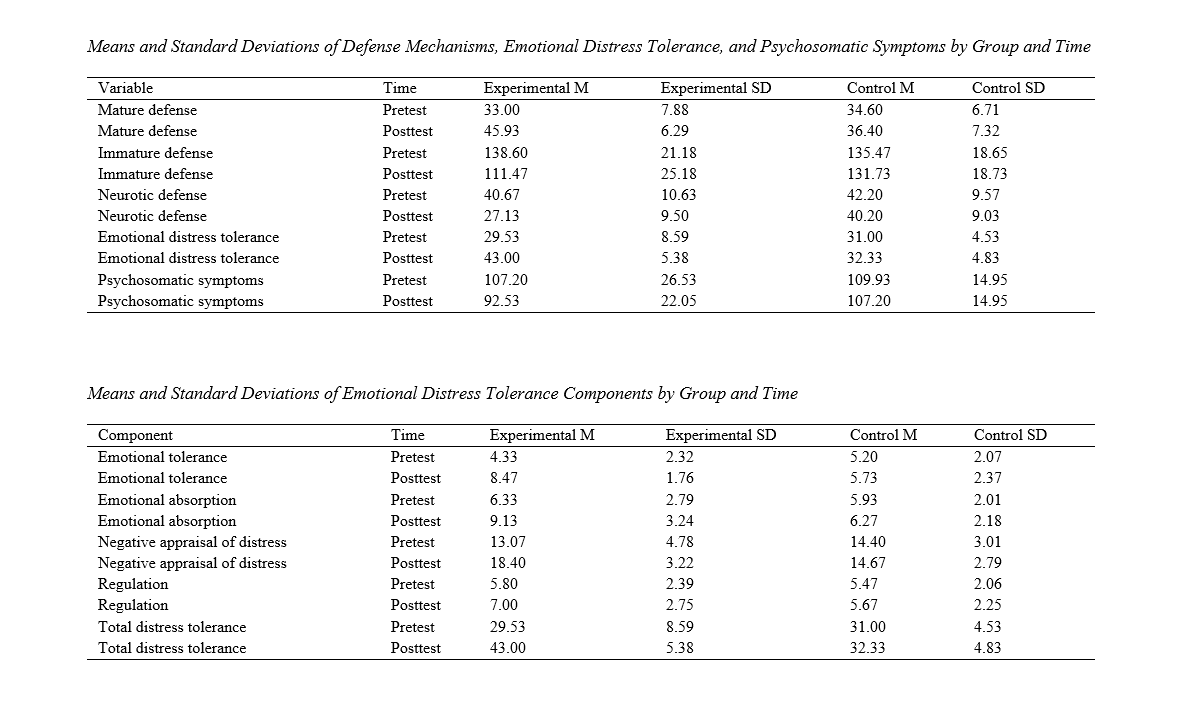
Findings: The multivariate results showed a significant overall effect of emotional schema therapy on the combined outcomes, Wilks’ Λ = .246, F(5, 24) = 14.68, p = .001, η² = .75. Follow-up analyses showed significant effects on mature defense, F(1, 28) = 9.73, p = .004, η² = .25; immature defense, F(1, 28) = 6.25, p = .010, η² = .18; neurotic defense, F(1, 28) = 14.90, p = .001, η² = .34; emotional distress tolerance, F(1, 28) = 32.58, p = .001, η² = .53; and psychosomatic symptoms, F(1, 28) = 4.54, p = .040, η² = .14.
Conclusion: Emotional schema therapy improved defensive functioning, increased emotional distress tolerance, and reduced psychosomatic symptoms in married women with psychosomatic disorder symptoms. Therefore, it may be considered an effective intervention for improving emotional and somatic functioning in this population.
Downloads
References
Assmann, N., Schaich, A., Arntz, A., Wagner, T., Herzog, P., Alvarez-Fischer, D., Sipos, V., Jauch-Chara, K., Klein, J. P., Hüppe, M., Schweiger, U., & Fassbinder, E. (2024). The effectiveness of dialectical behavior therapy compared to schema therapy for borderline personality disorder: A randomized clinical trial. Psychotherapy and psychosomatics, 93(4), 249-263. https://doi.org/10.1159/000538404
Babaeifard, M., Akbari, M., Mohammadkhani, S., Hasani, J., Shahbazian, R., & Selby, E. A. (2024). Early Maladaptive Schemas, Distress Tolerance and Self-Injury in Iranian Adolescents: Serial Mediation Model of Transdiagnostic Factors. BJPsych Open, 10(3). https://doi.org/10.1192/bjo.2024.708
Bahrami, Z., Ghodsi, P., & Hassani, F. (2025). A Structural Equation Model of Psychological Distress according to Initial Maladaptive Schemas in Women with Domestic Violence Experiences. Journal of Basic Research in Medical Sciences, 12(4). https://jbrms.medilam.ac.ir/article-1-943-fa.html
Besharat, M. A., Ranjbar Shirazi, F., & Dehghani Arani, F. (2019). The mediating role of early maladaptive schemas on the relationship between attachment styles and defense mechanisms [Research]. Journal of Psychological Science, 17(72), 859-872. http://psychologicalscience.ir/article-1-324-en.html
Ezatian, S., & Ahmadpanah, M. (2017). Study the Relationship Among Early Maladaptive Schemas, Alexithymia and Ego Defensive Styles of Students at Azad and Payame Noor Universities in Shahindej. Avicenna Journal of Neuro Psych Physiology, 87-94. https://doi.org/10.32598/ajnpp.4.3.87
Fereydooni, F., & Sheykhan, R. (2024). The Effectiveness of Schema Therapy on Depression, Self-Esteem, and Distress Tolerance in Fatherless Depressed Adolescents. Jayps, 5(8), 87-96. https://doi.org/10.61838/kman.jayps.5.8.10
Khayabani, F. (2024). The Effectiveness of Emotional Schema Therapy on Emotion Regulation Strategies, Distress Tolerance, Social Problem Solving, and Reducing Risky Behaviors in Adolescent Boys in Kashmar County Master's Thesis in General Psychology, Islamic Azad University, Sabzevar Branch].
Kopf-Beck, J., Müller, C. L., Tamm, J., Fietz, J., Rek, N., Just, L., & Egli, S. (2024). Effectiveness of Schema Therapy versus Cognitive Behavioral Therapy versus Supportive Therapy for Depression in Inpatient and Day Clinic Settings: A Randomized Clinical Trial. Psychotherapy and psychosomatics, 1-12. https://doi.org/10.1159/000535492
Mobarhan, V., & Foroutan-Bagha, P. (2024). Predicting Psychosomatic Symptoms in Working Women Based on Early Maladaptive Schemas. Journal of Mashhad University of Medical Sciences, Faculty of Medicine, 67(6), 1585-1592. https://mjms.mums.ac.ir/article_25438.html
Mohamadi, M., & Jabalameli, s. (2024). The Effectiveness of Group Schema Therapy on Self-Criticism and Distress Tolerance in Women with Substance-Dependent Spouses. etiadpajohi, 17(70), 221-244. https://doi.org/10.61186/etiadpajohi.17.70.221
Namavari, Z., Jalil, M., Khashei, S., Sanaei, S. S., & Sadeghi, E. (2023). Investigation of Differences in Early Maladaptive Schemas and Defense Mechanisms in Individuals with Gender Identity Disorder Compared to Normal Individuals. Health Nexus, 1(2), 87-93. https://doi.org/10.61838/kman.hn.1.2.12
Nejadian, A. B., Babamiri, M., & Fard, R. J. (2017). The Association Between Defensive Styles and Early Maladaptive Schemas in Patients With Migraine Headaches. Iranian journal of psychiatry and behavioral sciences, 11(3). https://doi.org/10.5812/ijpbs.7592
Sharma, S. K. (2021). Early Maladaptive Schema, Attachment Style and Defense Mechanism in Patient of Obsessive-Compulsive Disorder With and Without Childhood Sexual Abuse Central Institute of Psychiatry (India)].
Yousefi, R., Hashemi, S. G. S., Sohrabi, L., & Abadi, M. H. (2018). The Association Between Early Maladaptive Schemas and Defense Styles With Hoarding Behaviour Among University Students. Practice in Clinical Psychology. https://doi.org/10.32598/jpcp.6.4.223
Zareei, M. B., Bahrainian, S. A. M., Ahi, Q., & Mansouri, A. (2024). Comparison of the effectiveness of cognitive therapy based on mindfulness and schema therapy on emotion regulation and distress intolerance of women with obsessive-compulsive symptoms. Journal of Research in Psychological Health, 17(4), 82-105. https://rph.khu.ac.ir/article-1-4421-en.html
Zerang, M., Ahangari, S. K., Saberi, F., Iraninezhad, Z. S. J., & Abbasimofrad, P. (2025). Effectiveness of Schema Therapy on Psychological Distress and Life Engagement in Couples Experiencing Marital Conflict. Ijbmc, 12(1), 244-249. https://doi.org/10.61838/ijbmc.v12i1.975
Downloads
Additional Files
Publication Timeline
- Submitted
- Revised
- Accepted