Lived Experiences of Couples Regarding Grief Caused by Recurrent Miscarriages in Infertile Women: A Phenomenological Study
DOI:
https://doi.org/10.61838/Keywords:
recurrent miscarriage, grief, lived experience, phenomenology, couples, infertilityAbstract
Objective: This study aimed to gain an in-depth understanding of couples’ lived experiences of grief caused by recurrent miscarriages in infertile women.
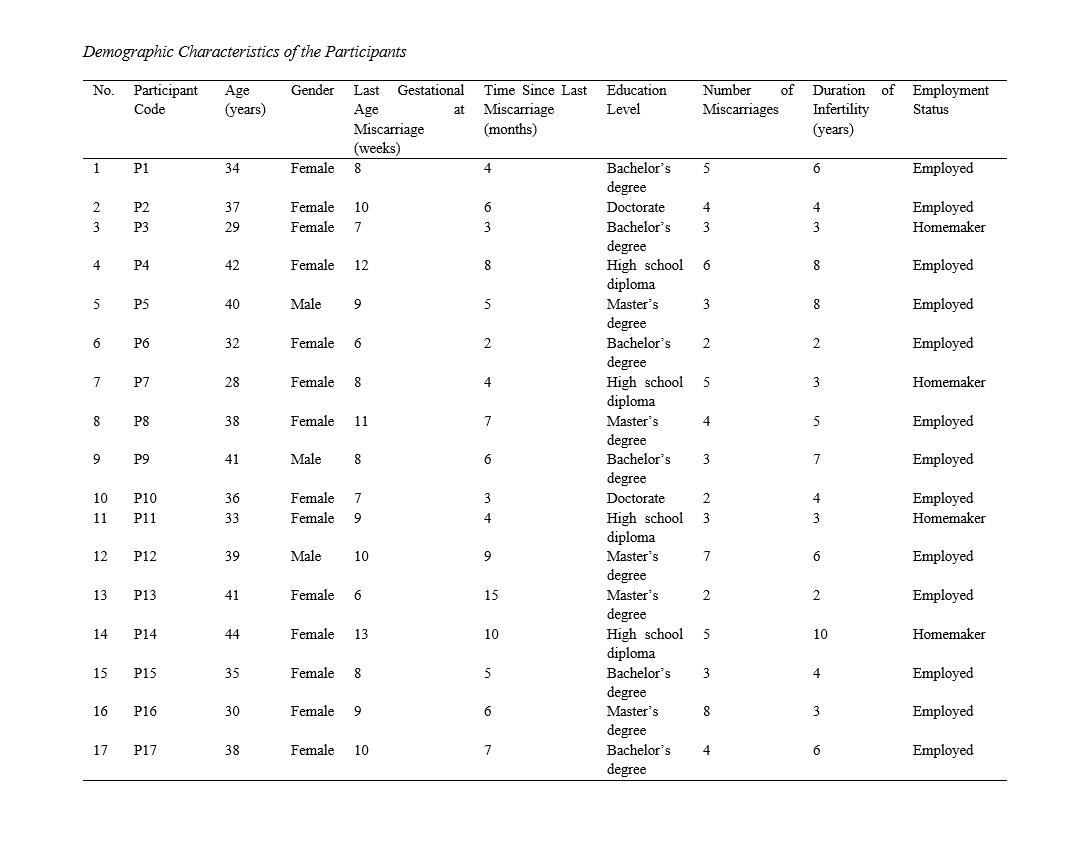
Methods and Materials: This qualitative study was conducted using a descriptive phenomenological approach. Seventeen participants (14 women and 3 men) with a history of at least two consecutive miscarriages and infertility were purposively selected from specialized infertility centers in Tehran and Qom in 2025. Data were collected through semi-structured interviews (individual and couple interviews) and analyzed using Colaizzi’s seven-step method.
Findings: Six main themes emerged: emotional turmoil (shock, anxiety, guilt, chronic sorrow, and hopelessness); continuity of loss (multilayered, disenfranchised, and complicated grief); distorted self-concept (sense of bodily defectiveness, doubts about gender identity, and reduced self-esteem); the relationship under the shadow of loss (mutual empathy, distance resulting from differences in grieving styles, and strengthened bond); coping and adaptation (individual strategies, social support, and the role of healthcare staff); and search for meaning (religious meaning-making, post-traumatic growth, and redefinition of goals).
Conclusion: Recurrent miscarriage is an existential, relational, and culture-based phenomenon. Grief in this context is multilayered, chronic, and often overlooked. A deep understanding of this experience can contribute to the design of couple-centered interventions and enhance healthcare providers’ sensitivity.
Downloads
References
Afshani, S. A., Hashemi, N., & Zargham-Boroujeni, A. (2022). Women’s Lived Experiences of Miscarriage in the Iranian Cultural Context. Journal of Qualitative Research in Health Sciences, 11(3), 45-56.
Asayesh-Oberg, S., Elmerstig, E., & Wijma, B. (2023). The Impact of Infertility and Pregnancy Loss on Women’s Identity: A Qualitative Study. BMC Women’s Health, 23(1), 112. https://doi.org/10.1186/s12905-023-02240-1
Barbe, C., Boiteux-Chabrier, M., Charillon, E., Bouazzi, L., Maheas, C., Merabet, F., Graesslin, O., Auer, J., Hammami, S., Rolland, A. C., & Hurtaud, A. (2023). Utility of early, short psychological care for women who experience early miscarriage: protocol for the randomized, controlled MisTher trial. BMC psychology, 11(1), 198. https://doi.org/10.1186/s40359-023-01421-x
Bellhouse, C., Temple-Smith, M., & Bilardi, J. (2022). “It’s Just Not Acknowledged”: Women’s Experiences of Disenfranchised Grief Following Miscarriage. Women and Birth, 35(3), e317-e325. https://doi.org/10.1016/j.wombi.2021.05.003
Burden, C., Bradley, S., & Brewer, J. (2023). The Hidden Grief of Early Pregnancy Loss: A Qualitative Metasynthesis. BMJ open, 13(2), e065221. https://doi.org/10.1136/bmjopen-2022-065221
Côté-Arsenault, D., & Denney-Koelsch, E. (2023). Pregnancy after Loss: A Revised Understanding of Parental Vulnerability. Journal of Perinatal & Neonatal Nursing, 37(1), 12-22.
DeMontigny, F., Gervais, C., & Verdon, C. (2023). Psychological Distress among Couples Following Recurrent Miscarriage: A Longitudinal Study. Journal of Psychosomatic Obstetrics & Gynecology, 44(2), 145-155.
Farren, J., Jalmbrant, M., & Bourne, T. (2022). Psychological Morbidity Following Miscarriage: A Systematic Review and Meta-Analysis. bmj, 376, e067949. https://doi.org/10.1136/bmj-2021-067949
Gameiro, S., Verhaak, C., & Cardoso, F. (2022). Parenthood as a Developmental Task: Psychological Perspectives. Human Reproduction Update, 28(4), 560-577.
Giakoumelou, S., Moore, H., Norman, J., & Holt, P. (2023). Recurrent Miscarriage: Epidemiology, Causes, and Clinical Management. The Lancet Reproductive Medicine, 7(2), 112-123.
Haks, M. C., van den Akker, O., & Boivin, J. (2023). The Cyclical Nature of Hope and Despair in Recurrent Pregnancy Loss. Fertility and sterility, 120(2), 355-364.
Holland, J. M., & Neimeyer, R. A. (2023). Meaning Reconstruction in Bereavement: Current Status and Future Directions. Death Studies, 47(1), 1-14. https://doi.org/10.1080/07481187.2021.1900456
Hosseininia, S. (2022). Gendered Emotional Responses to Pregnancy Loss: A Comparative Qualitative Study in Iran. Iranian Journal of Psychiatry and Clinical Psychology, 28(3), 210-222.
Jomeen, J., & Tokosi, T. (2022). The Relational Impact of Miscarriage: A Review of Couple-Based Perspectives. Journal of Reproductive and Infant Psychology, 40(1), 1-18.
Kalantari, M. (2023). Men’s Silent Grief Following Pregnancy Loss: A Qualitative Exploration. Middle East Journal of Family Health, 9(1), 45-57.
Koert, E., Lewis, J., & McQuillan, J. (2022). Pregnancy Loss as a Life Event: Reconsidering Assumptions about Adjustment and Resilience. Sociology of Health & Illness, 44(7), 1583-1602.
Kousar, R., Khan, M. L., & Alam, N. (2024). Marital Satisfaction, Social Support and Coping Strategies Among Couple Having Miscarriage. International Journal of Social Science & Entrepreneurship, 4(2), 275-297. https://doi.org/10.58661/ijsse.v4i2.282
Lok, I. H., Yip, A., & Sahota, D. (2024). Pregnancy after Miscarriage: Anxiety, Bonding, and Perinatal Well-Being. Archives of Women’s Mental Health, 27(1), 103-112.
Loss, E. G. G. o. R. P. (2023). ESHRE Guideline: Recurrent Pregnancy Loss. Human Reproduction Open, 2023(1), hoad003.
Majalia, A. A., & Salehb, S. (2025). The effect of ACTIVIN A hormone levels in women who suffer from recurrent miscarriages with polycystic ovary syndrome. Ibn Sina Journal of Medical Science, Health & Pharmacy, 2(3), 8-19. https://doi.org/10.3390/ani15040592
McNamee, R., & O’Reilly, A. (2023). Couples’ Experiences of Miscarriage: A Qualitative Meta-Synthesis. Qualitative Health Research, 33(10), 945-960.
Meaney, S., Maher, S., & O’Connor, C. (2023). The Psychological Impact of Early Pregnancy Loss: A Narrative Review. International Journal of Gynecology & Obstetrics, 160(1), 19-28.
Muhaisin, S. H., Hasan, A. M. A., & Hindi, N. K. K. (2022). Psychological Aspects Among Women With Miscarriage Associated Viral Infection. International journal of health sciences. https://doi.org/10.53730/ijhs.v6ns1.7607
Murphy, K., & Philpin, S. (2022). Feeling Unseen: How Lack of Social Recognition Shapes Grief after Pregnancy Loss. Journal of Loss and Trauma, 27(5), 415-428.
Navabinejad, S., Rizzo, A., & Kiliçaslan, F. (2024). Exploring The Psychological Impact of Miscarriage on Women. Psychology of Woman Journal, 5(2), 59–65. https://doi.org/10.61838/kman.pwj.5.2.9
Obst, K. L., Due, C., & Oxlad, M. (2023). Men’s Grief Following Pregnancy Loss: A Systematic Review. BMC Pregnancy and Childbirth, 23(1), 153. https://doi.org/10.1186/s12884-023-05431-0
Park, C. L. (2022). Meaning in Life and Meaning Making in Stressful and Traumatic Experiences: A Meaning Systems Perspective. Oxford University Press.
Purewal, S., van den Akker, O., & Montmasson, M. (2023). Parenthood, Identity, and Fertility: A Qualitative Metasynthesis. Reproductive Health, 20(1), 81.
Su, P. L., & Chen, C. W. (2022). Women’s Lived Experiences of Unsuccessful Fertility Treatment: A Phenomenological Study. Journal of Advanced Nursing, 78(6), 1831-1843.
Walsh, F. (2021). Family Resilience: A Systemic-Relational Framework for Recovery and Growth. In J. L. Lebow, A. Chambers, & D. C. Breunlin (Eds.), Encyclopedia of Couple and Family Therapy (pp. 1089-1094). Springer. https://doi.org/10.1007/978-3-319-49425-8_249
Wright, E., Jones, A., & Wesson, H. (2024). Fathers’ Experiences of Early Pregnancy Loss: An Integrative Review. Journal of Family Nursing, 30(1), 45-67.
Downloads
Additional Files
Publication Timeline
- Submitted
- Revised
- Accepted