Investigating the Relationship Between Prosocial Rule Breaking and Quality of Life with the Mediating Role of Psychological Safety Among Women Employed in Government Offices in Ahvaz
DOI:
https://doi.org/10.61838/Keywords:
Prosocial rule breaking, quality of life, psychological safety, employed womenAbstract
Objective: The present study aimed to investigate the relationship between prosocial rule breaking and quality of life with the mediating role of psychological safety among women employed in governmental offices in Ahvaz.
Methods and Materials: This study was applied in terms of purpose and descriptive-correlational in terms of methodology using structural equation modeling (SEM). The statistical population consisted of women employed in governmental offices in Ahvaz, from whom 385 participants were selected through convenience sampling. Data were collected using the Prosocial Rule Breaking Questionnaire developed by Vardaman et al. (2014), the World Health Organization Quality of Life Questionnaire–Short Form (WHOQOL-BREF), and Edmondson’s Psychological Safety Questionnaire. The collected data were analyzed using SPSS version 26 and AMOS version 25. Descriptive statistics, Pearson correlation coefficients, and structural equation modeling were employed to examine the relationships among the research variables and test the conceptual model.
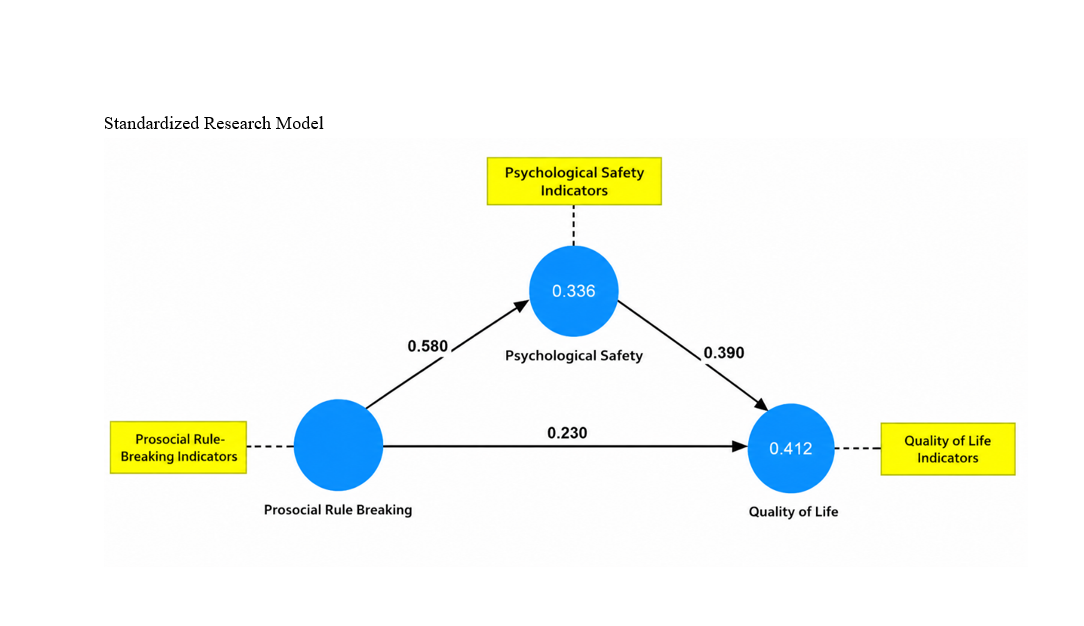
Findings: The results revealed significant positive relationships among prosocial rule breaking, psychological safety, and quality of life. Prosocial rule breaking had a positive and significant effect on psychological safety (β = .580). Psychological safety also demonstrated a positive and significant effect on quality of life (β = .390). In addition, the direct effect of prosocial rule breaking on quality of life was positive and significant (β = .230). The indirect effect of prosocial rule breaking on quality of life through psychological safety was confirmed (β = .226), indicating the mediating role of psychological safety in this relationship. The structural model demonstrated a desirable fit with the data (χ²/df = 2.38, CFI = .951, RMSEA = .060). Furthermore, prosocial rule breaking explained 33.6% of the variance in psychological safety, while prosocial rule breaking and psychological safety together explained 41.2% of the variance in quality of life.
Conclusion: The findings suggest that prosocial rule breaking, when occurring within psychologically safe organizational environments, can contribute positively to employees’ quality of life. Psychological safety plays a significant mediating role by reducing fear of negative consequences and encouraging constructive organizational behaviors. Therefore, creating supportive and psychologically secure workplace climates may enhance employees’ well-being, organizational participation, and adaptive performance among women employed in governmental organizations.
Downloads
References
Abbasi, T., Monavarian, A., & Khazaei, J. (2016). Individual Factors Affecting Benevolent Rule Breaking in the Workplace. Organizational Behavior Studies, 5(4), 75-103.
Barazandeh, A., Samavatian, H., Nouri, A., & Abedi, M. R. (2023). The Effectiveness of a Work Quality-of-Life Improvement Training Program on Work-Family Conflict and Self-Actualization of Employees Based on the Moderating Role of Perceived Job Security and Optimism. Career and Organizational Counseling, 15(3), 169-192.
Edmondson, A. C. (1999). Psychological Safety and Learning Behavior in Work Teams. Administrative Science Quarterly, 44(2), 350-383. https://doi.org/10.2307/2666999
Eldor, L., Hodor, M., & Cappelli, P. (2023). The Limits of Psychological Safety: Nonlinear Relationships with Performance. Organizational Behavior and Human Decision Processes. https://doi.org/10.1016/j.obhdp.2023.104255
Fyhn, B., Bang, H., Egeland, T., & Schei, V. (2023). Safe Among the Unsafe: Psychological Safety Climate Strength and Team Performance. Small Group Research. https://doi.org/10.1177/10464964221121273
Gerlach, R., & Gockel, C. (2022). Development of Psychological Safety in Teams Over Time. Frontiers in psychology. https://doi.org/10.3389/fpsyg.2022.765793
Giahi, M., Babaei, M., & Mohammadian, M. (2021). The Effect of Quality of Work Life on Employee Performance: A Case Study of Employees of a Military University. Military medicine, 23(7).
Hosseini Maram, A. S., & Mehdad, A. (2023). The Relationship Between Servant Leadership and Organizational Commitment, Job Satisfaction, and Adaptive Performance with the Mediating Role of Organizational Trust. Quarterly Journal of Work Psychology, 2(2), 53-64.
Iqbal, S., Ullah, S., Zanker, M., & Zainab, F. (2025). Benevolent Leadership Enhances Organizational Learning Through Communication, Trust, and Knowledge Sharing. Scientific reports, 15(1), 29769. https://doi.org/10.1038/s41598-025-15170-x
Jalilvand, M. A., Raeisi, A. R., & Shaarbafchizadeh, N. (2025). Hospital Governance Accountability Challenges in Iran: A Qualitative Study. BMC Health Services Research, 25(1), 946. https://doi.org/10.1186/s12913-025-13100-1
John, L. M., & Shafi, M. (2020). Impact of Organizational Structure and Social Support on Pro-Social Rule Breaking: A Frontline Perspective. Cogent Business & Management, 7(1), 1781994. https://doi.org/10.1080/23311975.2020.1781994
Lintanga, A. J. B. J., & Rathakrishnan, B. (2024). Psychological Safety Climate and Job Satisfaction. BMC psychology. https://doi.org/10.1186/s40359-023-01513-8
Morrison, E. W. (2006). Doing the Job Well: An Investigation of Pro-Social Rule Breaking. Journal of Management, 32(1), 5-28. https://doi.org/10.1177/0149206305277790
Mousa, M., Boyle, J., Skouteris, H., Mullins, A. K., Currie, G., Riach, K., & Teede, H. J. (2021). Advancing Women in Healthcare Leadership: A Systematic Review and Meta-Synthesis of Multi-Sector Evidence on Organisational Interventions. EClinicalMedicine, 39, 101084. https://doi.org/10.1016/j.eclinm.2021.101084
Nedjat, S., Montazeri, A., Holakouie, K., Mohammad, K., & Majdzadeh, R. (2008). Psychometric Properties of the Iranian Interview-Administered Version of the World Health Organization's Quality of Life Questionnaire (WHOQOL-BREF): A Population-Based Study. BMC Health Services Research, 8, 61. https://doi.org/10.1186/1472-6963-8-61
Sabet, A., Roudsaz, H., Rezaeimanesh, B., & Vijeh, M. R. (2020). The Effect of Psychological Factors on the Development of Benevolent Rule-Breaking Behaviors. Journal of Psychological Science, 19(91), 821-831.
Shum, C., Ghosh, A., & Gatling, A. (2019). Prosocial Rule-Breaking to Help Coworker: Nature, Causes, and Effect on Service Performance. International Journal of Hospitality Management, 79, 100-109.
Sun, Y., & Huang, J. (2019). Psychological Capital and Innovative Behavior: Mediating Effect of Psychological Safety. Social Behavior and Personality: an international journal, 47(9), 1-7.
Tu, C. K., & Luo, B. (2020). Paternalistic Leadership and Pro-Social Rule Breaking: The Moderating Roles of Psychological Empowerment and Leader-Member Exchange. Human Systems Management, 39(1), 93-103.
Vardaman, J. M., Gondo, M. B., & Allen, D. G. (2014). Ethical Climate and Pro-Social Rule Breaking in the Workplace. Human Resource Management Review, 24(1), 108-118.
Wang, F., & Shi, W. (2021). Inclusive Leadership and Pro-Social Rule Breaking: The Role of Psychological Safety, Leadership Identification, and Leader-Member Exchange. Psychological Reports, 124(5), 2155-2179.
Zhenjing, G., Chupradit, S., Ku, K. Y., Nassani, A. A., & Haffar, M. (2022). Impact of Employees' Workplace Environment on Employees' Performance: A Multi-Mediation Model. Frontiers in Public Health, 10, 890400. https://doi.org/10.3389/fpubh.2022.890400
Downloads
Additional Files
Publication Timeline
- Submitted
- Revised
- Accepted