The Effectiveness of Self-Compassion Training on Body Image Concern and Difficulties in Emotion Regulation in Women with Overweight
DOI:
https://doi.org/10.61838/Keywords:
Self-compassion training, body image concern, difficulties in emotion regulation, overweightAbstract
Objective: The present study was conducted to determine the effectiveness of self-compassion training on body image concern and difficulties in emotion regulation in women with overweight.
Materials and Methods: This was a quasi-experimental study with a pretest–posttest design and a two-month follow-up including a control group. The statistical population consisted of women with overweight in Tehran in 2026. Overweight was defined based on a body mass index (BMI) ranging from 25 to 29.9. Following the initial screening, volunteer participants completed the Body Image Concern Questionnaire and the Difficulties in Emotion Regulation Scale. The mean score of the initial sample was 54.30 on the Body Image Concern Questionnaire and 106.40 on the Difficulties in Emotion Regulation Scale. Therefore, women who obtained scores above the mean on these two instruments were considered eligible for the intervention phase. Subsequently, 30 participants were selected through purposive sampling and randomly assigned to two groups: an experimental group and a control group, with 15 participants in each group. The experimental group received self-compassion training in eight 60-minute sessions, whereas the control group received no intervention during this period. Data were analyzed using the independent samples t-test, Fisher’s exact test, and two-way repeated measures analysis of variance in IBM SPSS Statistics.
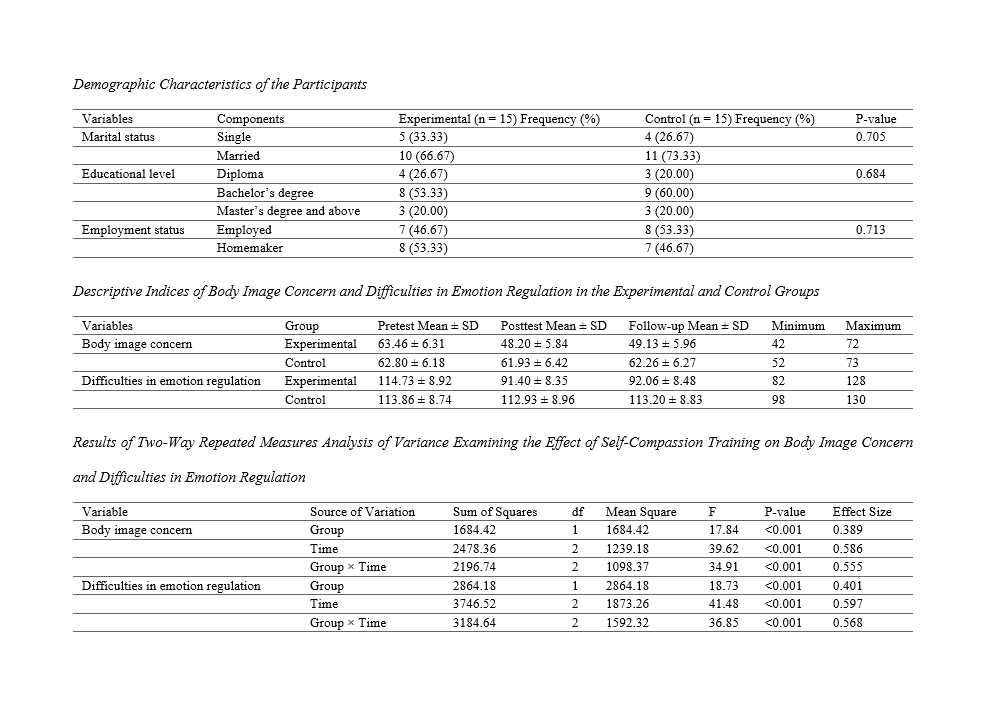
Findings: The results indicated that the experimental and control groups did not differ significantly in terms of demographic characteristics. Furthermore, the results of the two-way repeated measures analysis of variance demonstrated that the interaction effect of group and time on body image concern and difficulties in emotion regulation was significant. Based on mean comparisons, the scores of body image concern and difficulties in emotion regulation in the experimental group decreased from the pretest to the posttest stage, and this reduction remained largely stable at the two-month follow-up stage, whereas no substantial changes were observed in the control group.
Conclusion: Based on the findings of the study, self-compassion training can reduce body image concern and difficulties in emotion regulation among women with overweight. Therefore, the application of this training in counseling centers, nutrition clinics, and psychological programs related to body image may be beneficial for improving women’s relationship with their bodies and enhancing their ability to manage difficult emotions.
Downloads
References
Abdoli, M., Schiechtl, E., Rosato, M. S., Mangweth-Matzek, B., Cotrufo, P., & Hufner, K. (2025). Body Image, Self-Esteem, Emotion Regulation, and Eating Disorders in Adults: A Systematic Review. Neuropsychiatrie: Klinik, Diagnostik, Therapie und Rehabilitation: Organ der Gesellschaft Osterreichischer Nervenarzte und Psychiater, 39(3), 118-132. https://doi.org/10.1007/s40211-025-00544-4
Albertson, E. R., Neff, K. D., & Dill-Shackleford, K. E. (2015). Self-Compassion and Body Dissatisfaction in Women: A Randomized Controlled Trial of a Brief Meditation Intervention. Mindfulness, 6, 444-454. https://doi.org/10.1007/s12671-014-0277-3
de Wet, A. J., Lane, B. R., & Mulgrew, K. E. (2020). A Randomised Controlled Trial Examining the Effects of Self-Compassion Meditations on Women's Body Image. Body Image, 35, 22-29. https://doi.org/10.1016/j.bodyim.2020.07.009
Gilbert, P., & Irons, C. (2009). Shame, Self-Criticism, and Self-Compassion in Adolescence. In N. B. Allen & L. B. Sheeber (Eds.), Adolescent Emotional Development and the Emergence of Depressive Disorders (pp. 195-214). Cambridge University Press.
Haley, E. N., Dolbier, C. L., Campbell, L. C., Carels, R. A., & Braciszewski, J. M. (2025). Brief Self-Compassion Intervention for Women of Higher Weight and Internalized Weight Bias: A Randomized Pilot Study. International Journal of Behavioral Medicine, 32(2), 293-307. https://doi.org/10.1007/s12529-024-10297-z
Jafari, A., & Kiani, Z. (2024). The Effectiveness of Self-Compassion Training on Emotion Regulation and Cognitive Flexibility in Adolescent Girls with Self-Harming Behavior. Journal of Adolescent and Youth Psychological Studies, 5(6), 1-11. https://doi.org/10.61838/kman.jayps.5.6.1
Randhawa, A. K., & Vella-Brodrick, D. A. (2025). Online Self-Compassion Interventions and Wellbeing Outcomes: A Systematic Review of RCTs. Mindfulness, 16, 1795-1820. https://doi.org/10.1007/s12671-025-02606-8
Ranjouri, S., Meyer, D., & Bates, G. W. (2025). Self-Compassion Components and Emotional Regulation Strategies as Predictors of Psychological Distress and Well-Being. Behavioral Sciences, 15(11), 1576. https://doi.org/10.3390/bs15111576
Rodgers, R. F., Laveway, K., Campos, P., & de Carvalho, P. H. B. (2023). Body Image as a Global Mental Health Concern. Global Mental Health, 10, e9. https://doi.org/10.1017/gmh.2023.2
Segal, Y., & Gunturu, S. (2024). Psychological Issues Associated With Obesity. StatPearls. https://www.ncbi.nlm.nih.gov/books/NBK603747/
Woodfin, V., Molde, H., Dundas, I., & Binder, P. E. (2021). A Randomized Control Trial of a Brief Self-Compassion Intervention for Perfectionism, Anxiety, Depression, and Body Image. Frontiers in psychology, 12, 751294. https://doi.org/10.3389/fpsyg.2021.751294
Zafar, H., Debowska, A., & Boduszek, D. (2021). Emotion Regulation Difficulties and Psychopathology Among Pakistani Adolescents. Clinical Child Psychology and Psychiatry, 26(1), 121-139. https://doi.org/10.1177/1359104520969765
Downloads
Additional Files
Publication Timeline
- Submitted
- Revised
- Accepted