The Effectiveness of Cognitive Behavioral Therapy on Psychological Flexibility and Suicidal Ideation in Women with Experiences of Spousal Infidelity
DOI:
https://doi.org/10.61838/Keywords:
cognitive behavioral therapy, psychological flexibility, suicidal ideation, women, infidelity.Abstract
Objective: The present study aimed to determine the effectiveness of cognitive behavioral therapy on psychological flexibility and suicidal ideation in women with experiences of spousal infidelity.
Methods and Materials: The present study employed a quasi-experimental design with a pretest–posttest structure and a control group. The statistical population consisted of women with experiences of spousal infidelity who were referred to the Arsam Psychological and Counseling Services Center in Tonekabon in 2026. Using convenience sampling, 28 participants were selected and randomly assigned into experimental and control groups, with 14 participants in each group. Data collection instruments included the Psychological Flexibility Questionnaire developed by Dennis and Vander Wal and the Suicide Ideation Questionnaire developed by Keith. The experimental group received cognitive behavioral therapy during eight 90-minute sessions, while the control group received no intervention during the study period. Data were analyzed using descriptive statistics and analysis of covariance in SPSS software.
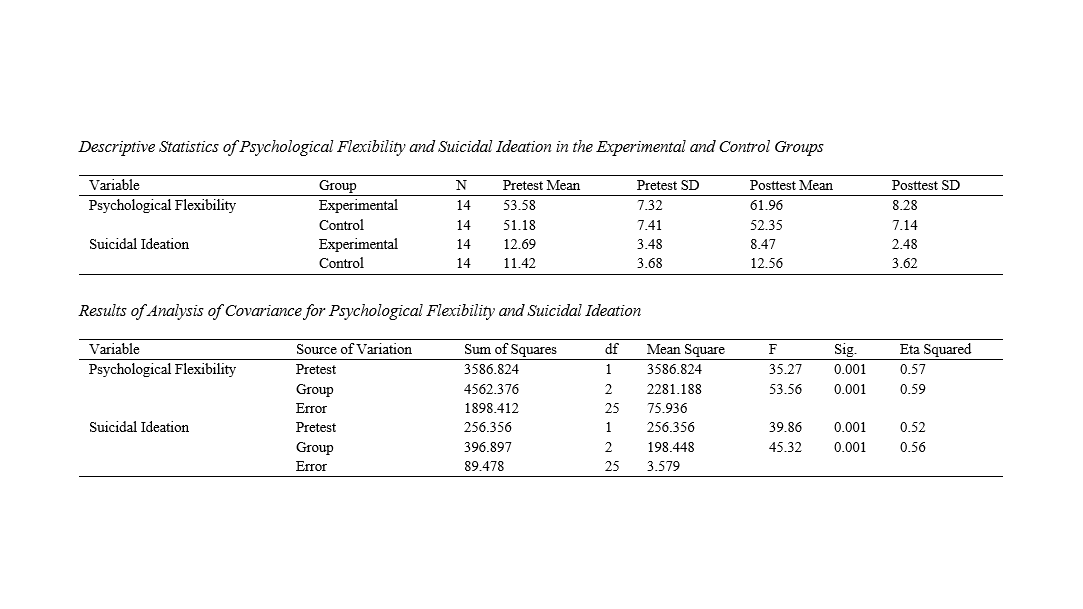
Findings: The findings indicated that cognitive behavioral therapy significantly improved psychological flexibility in women with experiences of spousal infidelity. The results of covariance analysis demonstrated a statistically significant difference between the experimental and control groups in posttest psychological flexibility scores after controlling for pretest scores (F = 53.56, p < .001, η² = .59). In addition, cognitive behavioral therapy significantly reduced suicidal ideation among participants in the experimental group compared with the control group (F = 45.32, p < .001, η² = .56).
Conclusion: The findings suggest that cognitive behavioral therapy is an effective psychological intervention for increasing psychological flexibility and reducing suicidal ideation among women affected by spousal infidelity.
Downloads
References
Allahmoradi, M., Yaghoubi, M., Ebrahimi, F., Pourmohammadghouchani, K., & Norouziani, Z. (2026). Comparison of the Effectiveness of Cognitive Behavioral Therapy and Acceptance and Commitment Therapy on Referential Thoughts, Cognitive Flexibility, and Distress Tolerance in Patients with Major Depression. Psychological Dynamics in Mood Disorders, 1-18. https://maherpub.com/pdmd/article/view/628
Ansari, M. (2019). Suicide, causes, prevalence, and prevention strategies among youth and adolescents. Nasl-e Roshan Publications.
Arab, A., Zeraatkar Maki, M., Eftekhari Kenzarki, F., & Afsharpour, P. (2024). Predicting suicidal thoughts based on difficulty in emotion regulation and perceived social support among secondary school students. Journal of New Ideas in Psychology, 24(20), 1-13.
Batabyal, A. A. (2018). Marital infidelity: A game-theoretic analysis. Journal of Quantitative Economics, 16(1), 227-233.
Fazeli, M., & Ehteshamzadeh Hashemi Sheikh Shabani, S. E. (2014). The effectiveness of cognitive-behavioral therapy on cognitive flexibility in depressed individuals. Thought and Behavior, 9(34).
Hommel, B., Ruppel, R., & Zacher, H. (2022). Assessment of cognitive flexibility in personnel selection: Validity and acceptance of a gamified version of the Wisconsin card sorting test. International Journal of Selection and Assessment, 30, 126-144.
Igu, N. C., Ogba, F. N., Eze, U. N., Binuomote, M. O., Elom, C. O., Nwinyinya, E., & Ekeh, D. O. (2023). Effectiveness of cognitive behavioral therapy with yoga in reducing job stress among university lecturers. Frontiers in psychology, 13, 950969.
Jafari Nasab, R., Safarian Toosi, M., Naseri, N., & Akbari Amraghan, H. (2021). The effectiveness of imago-based couple therapy on improving marital distress and quality of life in women affected by marital infidelity. Applied Family Therapy, 2(4), 519-533.
Jiao, Y., & Zhang, W. (2025). The efficacy of cognitive behavioral therapy on reducing suicidal ideation and deliberate self-harm: A systematic review. Frontiers in psychology, 16, 1672957. https://doi.org/10.3389/fpsyg.2025.1672957
Karayazi, H. (2018). Suicide in adolescents: A case study. Journal of Awareness.
Liang, J., Kolves, K., Lew, B., de Leo, D., Yuan, L., Abu Talib, M., & Jia, C. X. (2020). Coping strategies and suicidality: A cross-sectional study from China. Frontiers in Psychiatry, 11(129), 1-10.
Martinez-Vispo, C., Lopez-Duran, A., Senra, C., Rodriguez-Cano, R., Del Rio, E. F., & Becona, E. (2020). Behavioral activation and smoking cessation outcomes: The role of depressive symptoms. Addictive behaviors, 102, 106183.
Mortier, P., Auerbach, R. P., Alonso, J., Axinn, W. G., & Cuijpers, P. (2018). Suicidal thoughts and behaviors among college students and same-aged peers: Results from the World Health Organization World Mental Health Surveys. Social Psychiatry and Psychiatric Epidemiology, 53(3), 279-288.
Okesina, F. A. (2022). Marital adjustment and communication styles among married adults in Ilorin, Kwara State, Nigeria. Canadian Journal of Family and Youth, 14(1), 162-179.
Olfson, M., Cosgrove, C., Altekruse, S. F., Wall, M. M., & Blanco, C. (2021). Deaths of despair: Adults at high risk for death by suicide, poisoning, or chronic liver disease in the US. Health Affairs, 40(3), 505-512.
Qasemzadeh, S. (2023). Practical guide to cognitive-behavioral therapy. Arjmand Publications.
Rezaeian, M., & Behzad, B. (2017). Nonfatal suicidal behavior and related features in students within Muslim majority countries: A report from an ongoing international proposal in Iran. Journal of Rafsanjan University of Medical Sciences, 16(6), 553-555.
Rostami, C., Jahangirlou, A., Sohrabi, A., & Ahmadian, H. (2016). The role of cognitive flexibility and mindfulness in predicting students' procrastination. Zanko Journal of Medical Sciences.
Salehi, H., Hosseinian, S., & Yazdi, S. M. (2022). Modeling the relationship between cognitive flexibility and self-differentiation with successful marriage: The mediating role of cognitive emotion regulation. Applied Family Therapy, 3(12), 80-101.
Whiting, D. L., Deane, F. P., Ciarrochi, J., McLeod, H. J., & Simpson, G. K. (2015). Validating measures of psychological flexibility in a population with acquired brain injury. Psychological assessment, 27(2), 415-423.
Witvliet, C. V., Hofelich Mohr, A. J., Hinman, N. G., & Knoll, R. W. (2015). Transforming or restraining rumination: The impact of compassionate reappraisal versus emotion suppression on empathy, forgiveness, and affective psychophysiology. The Journal of Positive Psychology, 10(3), 248-261.
Yaghoubi, M., Ebrahimi, F., Pour Mohammad Ghochani, K., & Noorouziani, Z. (2026). A Comparison of the Effectiveness of Cognitive Behavioral Therapy and Acceptance and Commitment Therapy on Referential Thoughts, Cognitive Flexibility, and Distress Tolerance in Patients with Major Depression. Psychological Dynamics in Mood Disorders, 1-18. https://doi.org/10.1002/da.22878
Yaqubi, M., Ebrahimi, F., Pourmohammad Ghouchani, K., & Norouziani, Z. (2026). Comparison of cognitive behavioral therapy and acceptance and commitment therapy on referential thoughts, cognitive flexibility, and distress tolerance in patients with major depressive disorder. Psychological Dynamics in Emotional Disorders, 1-18. https://doi.org/https://maherpub.com/pdmd/article/view/628
Downloads
Additional Files
Publication Timeline
- Submitted
- Revised
- Accepted