Modeling Marital Satisfaction Based on Differentiation of Self and Perceived Social Support: The Mediating Role of Psychological Well-Being
DOI:
https://doi.org/10.61838/Keywords:
Psychological well-being, self-differentiation, perceived social support, marital satisfaction, female teachersAbstract
Objective: The present study aimed to investigate the mediating role of psychological well-being in the relationship between differentiation of self and perceived social support with marital satisfaction among married female teachers.
Methods and Materials: The present study employed a descriptive-correlational design using path analysis modeling. The statistical population consisted of married female teachers working in elementary, lower secondary, and upper secondary schools in Shiraz during the 2023–2024 academic year who had at least one child. A total of 378 participants were selected through convenience sampling. Data were collected using the ENRICH Marital Satisfaction Scale, Ryff’s Psychological Well-Being Scale, the Differentiation of Self Inventory, and the Multidimensional Scale of Perceived Social Support. Data analysis was performed using SPSS-26 and AMOS-18 software.
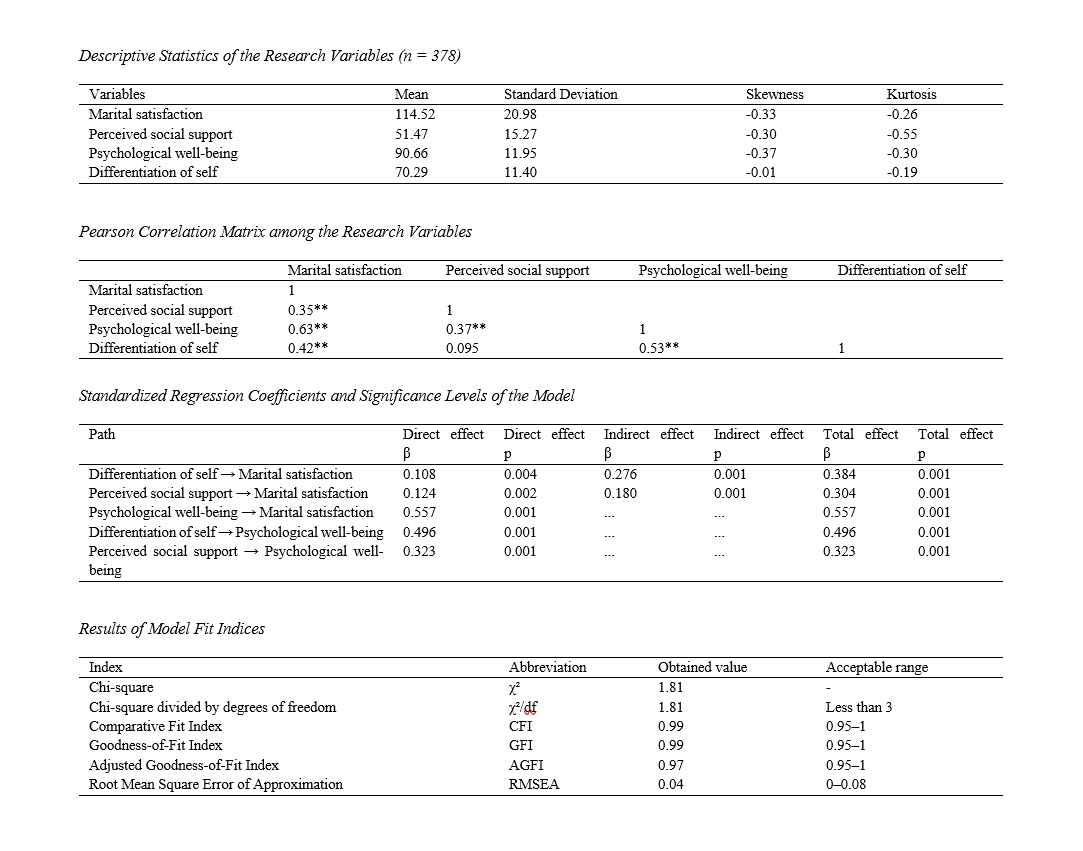
Findings: The findings demonstrated that the proposed structural model had an acceptable fit (CFI = 0.99, GFI = 0.99, RMSEA = 0.04). Differentiation of self had a positive and significant direct effect on marital satisfaction (β = 0.108, p < 0.05) and also an indirect effect through psychological well-being (β = 0.276, p < 0.05). Perceived social support similarly showed significant direct (β = 0.124, p < 0.05) and indirect effects (β = 0.180, p < 0.05) on marital satisfaction through psychological well-being. Psychological well-being had a strong direct effect on marital satisfaction (β = 0.557, p < 0.05). Furthermore, differentiation of self and perceived social support significantly predicted psychological well-being, with coefficients of 0.496 and 0.323, respectively (p < 0.05). The model explained 45% of the variance in marital satisfaction and 38% of the variance in psychological well-being.
Conclusion: The results indicated that psychological well-being plays an important mediating role in the relationship between differentiation of self, perceived social support, and marital satisfaction.
Downloads
References
Acoba, E. F. (2024). Social Support and Mental Health: The Mediating Role of Perceived Stress. Frontiers in psychology, 15, 1330720. https://doi.org/10.3389/fpsyg.2024.1330720
Cinamon, R. G., & Rich, Y. (2022). Work-Family Relations and Teacher Well-Being. Teaching and Teacher Education, 112, 103651. https://doi.org/10.1016/j.tate.2022.103651
Corbo, I., Troisi, G., Marselli, G., & Casagrande, M. (2024). The Role of Cognitive Flexibility on Higher Level Executive Functions in Mild Cognitive Impairment and Healthy Older Adults. BMC psychology, 12(1), 317. https://doi.org/10.1186/s40359-024-01807-5
Don, B. P., & Mickelson, K. D. (2022). Relationship Satisfaction and Perceived Social Support: A Meta-Analytic Review. Journal of Social and Personal Relationships, 39(4), 1012-1034. https://doi.org/10.1177/02654075211045040
Eryılmaz, A., & Atak, H. (2023). Psychological Well-Being and Marital Satisfaction among Adults: The Mediating Role of Interpersonal Competence. Current Psychology, 42, 15487-15498. https://doi.org/10.1007/s12144-022-02845-6
Finkel, E. J., Simpson, J. A., & Eastwick, P. W. (2023). The Psychology of Close Relationships: Fourteen Core Principles. Annual review of psychology, 74, 233-258. https://doi.org/10.1146/annurev-psych-020821-011146
Garner, R. C., & Kleiman, E. M. (2025). Distress Tolerance as a Moderator of Affective Forecasting Effects. Affective science, 6(2), 280-284. https://doi.org/10.1007/s42761-025-00303-2
Işık, E., & Işık, A. N. (2022). Differentiation of Self, Emotion Regulation, and Marital Adjustment in Married Individuals. Current Psychology, 41(11), 7894-7903. https://doi.org/10.1007/s12144-020-01145-1
Jalambadani, Z. (2024). The Relationship of Perceived Social Support with Sexual Satisfaction and Marital Commitment in Iranian Married Women. Italian Journal of Gynaecology and Obstetrics, 36(02), 239. https://doi.org/10.36129/jog.2023.131
Kashefi, H., Keshavarz, S., & Amiri, M. (2023). Self-Differentiation and Marital Satisfaction: The Mediating Role of Intimacy and Emotional Regulation. Journal of Family Studies, 29(3), 1150-1165. https://doi.org/10.1080/13229400.2022.2035198
Kim, H., & Kang, S. (2023). Differentiation of Self and Psychological Well-Being in Adults: The Mediating Role of Emotion Regulation. Current Psychology.
Kim, H., & Lee, S. (2023). Psychological Well-Being and Marital Satisfaction among Married Adults: The Mediating Role of Emotional Regulation and Supportive Interactions. Current Psychology, 42(18), 15840-15851. https://doi.org/10.1007/s12144-022-03192-4
Kim, H., & Yoon, K. L. (2023). Differentiation of Self and Relationship Functioning in Married Couples. Family Process, 62(2), 735-749. https://doi.org/10.1111/famp.12835
Lakey, B., & Orehek, E. (2023). Relational Regulation Theory and Perceived Social Support. Psychological review, 130(2), 337-356. https://doi.org/10.1037/rev0000373
Lampis, J. (2022). Differentiation of Self and Psychological Well-Being: The Mediating Role of Emotional Regulation. Journal of Adult Development, 29(2), 142-153. https://doi.org/10.1007/s10804-021-09394-w
Ledermann, T., Macho, S., & Kenny, D. A. (2023). Stress, Psychological Well-Being, and Relationship Satisfaction in Couples: A Dyadic Perspective. Journal of Social and Personal Relationships, 40(6), 1825-1843. https://doi.org/10.1177/02654075221145032
Lim, J., & Lee, Y. (2024). Differentiation of Self, Emotional Regulation, and Psychological Well-Being in Close Relationships. Journal of Family Psychology.
Mozas Alonso, M., Carrasco, M. A., Delgado, B., & Holgado-Tello, F. P. (2022). Differentiation of Self and Marital Satisfaction in Couples: The Mediating Role of Emotional Distress. International journal of environmental research and public health, 19(18), 11327. https://doi.org/10.3390/ijerph191811327
Overall, N. C., & McNulty, J. K. (2022). What Makes Relationships Thrive? Current Directions in Psychological Science, 31(3), 197-202. https://doi.org/10.1177/09637214221079629
Park, Y., & Lee, S. (2023). Psychological Well-Being as a Mediator between Social Resources and Marital Satisfaction. Journal of Happiness Studies, 24, 1845-1862. https://doi.org/10.1007/s10902-022-00579-3
Parker, R., Fletcher, G. J. O., & Overall, N. C. (2023). Psychological Well-Being and Relationship Satisfaction: The Role of Emotional Processes in Intimate Relationships. Journal of Social and Personal Relationships, 40(6), 1802-1821. https://doi.org/10.1177/02654075221142567
Randall, A. K., & Bodenmann, G. (2023). Stress and Its Associations with Relationship Satisfaction. Current opinion in psychology, 43, 96-101. https://doi.org/10.1016/j.copsyc.2021.06.010
Rusu, P. P., Turliuc, M. N., & Matei, A. (2024). Psychological Well-Being and Marital Satisfaction: The Protective Role of Emotional Support and Dyadic Coping. Frontiers in psychology, 15, 1287643. https://doi.org/10.3389/fpsyg.2024.1287643
Ryff, C. D. (2022). Psychological Well-Being Revisited: Advances in Science and Practice. Psychotherapy and psychosomatics, 91(2), 85-95. https://doi.org/10.1159/000519572
Skaalvik, E. M., & Skaalvik, S. (2023). Teacher Stress and Teacher Well-Being: The Role of School Environment. Teaching and Teacher Education, 121, 103908. https://doi.org/10.1016/j.tate.2022.103908
Sørensen, T., & Ryff, C. D. (2023). The Privilege of Well-Being in an Increasingly Unequal Society. Proceedings of the National Academy of Sciences, 120(7), e2215998120. https://doi.org/10.1073/pnas.2215998120
Szkody, E., & McKinney, C. (2022). Perceived Social Support and Psychological Well-Being among Adults: The Mediating Role of Emotion Regulation. Journal of Social and Personal Relationships, 39(8), 2438-2460. https://doi.org/10.1177/02654075221089931
Taylor, S. E. (2022). Social Support: A Review. In Handbook of Health Psychology and Behavioral Medicine (pp. 189-214).
Telli, A. A., & Yavuz Güler, Ç. (2023). The Association between Self-Differentiation and Marital Satisfaction: The Mediating Role of Emotional Intimacy. The Family Journal, 31(4), 512-521. https://doi.org/10.1177/10664807231165421
Ulrich, T., Sanderson, C. A., & McNulty, J. K. (2022). Psychological Well-Being and Relationship Quality among Married Couples. Journal of Social and Personal Relationships, 39(9), 2724-2742. https://doi.org/10.1177/02654075221088476
Van Osch, Y., Karremans, J. C., & Schmeichel, B. J. (2023). Well-Being and Relationship Functioning: How Individual Psychological Resources Contribute to Relationship Satisfaction. Personality and Social Psychology Bulletin, 49(9), 1392-1406. https://doi.org/10.1177/01461672221131941
Wang, H., Hall, N. C., & Rahimi, S. (2023). Self-Efficacy and Stress among Teachers: A Cross-Cultural Study. Educational psychology review, 35, 35-58. https://doi.org/10.1007/s10648-022-09666-2
Wang, Y., Li, X., & Zhang, H. (2024). Perceived Social Support and Psychological Well-Being: The Mediating Role of Emotional Regulation and Loneliness. Frontiers in psychology, 15, 1298456. https://doi.org/10.3389/fpsyg.2024.1298456
Yang, Y., Chen, H., & Wang, L. (2023). Depression, Emotional Withdrawal, and Marital Satisfaction in Intimate Relationships. Journal of Social and Personal Relationships, 40(8), 2503-2521. https://doi.org/10.1177/02654075231123456
Yıldırım, M., & Demir, A. (2022). Differentiation of Self and Marital Satisfaction: The Role of Emotional Regulation. Journal of Family Psychology, 36(6), 933-942. https://doi.org/10.1037/fam0000991
Yoo, J., & Kim, J. (2022). Social Support and Psychological Well-Being in Married Adults. Journal of Family Issues, 43(9), 2420-2438. https://doi.org/10.1177/0192513X211052347
Yu, S., Li, J., & Zhou, Y. (2023). Social Support and Psychological Well-Being among Adults: A Cross-Cultural Analysis. Frontiers in psychology, 14, 1187654. https://doi.org/10.3389/fpsyg.2023.1187654
Zhao, Y., & Li, Q. (2023). Social Support and Teacher Burnout: The Mediating Role of Psychological Well-Being. Frontiers in psychology, 14, 1184562. https://doi.org/10.3389/fpsyg.2023.1184562
Downloads
Additional Files
Publication Timeline
- Submitted
- Revised
- Accepted