The Mediating Role of Psychological Distress in Explaining the Relationship Between Early Maladaptive Schemas and Marital Burnout in Women Who Have Experienced Marital Infidelity
Keywords:
psychological distress, marital infidelity, marital burnout, early maladaptive schemasAbstract
Objective: The present study aimed to explain the mediating role of psychological distress in the relationship between early maladaptive schemas and marital burnout among married women who had experienced spousal infidelity.
Methods and Materials: This study employed a descriptive-correlational design based on structural equation modeling. The statistical population consisted of all married women affected by spousal infidelity who attended counseling and psychological service centers in Tehran in 2026. From this population, a sample of 252 participants was selected using convenience sampling. Data were collected using the short form of the Young Schema Questionnaire (Young, 1998), the Depression Anxiety Stress Scales (Lovibond & Lovibond, 1995), and the Couple Burnout Measure (Pines, 1996). The data were analyzed using SmartPLS software.
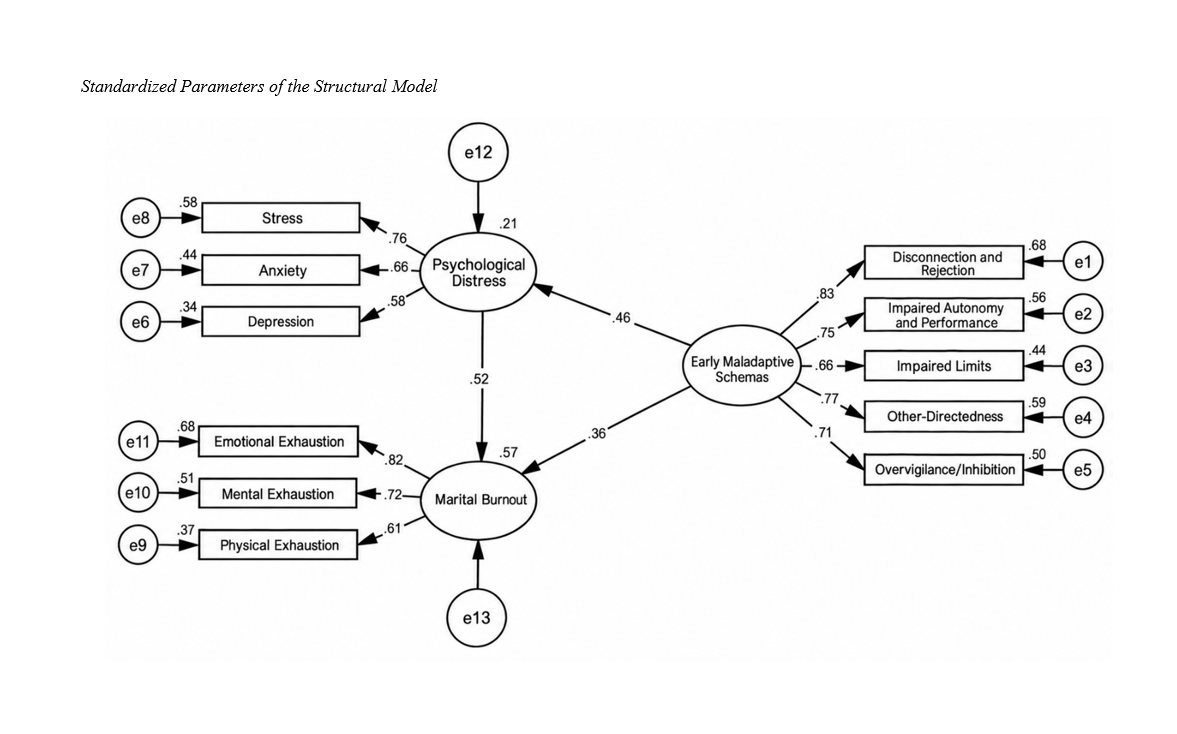
Findings: The results of structural equation modeling indicated that the hypothesized model demonstrated satisfactory fit. Collectively, the variables included in the model explained 61% of the variance in marital burnout and 57% of the variance in psychological distress. Early maladaptive schemas had a significant direct effect on marital burnout (β = .355, p = .001) and psychological distress (β = .462, p = .001). The direct effect of psychological distress on marital burnout was also positive and statistically significant (β = .524, p = .001). Furthermore, psychological distress significantly mediated the indirect relationship between early maladaptive schemas and marital burnout (β = .242, p = .001).
Conclusion: The findings indicate that early maladaptive schemas contribute substantially to increased marital burnout among women affected by infidelity by eliciting and intensifying psychological distress, including symptoms of anxiety, depression, and stress. Accordingly, therapeutic and counseling interventions for individuals affected by marital infidelity should emphasize restructuring maladaptive cognitive schemas and reducing symptoms of psychological distress.
Downloads
References
Afsharzadeh, M., Etemadi, O., & Naghavi, A. (2024). Marital Infidelity: Cognitive, Behavioral, and Emotional Reactions and Coping Strategies Among Afghan Women. Cognitive and Behavioral Sciences Research, 14(2), 11-18.
Alsawalqa, R. O. (2019). Marriage Burnout: When the Emotions Exhausted Quietly Quantitative Research. Journal of Psychiatry and Behavioral Sciences, 13(2). https://doi.org/10.5812/ijpbs.68833
Bagherzadeh, K. S., Ahmadi, K., & Navabinejad, S. (2023). The Role of Early Maladaptive Schemas Resulting from Spousal Infidelity in the Development of Acute Stress Disorder After Disclosure of Infidelity. Clinical Psychology and Personality, 21(2), 59-72.
Fincham, F. D., & May, R. W. (2017). Infidelity in Romantic Relationships. Current opinion in psychology, 13, 70-74. https://doi.org/10.1016/j.copsyc.2016.03.008
Ghahari, S., & Attari, Y. (2020). Examining the Psychometric Properties of the Young Schema Questionnaire-Short Form in an Iranian Population. Journal of Cognitive Psychology and Psychiatry, 7(1), 35-48.
Ghasemi, K., Elahi, T., & Yousefi Afrashteh, M. (2022). The Role of Early Maladaptive Schemas (Emotional Deprivation, Abandonment/Instability, and Mistrust/Abuse) in Marital Commitment with the Mediating Role of Gender Roles. Clinical Psychology and Counseling Research, 12(1), 5-21.
Glass, S. P. (2023). Not "Just Friends": Rebuilding Trust and Recovering Your Sanity After Infidelity. Free Press.
Grabowski, A. (2023). Early Maladaptive Schemas and the Quality of Marital Bond and Communication. Kwartalnik Naukowy Fides et Ratio, 53(1), 9-17. https://doi.org/10.34766/fetr.v53i1.1160
Güler, K. (2022). Early Period Maladaptive Schemas, Psychological Symptoms and Examining the Tendency of Deception. The European Research Journal, 8(2), 232-241. https://doi.org/10.18621/eurj.1034350
Haddadi, S., Abbasi, G., & Mirzaeian, B. (2024). Effectiveness of Acceptance and Commitment Therapy on Psychological Distress and Regret About Spouse Choice in Women Affected by Infidelity. Journal of Cognitive Psychology and Psychiatry, 11(6), 51-64.
Hashemi Fesharaki, S. S., & Salehi, M. (2026). Comparing Schema Therapy and Cognitive-Behavioral Therapy on Psychological Distress and Forgiveness in Divorced Women Affected by Marital Infidelity. Quarterly Journal of New Psychological Research, 21(81), 148-165.
Heydari, M. (2017). Examining the Psychometric Properties of the Depression Anxiety Stress Scale (DASS-21) in University Students. Quarterly Journal of Educational Measurement, 7(25), 85-105.
Hicks, O., Murphy, G. C., Ying, F., Maxwell, J. A., Wilde, J. L., & Dozois, D. J. (2025). Core Beliefs About You and Me: Schema Structures, Relationship Quality, and Depressive Severity in Romantic Couples. Journal of affective disorders, 121093. https://doi.org/10.1016/j.jad.2025.121093
Kharratzadeh, M., Javaheri, A., & Gholamali Lavasani, M. (2022). Predicting Marital Burnout Based on Early Maladaptive Schemas and Psychological Capital. Women and Family Cultural-Educational Quarterly, 17(59), 61-83.
Koçyiğit, M., & Uzun, M. (2024). Couple Burnout and Marital Satisfaction: Serial Mediation by Mindfulness and Emotion Regulation. The American Journal of Family Therapy, 52(5), 575-593. https://doi.org/10.1080/01926187.2024.2322461
Körük, S., & Kurt, A. A. (2019). The Predictive Role of Early Maladaptive Schemas in the Evaluation of Pre-Marital Romantic Relationships Among University Students. Yaşam Becerileri Psikoloji Dergisi, 3(5), 73-83. https://doi.org/10.31461/ybpd.556424
Laaser, D., Putney, H. L., Bundick, M., Delmonico, D. L., & Griffin, E. J. (2017). Posttraumatic Growth in Relationally Betrayed Women. Journal of marital and family therapy, 43(3), 435-447. https://doi.org/10.1111/jmft.12211
Lesani Behzadkalai, S., Sotoudeh Alokandeh, R., & Abbasi, G. (2025). The Relationship Between Early Maladaptive Schemas and Insecure Attachment Styles with Couple Burnout in Married Individuals: The Mediating Role of Emotion Regulation. Journal of Psychology New Ideas, 25(29), 1-24.
Lian, A. E. Z., Chooi, W. T., & Bono, S. A. (2023). A Systematic Review Investigating the Early Maladaptive Schemas (EMS) in Individuals with Trauma Experiences and PTSD. European Journal of Trauma & Dissociation, 7(1), 100315. https://doi.org/10.1016/j.ejtd.2023.100315
Moutabi, S., & Fattahi, N. (2025). The Relationship Between Marital Burnout and Psychological Capital with Psychological Hardiness in Conflicted Couples. Iranian Journal of Neurodevelopmental Disorders, 1-10.
Özdemir, P., & Özen, C. S. (2025). Are the Schemas Worsening the Situation? Perceived Sacrifice Harmfulness and Early Maladaptive Schemas Among Married Individuals. Klinik ve Ruh Sağlığı Psikolojik Danışmanlığı Dergisi, 5(2), 47-63.
Roby, F. C. L. (2024). Infidelity, Post-Infidelity Stress Disorder, and Post-Infidelity Stress Marital Outcomes [Doctoral dissertation, Liberty University].
Rokach, A., & Chan, S. H. (2023). Love and Infidelity: Causes and Consequences. International journal of environmental research and public health, 20(5), 3904. https://doi.org/10.3390/ijerph20053904
Sadeghi, M., & Ahmadi, M. (2021). The Mediating Role of the Disconnection and Rejection Early Maladaptive Schema Domain in the Relationship Between Gender Stereotypes and Overcompensation. Psychological studies, 17(4), 141-159.
Saraswaty, R., Wulandari, P. D., & Astaningtias, N. M. I. N. (2025). Psychological Dynamics of Middle-Aged Balinese Women Following Spousal Infidelity. Bali Medical and Wellness Journal, 2(3). https://doi.org/10.71341/bmwj.v2i3.44
Satarian, S., & Shojaei-Jeshvaghani, R. (2025). Predicting Marital Burnout Based on the Hexaco Personality Trait and Early Maladaptive Schemas, Considering the Mediating Role of Resilience in Married Women in Isfahan. Journal of Emergency Health Care, 14(1), 1-9.
Seydi, F., Zare, H., Saffarinia, M., & Erfani, N. (2021). Presenting a Model of the Relationship Between Psychological Capital and Forgiveness with Distress Tolerance Through the Mediation of Cognitive Flexibility and Perceived Stress. Social Cognition, 10(19), 80-98.
Shoa Kazemi, M., Farahani, Z., Yadollahi, M., & Nazifi, Z. (2025). A Phenomenological Exploration of the Positive Dimensions of Post-Divorce Growth in Divorced Women in Tehran. Clinical Psychology and Personality, 23(2), 111-122.
Sugrue, J., McKenna, S., Purtill, H., & O'Sullivan, K. (2025). Screening for Depression, Anxiety, and Psychological Distress Associated with Low Back Pain by Musculoskeletal and Spinal Clinicians: A Scoping Review. European Spine Journal, 34(4), 1319-1330. https://doi.org/10.1007/s00586-025-08678-3
Young, J. E., Klosko, J. S., & Weishaar, M. E. (2014). Schema Therapy: A Practitioner's Guide. Guilford Press.
Downloads
Additional Files
Publication Timeline
- Submitted
- Revised
- Accepted