The Effectiveness of Cognitive Behavioral Therapy on Rumination, and Quality of Life among Girls with Body Dysmorphic Symptoms
DOI:
https://doi.org/10.61838/kman.hn.2.2.11Keywords:
Cognitive Behavioral Therapy, Body Dysmorphic Disorder, rumination, quality of life, randomized controlled trialAbstract
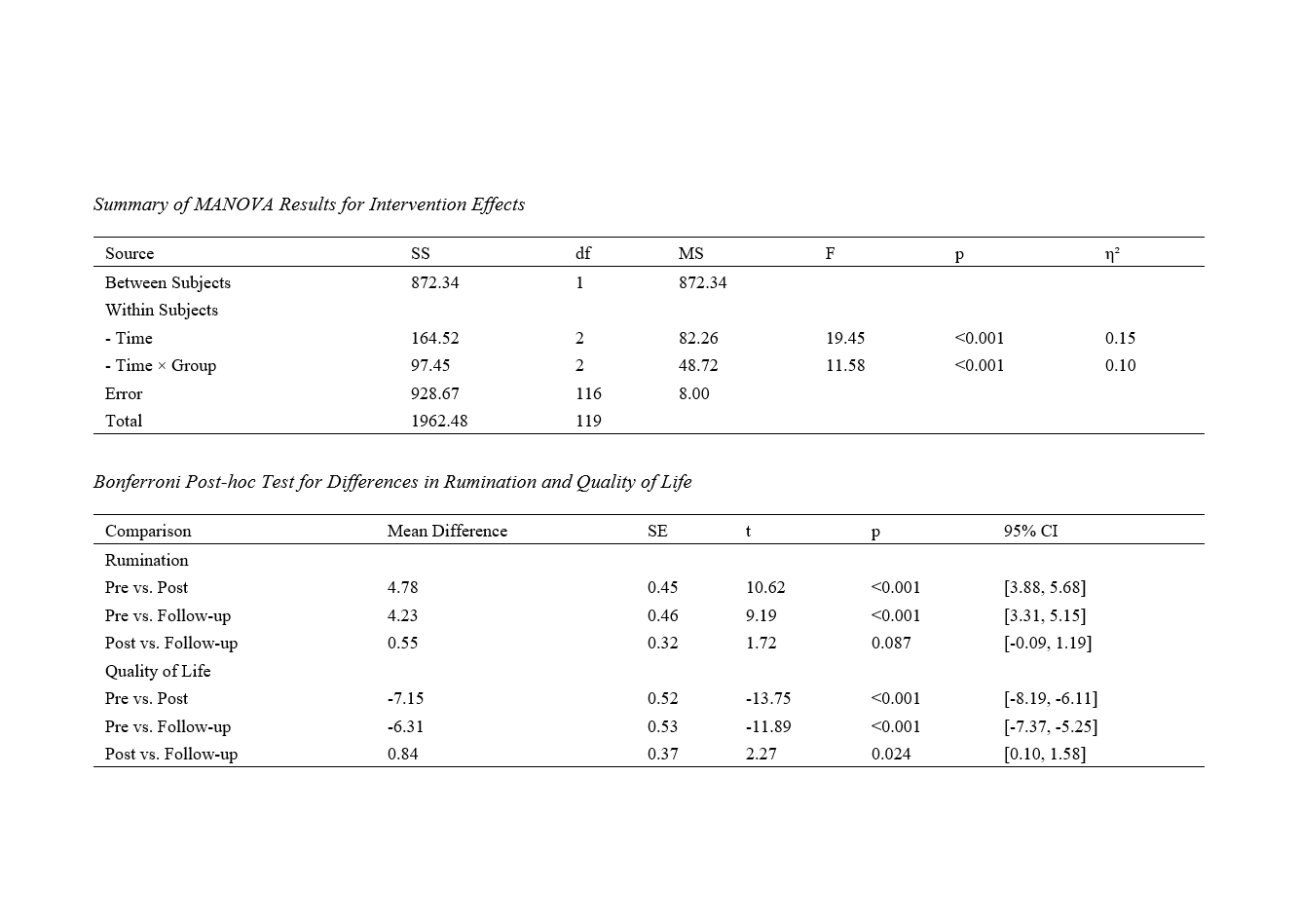
The objective of this study was to evaluate the effectiveness of Cognitive Behavioral Therapy (CBT) in reducing rumination and enhancing quality of life among girls diagnosed with Body Dysmorphic Disorder (BDD). This randomized controlled trial involved 60 participants, diagnosed with BDD, who were recruited from the Pouyesh Clinic in Tehran in 2023. Participants were randomly assigned to either a CBT intervention group or a control group, with each group comprising 30 participants. The intervention consisted of ten 75-minute sessions of CBT specifically tailored to address rumination and improve quality of life. Data were collected at baseline, immediately post-intervention, and at a three-month follow-up, and analyzed using Analysis of Variance with Repeated Measurements and Bonferroni post-hoc tests. The CBT intervention led to a significant reduction in rumination, with mean scores decreasing from 18.45 (SD = 3.52) pre-treatment to 13.67 (SD = 3.01) post-treatment, and slightly rising to 14.22 (SD = 2.86) at follow-up. Quality of life significantly improved, increasing from a mean of 42.58 (SD = 4.45) pre-treatment to 49.73 (SD = 4.12) post-treatment, with a slight reduction at follow-up to 48.89 (SD = 3.98). Statistical analysis confirmed significant time effects (F(2, 116) = 19.45, p < 0.001, η² = 0.15) and time × group interaction effects (F(2, 116) = 11.58, p < 0.001, η² = 0.10). The findings suggest that CBT is effective in significantly reducing rumination and improving quality of life among girls with BDD. The intervention showed durability of effects at a three-month follow-up, indicating its potential for long-term benefits. These results support the incorporation of CBT into treatment protocols for BDD to address specific cognitive processes and enhance overall well-being.
Downloads
References
1. Patel TA, Stewart RA, Summers BJ, Wilver NL, Cougle JR. A Self-Report Assessment of Appearance-Related Safety Behaviours: Development and Psychometric Properties. Behavioural and Cognitive Psychotherapy. 2022;50(6):604-19. [PMID: 36062459] [DOI]
2. IsHak WW, Bolton M, Bensoussan J-C, Dous G, Nguyen T, Powell-Hicks AL, et al. Quality of Life in Body Dysmorphic Disorder. CNS Spectrums. 2012;17(4):167-75. [PMID: 22939280] [DOI]
3. Ortiz SN, Grunewald W, Morgan RD, Smith AR. Examining the Relationship Between Dysmorphia Symptoms and Suicidality Through the Lens of the Interpersonal Theory of Suicide. Journal of Clinical Psychology. 2022;79(2):541-57. [PMID: 35988134] [PMCID: PMC10087364] [DOI]
4. Drüge M, Roth T, Watzke B. Telephone-Administered Cognitive Behavioral Therapy for Body Dysmorphic Disorder: Case Series. International Journal of Environmental Research and Public Health. 2022;19(12):7373. [PMID: 35742621] [PMCID: PMC9223749] [DOI]
5. Prazeres AM, Nascimento AL, Fontenelle LF. Cognitive-Behavioral Therapy for Body Dysmorphic Disorder: A Review of Its Efficacy. Neuropsychiatric Disease and Treatment. 2013:307. [PMID: 23467711] [PMCID: PMC3589080] [DOI]
6. Hvenegaard M, Watkins E, Poulsen S, Rosenberg N, Gondan M, Grafton B, et al. Rumination-Focused Cognitive Behaviour Therapy vs. Cognitive Behaviour Therapy for Depression: Study Protocol for a Randomised Controlled Superiority Trial. Trials. 2015;16(1). [PMID: 26260780] [PMCID: PMC4532251] [DOI]
7. Watkins E. Psychological Treatment of Depressive Rumination. Current Opinion in Psychology. 2015;4:32-6. [DOI]
8. Espinosa F, Martín-Romero N, Sanchez-Lopez A. Repetitive Negative Thinking Processes Account for Gender Differences in Depression and Anxiety During Adolescence. International Journal of Cognitive Therapy. 2022;15(2):115-33. [PMID: 35251444] [PMCID: PMC8881790] [DOI]
9. McLaughlin KA, Aldao A, Wisco BE, Hilt LM. Rumination as a Transdiagnostic Factor Underlying Transitions Between Internalizing Symptoms and Aggressive Behavior in Early Adolescents. Journal of Abnormal Psychology. 2014;123(1):13-23. [PMID: 24661155] [PMCID: PMC4222508] [DOI]
10. Hyde JS, Mezulis AH, Abramson LY. The ABCs of Depression: Integrating Affective, Biological, and Cognitive Models to Explain the Emergence of the Gender Difference in Depression. Psychological Review. 2008;115(2):291-313. [PMID: 18426291] [DOI]
11. Jacobs RH, Watkins E, Peters AT, Feldhaus C, Alyssa B, Carbray JA, Langenecker SA. Targeting Ruminative Thinking in Adolescents at Risk for Depressive Relapse: Rumination-Focused Cognitive Behavior Therapy in a Pilot Randomized Controlled Trial With Resting State fMRI. Plos One. 2016;11(11):e0163952. [PMID: 27880789] [PMCID: PMC5120778] [DOI]
12. Spinhoven P, Klein NS, Kennis M, Cramer AOJ, Siegle GJ, Cuijpers P, et al. The Effects of Cognitive-Behavior Therapy for Depression on Repetitive Negative Thinking: A Meta-Analysis. Behaviour Research and Therapy. 2018;106:71-85. [PMID: 29699700] [DOI]
13. Bessette KL, Jacobs RH, Heleniak C, Peters AT, Welsh RC, Watkins E, Langenecker SA. Malleability of Rumination: An Exploratory Model of CBT-based Plasticity and Long-Term Reduced Risk for Depressive Relapse Among Youth From a Pilot Randomized Clinical Trial. Plos One. 2020;15(6):e0233539. [PMID: 32555582] [PMCID: PMC7299403] [DOI]
14. Schoenenberg K, Bosbach K, Baumeister H, Küchler A-M, Hartmann AS, Harrer M, et al. Internet-Based Treatment of Body Dysmorphic Disorder. The Journal of Nervous and Mental Disease. 2023;211(9):686-95. [PMID: 37639458] [DOI]
15. Almuhanna N, Abdullah FA, Zainalabedin A, Algaidi M, Algamdi W. Prevalence of Body Dysmorphic Disorder Among Female Patients Seeking Cosmetic Procedures. Psychology and Mental Health Care. 2022;6(3):01-4. [DOI]
16. Moreno-Amador B, Cervin M, Falcó R, Marzo JC, Rodríguez JAP. Body-Dysmorphic, Hoarding, Hair-Pulling, and Skin-Picking Symptoms in a Large Sample of Adolescents. Current Psychology. 2022;42(28):24542-53. [DOI]
17. Rahmani Moghaddam F, Bagherzadehgolmakani Z, Touzandehjani H, Nejat H. Exploring the Impact of Dialectical Behavior Therapy on Emotional Regulation and Rumination among the Physically Disabled People using the Services of the Welfare Organization of Mashhad. Research in Clinical Psychology and Counseling. 2023;13(1):123-38.
Downloads
Publication Timeline
License
Copyright (c) 2024 Mir Mehdi Hashemi Salehi (Author); Seyed Ali Aleyasin (Corresponding Author)

This work is licensed under a Creative Commons Attribution-NonCommercial 4.0 International License.