Effectiveness of Cognitive Behavioral Lifestyle Improvement Training on Anxiety and Self-Care in Women with Diabetes
DOI:
https://doi.org/10.61838/kman.hn.2.2.14Keywords:
Lifestyle, Cognitive Behavioral Therapy, Anxiety, Self-Care, Women, DiabetesAbstract
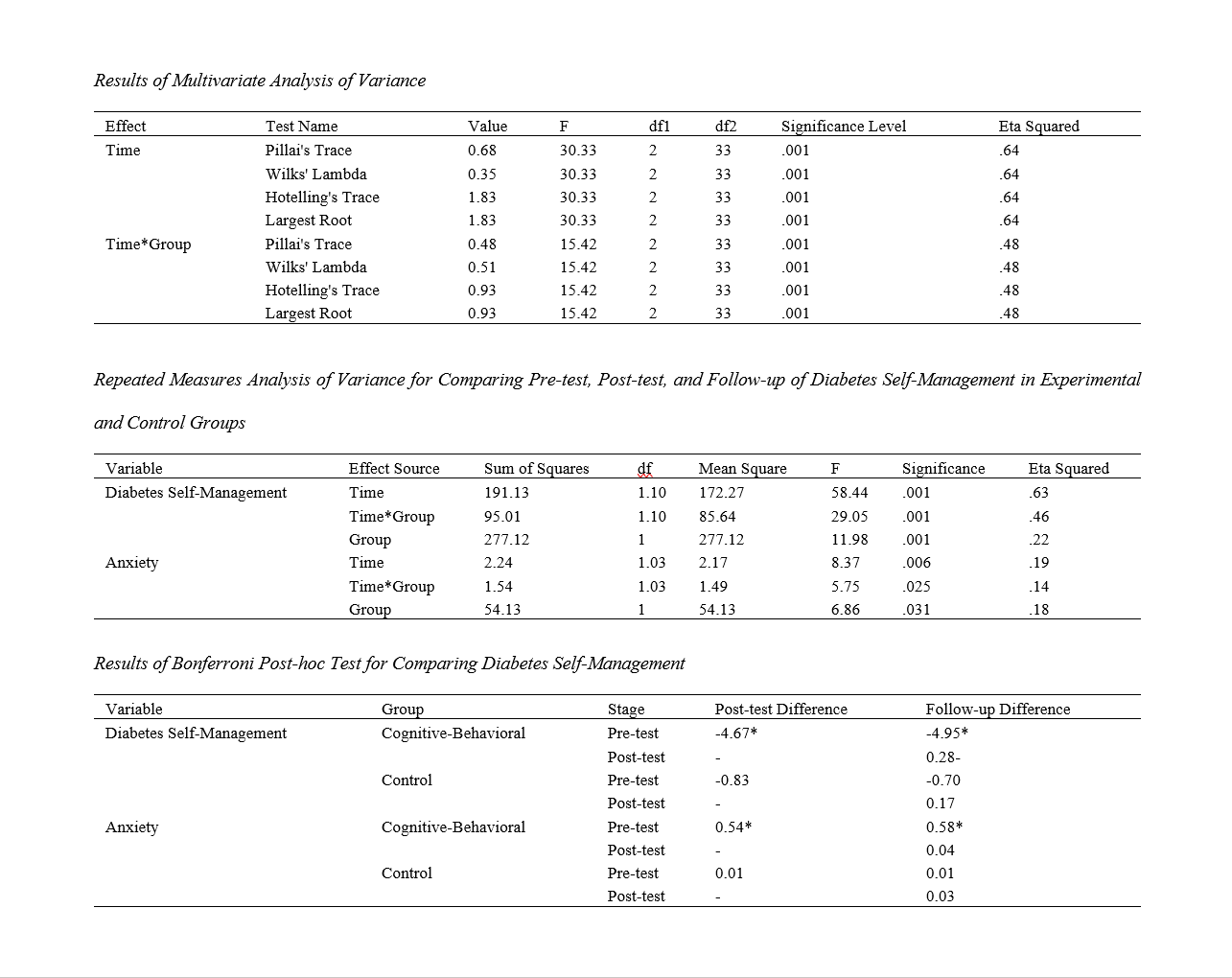
The purpose of this research is to examine the impact of cognitive-behavioral lifestyle improvement training on reducing anxiety and enhancing self-care in women with diabetes. The study utilized an experimental method. Initially, a sample of women with diabetes was selected and randomly divided into two groups. The first group received cognitive-behavioral lifestyle improvement training, and the second group served as the control. Subsequently, the levels of anxiety and self-care in women from both groups were measured before and after the training. Findings indicate that cognitive-behavioral lifestyle improvement training had a positive effect on reducing anxiety in women with diabetes. Additionally, self-care in the first group significantly increased. These results suggest that cognitive-behavioral lifestyle improvement training can be an effective method in reducing anxiety and enhancing self-care in women with diabetes. In conclusion, the importance of cognitive-behavioral lifestyle improvement training for reducing anxiety and enhancing self-care in women with diabetes is discussed, and the positive impact of this training on reducing anxiety levels and increasing self-care is confirmed. This study demonstrates that attention to a healthy lifestyle and its improvement can lead to significant improvements in the lives of women with diabetes.
Downloads
References
1. Wang L, Dong S, Zhao C, Gao Z, Jiang L, Zhang R, et al. Association of stressful life events with cognitive impairment in patients with type 2 diabetes mellitus. Journal of Diabetes Investigation. 2023;14(6):792-800. [PMID: 36987691] [PMCID: PMC10204176] [DOI]
2. Hansen A, Wangberg SC, Årsand E. Lifestyle Changes Among People With Type 2 Diabetes Are Associated With Participation in Online Groups and Time Since Diagnosis. BMC Health Services Research. 2021. [DOI]
3. Li Y, Schoufour J, Wang DD, Dhana K, Pan A, Liu X, et al. Healthy lifestyle and life expectancy free of cancer, cardiovascular disease, and type 2 diabetes: prospective cohort study. BMJ. 2020;368:l6669. [PMID: 31915124] [PMCID: PMC7190036] [DOI]
4. Liu G, Li Y, Hu Y, Zong G, Li S, Rimm EB, et al. Influence of Lifestyle on Incident Cardiovascular Disease and Mortality in Patients With Diabetes Mellitus. Journal of the American College of Cardiology. 2018. [DOI]
5. Liu G, Li Y, Pan A, Hu Y, Chen S, Qian F, et al. Adherence to a Healthy Lifestyle in Association With Microvascular Complications Among Adults With Type 2 Diabetes. Jama Network Open. 2023. [DOI]
6. Aliakbari Dehkordi M, Eisazadeh F, Monzavi Chaleshtari A. Assessing the Self-Care Status of Patients with Type 2 Diabetes During The Covid-19 Epidemic: A Qualitative Study. Iranian Journal of Diabetes and Lipid Disorders. 2021;21(2):79-91.
7. Ahmad F, Joshi SH. Self-Care Practices and Their Role in the Control of Diabetes: A Narrative Review. Cureus. 2023;15(7). [PMID: 37546053] [DOI]
8. Susanne A, Ingrid W, Fredrik L, Eva T, Unn-Britt J, Therese A. Acceptance and commitment therapy (ACT) for adult type 1 diabetes management: study protocol for a randomised controlled trial. BMJ Open. 2018;8(11):e022234. [PMID: 30498037] [PMCID: PMC6278833] [DOI]
9. Paudel G, Vandelanotte C, Dahal PK, Biswas T, Yadav UN, Sugishita T, et al. Self-care behaviours among people with type 2 diabetes mellitus in South Asia: A systematic review and meta-analysis. Journal of global health. 2022;12. [PMID: 35916498] [PMCID: PMC9346342] [DOI]
10. Sidi M, Mohammadi M, Omidi M, Habibnia MR. The role of self-care on cognitive ability in diabetic elderly. Applied Family Therapy Journal (AFTJ). 2022;3(5):196-208. [DOI]
11. Solhi M, Hazrati S, Nejaddadgar N. Analysis of Self-care Behaviors and their Related Factors in Patients with Type II Diabetes. Journal of Diabetes Nursing. 2017;5(3):223-31.
12. Zal E, Rezaei_Jamaloei H, Taheri M. Structural model of self care based on self transcendence mediated by social support on patients with diabetes. Daneshvar Medicine. 2022;30(4):11-22. [DOI]
13. Baroni I, Caruso R, Dellafiore F, Ausili D, Barello S, Magon A, et al. Self-care and type 2 diabetes mellitus (T2DM): a literature review in sex-related differences. Acta Bio Medica: Atenei Parmensis. 2022;93(4).
14. Chong S, Ding D, Byun R, Comino E, Bauman A, Jalaludin B. Lifestyle Changes After a Diagnosis of Type 2 Diabetes. Diabetes Spectrum. 2017. [PMID: 28270714] [PMCID: PMC5309903] [DOI]
15. Bayat F, Shojaeizadeh D, Hossaini SM, Sadeghi R, Tol A. Effectiveness of Educational Program on Lifestyle Modification among Type II Diabetic Patients. Health System Research. 2013;8(7):1235-44.
16. Zare' Shahabadi A, Ebrahimi Sadrabadi F. Impact of Cognitive Factors on Treatment of Type 2 Diabetes in Yazd. Clinical Psychology Studies. 2013;4(13):1-22.
17. Nagelkerk J, Reick K, Meengs L. Perceived barriers and effective strategies to diabetes self-management. Journal of Advanced Nursing. 2006;54(2):151-8. [PMID: 16553701] [DOI]
18. Sakane N, Suganuma A, Domichi M, Sukino S, Abe K, Fujisaki A, et al. The Effect of a mHealth App (KENPO-app) for Specific Health Guidance on Weight Changes in Adults With Obesity and Hypertension: Pilot Randomized Controlled Trial. JMIR Mhealth Uhealth. 2023;11:e43236. [PMID: 37043287] [PMCID: PMC10134028] [DOI]
19. Akbari M, Dehghani B, Jafari A, Kardar A. the effect of game therapy with a cognitive-behavioral approach on the regulation of excitement, anxiety and depression in children with type-1 diabetes. jnip. 2017;1(2):45-54.
20. Alahyari AZ, Bayazi MH, Rajaei AR. The effectiveness of cognitive behavioral group intervention on depression and anxiety in patients with type II diabetes. European Review of Applied Psychology. 2021;71(1):100624. [DOI]
21. Keramati MR. A Comparison of Health-Related Quality of Life and Job Satisfaction in Physically Active and Sedentary Faculty Members. International Journal of Education and Cognitive Sciences. 2021;2(3):23-32. [DOI]
22. Khoshemehry S, Ghorban Fathi A, Pourvaghar MJ. The effect of cognitive-behavioral therapy group with emphasis on healthy lifestyle on reducing depression, loneliness and depiction of adolescent female students in Tehran. Islamic Lifestyle Centered on Health. 2019;3(3):136-44.
23. Sadeghzadeh Mofrad Z, Dortaj F, Ghaemi F, Farrokhi N. The Effectiveness of Healthy Lifestyle Promotion Training Based and Cognitive-Behavioral Therapy on Self-Efficacy and Psychological Well-Being of Cancer Patients. Community Health Journal. 2022;16(1):53-64.
Downloads
Additional Files
Publication Timeline
License
Copyright (c) 2024 Majid Amiri, Nafiseh Tavakoli (Author); Majid Akhondzadeh (Corresponding Author); Leila Torkashvand (Author)

This work is licensed under a Creative Commons Attribution-NonCommercial 4.0 International License.