Comparison of the Effectiveness of Lifestyle-Focused Cognitive Behavioral Therapy and Semantic Cognitive Restructuring Therapy on Pain Perception in Patients with Irritable Bowel Syndrome
DOI:
https://doi.org/10.61838/kman.hn.2.3.5Keywords:
Lifestyle-Focused Cognitive Behavioral Therapy, Semantic Cognitive Restructuring Therapy, Pain Perception, Irritable Bowel SyndromeAbstract
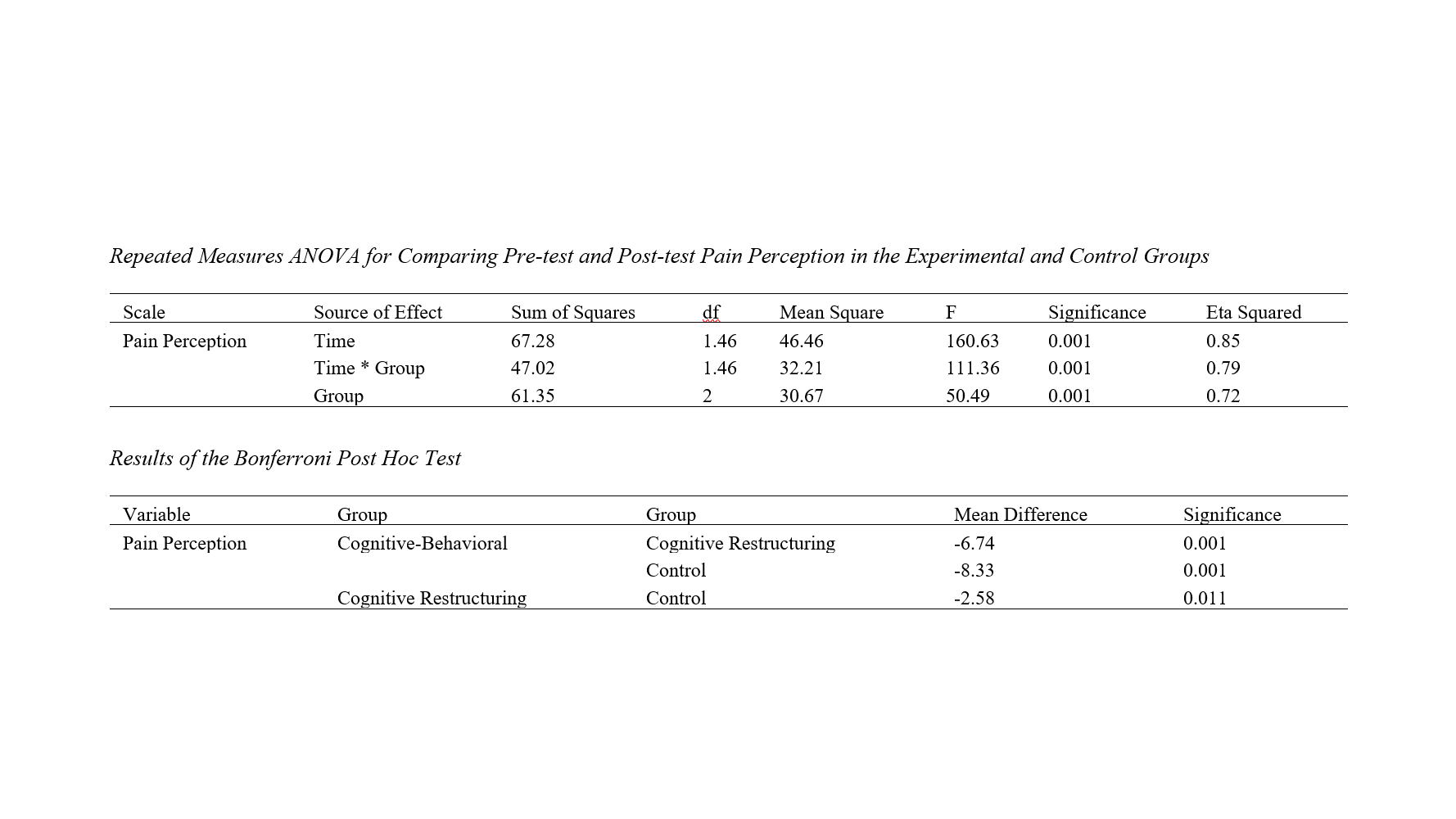
This study aimed to compare the effectiveness of lifestyle-focused cognitive behavioral therapy and semantic cognitive restructuring therapy on pain perception in patients with irritable bowel syndrome. This quasi-experimental study utilized a pretest-posttest-follow-up design with a control group. The statistical population included all patients with irritable bowel syndrome in Babol city in 2023, selected through convenience sampling and randomly assigned to two experimental groups and one control group. Data were collected using the Pain Perception Scale developed by Schallz et al. (2010). The lifestyle-focused cognitive behavioral therapy group received eight 90-minute sessions, while the semantic cognitive restructuring therapy group received twelve 90-minute sessions, both conducted once a week. The control group did not receive any intervention. Data analysis was performed using a mixed design with repeated measures and SPSS-26 software. The results indicated that both lifestyle-focused cognitive behavioral therapy and semantic cognitive restructuring therapy were effective in reducing pain perception in patients with irritable bowel syndrome (P < 0.05). Moreover, lifestyle-focused cognitive behavioral therapy had a higher impact on reducing pain perception compared to semantic cognitive restructuring therapy in patients with irritable bowel syndrome. The present study demonstrated that lifestyle-focused cognitive behavioral therapy and semantic cognitive restructuring therapy are effective in reducing pain perception in patients with irritable bowel syndrome. Therefore, these approaches can be utilized alongside medical interventions in treatment centers for such individuals.
Downloads
References
1. Ringel Y, Maharshak N. Intestinal microbiota and immune function in the pathogenesis of irritable bowel syndrome. American Journal of Physiology-Gastrointestinal and Liver Physiology. 2013;305(8):G529-G41. [PMID: 23886861] [PMCID: PMC3798736] [DOI]
2. Fukudo S, Kaneko H, Akiho H, Inamori M, Endo Y, Okumura T, et al. Evidence-based clinical practice guidelines for irritable bowel syndrome. Journal of Gastroenterology. 2015;50(1):11-30. [PMID: 25500976] [DOI]
3. Vahedi H, Ansari R, Mir-Nasseri M, Jafari E. Irritable bowel syndrome: a review article. Middle East J Dig Dis. 2010;2(2):66-77. [PMCID: PMC4154827]
4. Waldhausen JHT. American Pediatric Surgical Association Presidential Address 2021 A Surgeon's Purpose. Journal of Pediatric Surgery. 2022;57(1):2-8. [PMID: 34366131] [DOI]
5. Dharsana IK, Suarni NK, Sudarsana GN, Paramartha WE, Ahmad M. Cognitive-Behavioral Therapy counseling in developing Cross-Gender Friendship in adolescents. Enfermería Clínica. 2020;30:206-8. [DOI]
6. Ashrafi M, Jomehri F, Niknam M, Rafieipour A. Effects of Cognitive Restructuring on Health Control and Self-Care in Women With Hypertension. MEJDS. 2020;10(0):191-.
7. Erhardt D, Bunyi J, Dodge-Rice Z, Neary M, Schueller SM. Digitized thought records: a practitioner-focused review of cognitive restructuring apps. The Cognitive Behaviour Therapist. 2022;15:e39. [DOI]
8. Azcue N, Gómez-Esteban JC, Acera M, Tijero B, Fernandez T, Ayo-Mentxakatorre N, et al. Brain fog of post-COVID-19 condition and Chronic Fatigue Syndrome, same medical disorder? Journal of Translational Medicine. 2022;20(1):569. [PMID: 36474290] [PMCID: PMC9724286] [DOI]
9. Mafakheri a, Khorrami M, Kaviyani F, Ashrafifard S. Effectiveness of Cognitive-Behavioral Therapy on Cognitive Strategies of Emotional Regulation and General Self-Efficacy among Mothers of Children with Cerebral Palsy. Health Psychology. 2022;11(42):85-100. [DOI]
10. Soleimani S, Tajoddini E. Effectiveness of Cognitive Behavioral Therapy Based on Fatigue on Dimensions of Mental Fatigue in Patients with Multiple Sclerosis: a case study. Journal of Clinical Psychology. 2016;8(2):13-21. [DOI]
11. Pakandish S, Kraskian A, Jamhari F. Determining the Effectiveness of Cognitive-Behavioral Therapy in Regulating Emotion and Mental Health of Obese Women. IJNR. 2021;16(2):59-68.
12. Dowsett E, Delfabbro P, Chur-Hansen A. Adult separation anxiety disorder: The human-animal bond. Journal of Affective Disorders. 2020;270:90-6. [PMID: 32339110] [DOI]
13. Pan Y, Liu H-y, Zhong S. Effect of cognitive behavior therapy (CBT) on lowering of blood glucose levels in gestational diabetes mellitus (GDM) patients: study protocol for a prospective, open-label, randomized controlled trial. Trials. 2023;24(1):26. [PMID: 36639702] [PMCID: PMC9840313] [DOI]
14. Hooshmandi R, Aljaberi MA, Hammadi F, Ma J. The Impact of Interoceptive Awareness on Pain Catastrophizing and Illness Perception. Journal of Personality and Psychosomatic Research (JPPR). 2024;2(2):4-10. [DOI]
15. Barlow DH, Rapee RM, Reisner LG. Mastering stress 2001 : a lifestyle approach. Dallas, Tex.: American Health Pub; 2001.
16. Mosayebi M, Ghanadzadegan H, Mirzaian B. Comparison of the Effectiveness of Semantic Cognitive Reconstruction Therapy and Self-Encouragement Therapy on Chronic Fatigue in People with Psychosomatic Skin. frooyesh. 2021;10(9):193-204.
17. Clark KB. Smart Device-Driven Corticolimbic Plasticity in Cognitive-Emotional Restructuring of Space-Related Neuropsychiatric Disease and Injury. Life [Internet]. 2022 PMC8875345]; 12(2).
18. Larsson A, Hooper N, Osborne LA, Bennett P, McHugh L. Using Brief Cognitive Restructuring and Cognitive Defusion Techniques to Cope With Negative Thoughts. Behavior Modification. 2015;40(3):452-82. [PMID: 26685210] [DOI]
19. Fiqri AM, Sjattar EL, Irwan AM. Cognitive Behavioral Therapy for self-care behaviors with type 2 diabetes mellitus patients: A systematic review. Diabetes & Metabolic Syndrome: Clinical Research & Reviews. 2022;16(7):102538. [PMID: https://doi.org/10.1016/j.dsx.2022.102538] [DOI]
20. Bоbomuratov TA, Imamova AOK. Forms and methods for forming a healthy lifestyle in children. Academic research in educational sciences. 2023(1):19-23.
21. Blattman C, Chaskel S, Jamison JC, Sheridan M. Cognitive Behavioral Therapy Reduces Crime and Violence over Ten Years: Experimental Evidence. American Economic Review: Insights. 2023;5(4):527-45. [DOI]
22. Soleymani Eslami A, Dastgiri S, Yaghoubi A, Golestan B, Imani S, Hemmati N, et al. Comparison of coronary artery disease risk factors between patients below and above 45 years old. sjsph. 2012;9(3):13-22.
23. Gerrits MMJG, van Marwijk HWJ, van Oppen P, van der Horst H, Penninx BWJH. Longitudinal association between pain, and depression and anxiety over four years. Journal of Psychosomatic Research. 2015;78(1):64-70. [PMID: 25466385] [DOI]
Downloads
Additional Files
Publication Timeline
License
Copyright (c) 2024 Mozhgan Akbari Ebtekar (Author); Seyedeh Olia Emadian (Corresponding Author); Bahram Mirzaian (Author)

This work is licensed under a Creative Commons Attribution-NonCommercial 4.0 International License.