Explaining the Communication Pattern of Attention to Health and Humor in the Work Environment with the Mediating Role of Sports Activities in Elementary School Teachers
DOI:
https://doi.org/10.61838/kman.hn.2.4.10Keywords:
Health, humor, work environment, teachers, sports activitiesAbstract
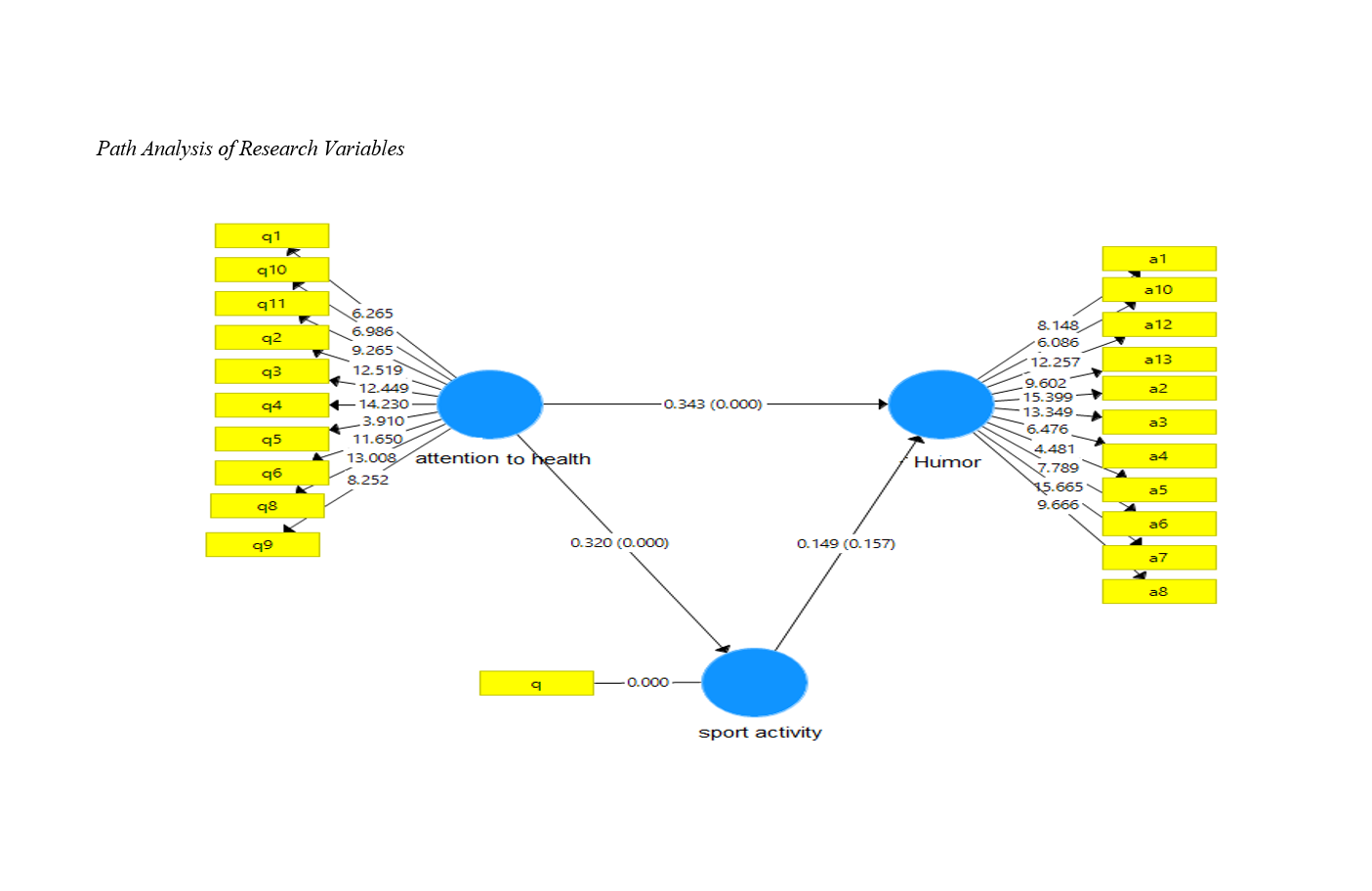
This research aims to elucidate the relationship between health awareness and humor in the work environment, focusing on the mediating role of sports activities among elementary school teachers. A correlational survey method was employed. The study population comprised all male and female elementary school teachers in Sahne City, totaling 289 individuals (126 men and 163 women). A sample of 182 participants was selected using the Krejcie and Morgan table. Research instruments included healthcare questionnaires (Sijtsama and Beck, 2009), humor measurement in the work environment (Maja et al., 2009), and self-reports on sports activities. Data analysis was conducted using SPSS 22 and SmartPLS 3 software, utilizing descriptive statistics, the Kolmogorov-Smirnov test, and structural equation modeling via the partial least squares method. Results indicated that teachers' attention to health and sense of humor are favorable. Teachers' sports activities ranged from low to moderate levels. Increased health awareness among elementary teachers correlated with higher levels of humor. However, sports activities did not significantly affect teachers' humor levels or mediate the relationship between health awareness and humor.The findings suggest that the mediating variable (sports activities) did not reach the desired level to impact teachers' humor significantly. Similarly, health awareness did not considerably influence humor through sports activity mediation. It is recommended that specialized classes for physical and mental sports activities (e.g., yoga, meditation) be planned and implemented for teachers.
Downloads
References
1. Marsh RJ, Higgins K, Morgan J, Cumming TM, Brown M, McCreery M. Evaluating School Connectedness of Students with Emotional and Behavioral Disorders. Children & Schools. 2019;41(3):153-60. [DOI]
2. Assem HD, Nartey L, Appiah E, Aidoo JK. A Review of Students’ Academic Performance in Physics: Attitude, Instructional Methods, Misconceptions and Teachers Qualification. European Journal of Education and Pedagogy. 2023;4(1):84-92. [DOI]
3. Mirzabeigi A, Bakhtiarpour S, Eftekhar saadi Z, Makvandi B, Pasha R. Comparison of educational vitality, feeling of belonging to the school, the motivation of academic achievement among male and female students of secondary schools in Ilam. Journal of Research in Educational Systems. 2018;12(Special Issue):1085-104.
4. Gedviliene G, Gerviene S, Pasvenskiene A, Ziziene S. The social competence concept development in higher education. European scientific journal. 2014;10(28).
5. Leist AK, Müller D. Humor Types Show Different Patterns of Self-Regulation, Self-Esteem, and Well-Being. Journal of Happiness Studies. 2013;14(2):551-69. [DOI]
6. Wong AYM. Humor styles, social competence and loneliness: A study among 337 youngsters in Hong Kong and Hangzhou. 2010.
7. Kuiper NA, Grimshaw, M., Leite, C., &Kirsh, G. Humor is not always the best medicine: Specific components of sense of humor and psychological well-being. 2004;17(1-2):135-68. [DOI]
8. Zeigler-Hill V, McCabe GA, Vrabel JK. The Dark Side of Humor: DSM-5 Pathological Personality Traits and Humor Styles. Europe’s Journal of Psychology. 2016;12(3):363-76. [PMID: 27547254] [PMCID: PMC4991045] [DOI]
9. Karnieli-Miller O, Divon-Ophir O, Sagi D, Pessach-Gelblum L, Ziv A, Rozental L. More Than Just an Entertainment Show: Identification of Medical Clowns’ Communication Skills and Therapeutic Goals. Qualitative Health Research. 2023;33(1-2):25-38. [PMID: 36384326] [PMCID: PMC9827496] [DOI]
10. Rezayi M, Nastiezaie N. The effect of workplace humor on teachers, psychological well-being mediated by interpersonal forgiveness. Journal of School Psychology and Institutions. 2023;12(3):62-78.
11. Tsai M-N, Cheng Y-C, Chen H-C. Humor Styles and Marital Satisfaction: Cluster Analysis of the Relationship. Psychological Reports. 2023;0(0):00332941221149151. [PMID: 36625132] [DOI]
12. Sijtsema S, Backus G, Linnemann A, Jongen W. Linking perception of health‐promoting food attributes to tangible product characteristics. British Food Journal. 2009;111(3):207-22. [DOI]
13. Maja T, Motshudi M. Precautions used by occupational health nursing students during clinical placements. Curationis. 2009;32(1):14-9. [PMID: 20225748]
14. Abel T. Measuring health lifestyles in a comparative analysis: Theoretical issues and empirical findings. Social Science & Medicine. 1991;32(8):899-908. [PMID: 2031206] [DOI]
15. Chaney D. Cosmopolitan Art and Cultural Citizenship. Theory, Culture & Society. 2002;19(1-2):157-74. [DOI]
16. Park J. General health: textbook of community medicine. Trans Shojaei Tehrani H Tehran, Iran: Samat Publications. 2004.
17. Romero EJ, Cruthirds KW. The use of humor in the workplace. IEEE Engineering Management Review. 2006;34(3):18-. [DOI]
Downloads
Additional Files
Publication Timeline
- Submitted
- Revised
- Accepted
License
Copyright (c) 2024 Fateh Faraziani (Corresponding Author)

This work is licensed under a Creative Commons Attribution-NonCommercial 4.0 International License.